
INFINITY TURBINE LLC We specialize in designs, plans, licensing, consulting, design services, and surplus spare parts. We no longer manufacture turbines or CO2 systems. More Info...
Please email for first contact with request for more information
Email: greg@infinityturbine.com
Infinity Turbine CO2 Turbine Development and Testing Cart Supercritical CO2 Turbine Development Cart using high pressure filter canisters for rapid prototyping and commercialization for 1-25 kWh Power Generation... More Info
ORC and sCO2 Performance Charts: R134a, R245fa, CO2 – 2026 Edition Updated 2026 edition of Infinity Turbine’s ORC and supercritical CO2 performance curves: R134a, R245fa and CO2 charts, CO2 heat-rate tables from 100 to 700 °C, sCO2 turbine types, and data-center applications. 62-page PDF... More Info
Supercritical CO2 Turbine Generator Plans (Transcritical) Rankine Cycle Lab format for development ... More Info
Matra Concentrated Solar Project Using Infinity Turbine Generator for Power Production Solar thermal power production using a reflective dish concentrator... More Info
Cluster Mesh Supercritical CO2 Power System for Data Centers and AI Pairing Cluster Mesh Supercritical CO2 Power System with Small Modular Reactors enables hyperscalers to convert high-grade nuclear heat into ultra-efficient, dispatchable power with a compact, modular footprint tailored for AI-scale demand. More Info
ORC and Products Index Infinity Turbine ORC Index... More Info
A Generator Without Magnets Switched Reluctance is the simplest rotating electrical machine there is: a rotor of stacked steel laminations with salient teeth, and a stator carrying concentrated coils. The rotor has no magnets, no windings, no bars and no slip rings... More Info
|
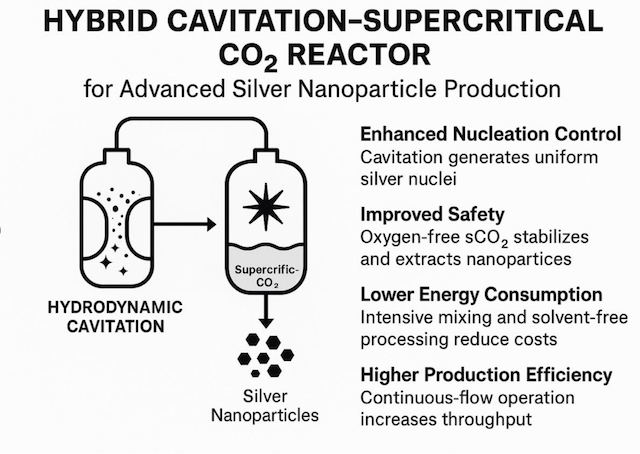
Hybrid Cavitation-Supercritical CO2 Reactor for Advanced Silver Nanoparticle Production Article: Hybrid Cavitation-Supercritical CO2 Reactor for Advanced Silver Nanoparticle ProductionSilver nanoparticles are among the highest-value nanomaterials produced today, with applications in electronics, catalysis, antimicrobial coatings, optics, and advanced sensing technologies. Traditional chemical batch reactors struggle to deliver the tight particle size distribution, clean surface chemistry, and high throughput required by modern industries. Two emerging technologies have shown exceptional promise in recent years: hydrodynamic cavitation and supercritical CO2 (sCO2) processing. Each provides substantial benefits for nanoparticle synthesis, but a combined hybrid system offers an entirely new level of performance.Hydrodynamic cavitation uses rapid pressure changes in a liquid to generate microscopic vapor bubbles that violently collapse. This collapse produces localized hotspots with temperatures near 5,000 K and pressures exceeding 1,000 atmospheres. These conditions dramatically improve mixing, break chemical bonds, accelerate nucleation, and fragment agglomerates. Cavitation is widely used for nanoparticle creation, but it has limitations in solvent control, particle stabilization, and downstream extraction.Supercritical CO2 operates under conditions where CO2 behaves as both a liquid and gas, producing a highly tunable solvent with exceptional transport properties. It provides clean, residue-free processing and allows nanoparticle precipitation in a controlled, oxygen-free environment. sCO2 excels at extraction, purification, and size uniformity. However, its standalone ability to rapidly nucleate or shear particles is limited compared to cavitation.By integrating both technologies into a hybrid reactor, a new processing paradigm emerges. Hydrodynamic cavitation becomes the high-intensity nucleation engine, forming silver nuclei with extreme uniformity. Immediately downstream, supercritical CO2 becomes the precision growth and separation environment, ensuring consistent particle size and preventing agglomeration. The sCO2 phase can extract solvent, stabilize surfaces, and produce dry, contamination-free silver nanoparticles directly from the reaction stream.This hybrid design enables closed-loop operation with minimal waste, reversible tuning of particle size through CO2 density adjustments, and the ability to incorporate green reducing agents. Energy consumption is lower than conventional batch reactors, and the process footprint is reduced through continuous-flow operation.Combining cavitation’s intense micro-reactor physics with the solvent power and environmental benefits of supercritical CO2 results in a next-generation nanoparticle production platform. For industries requiring high-value nanomaterials such as electronics, renewable energy, antimicrobials, and aerospace, this approach delivers cleaner production, tighter tolerances, and significantly greater scalability for silver nanoparticles and beyond.Revolutionizing Silver Nanoparticle Production with Hybrid Cavitation–Supercritical CO₂ Technology |
|
|
|
| CONTACT Email: greg@infinityturbine.com | AMP | PDF |