
Every rack of GPUs or CPUs is, thermodynamically, a resistive heater. A 100 kW compute stack rejects 100 kW of low-grade heat, typically into a liquid loop running somewhere between 35°C and 65°C. That heat has to go somewhere — and increasingly, operators are asking whether it can do something useful on the way out, rather than just being dumped to a cooling tower or dry cooler. CO₂ (R744) ejectors keep coming up in that conversation because they're mechanically simple, use a cheap, non-flammable, zero-GWP refrigerant, and are already commercially proven in a different industry: supermarket refrigeration. This article reviews what the engineering literature actually supports, lays out a realistic strategy for a 100 kWth data center application, and runs the numbers against conventional cooling and against the alternative of just generating electricity from the same waste heat.
A 100 kW rack today is typically cooled by direct-to-chip cold plates or rear-door heat exchangers feeding a facility water loop. Supply temperatures commonly run 30–45°C, with returns of 40–65°C depending on how aggressively the site runs "warm water cooling" to enable free cooling elsewhere in the plant. That return stream is the resource in question: 100 kWth of heat at a temperature that's too low to be very useful for power generation (see Section 6) but potentially useful as the driving energy for a heat-activated cooling cycle.
Two structurally different questions get conflated under the banner "CO₂ ejector cooling," and keeping them separate matters for everything that follows:
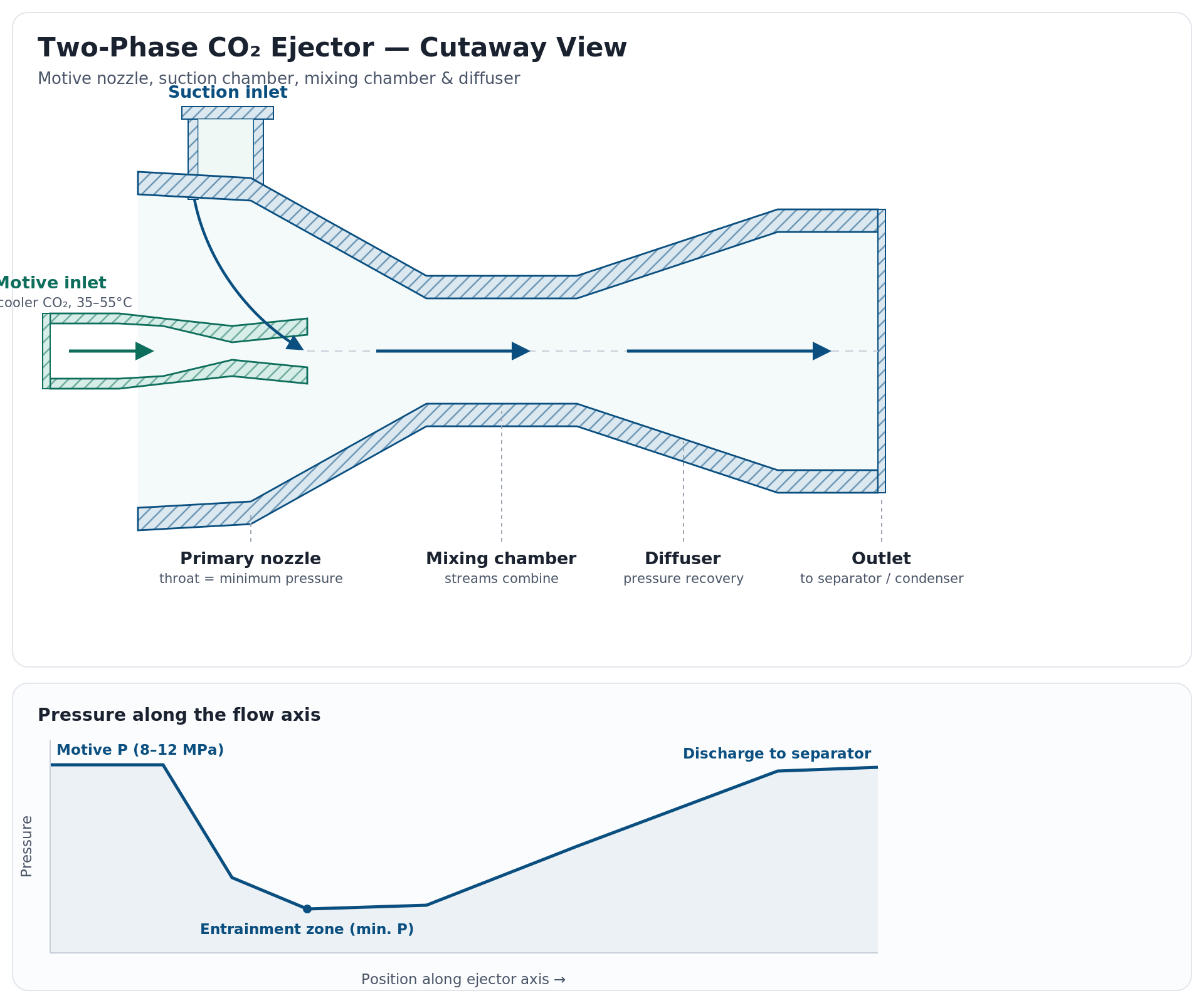
The CO₂ ejector systems already running in thousands of supermarkets (Danfoss, Carel, Hillphoenix and others build these) are not heat-driven. In a transcritical CO₂ booster system, the ejector's "motive" flow is high-pressure CO₂ leaving the gas cooler (8–12.5 MPa, 35–55°C) — it uses the compressor's own discharge energy to recover the throttling loss that would otherwise be thrown away across a conventional expansion valve. That's the single largest exergy loss in a transcritical CO₂ cycle (commonly cited at >40% of total irreversibility), and CO₂ is unusually prone to it because it throttles across the critical point.
A comprehensive 2016 review of ejector refrigeration (Besagni, Mereu & Inzoli, Renewable and Sustainable Energy Reviews) tabulates COP improvements of roughly 7–18% from a single ejector, growing to 10–25%, and up to 42% in hybrid multi-ejector/parallel-compression configurations under high-ambient conditions, versus the same cycle with a plain expansion valve. This is a genuine, commercially deployed efficiency gain on an electrically-driven refrigeration cycle — it does not consume the waste heat, it consumes less electricity to produce the same cooling.
The architecture that matches the question "use 100 kWth of waste heat to make cooling" is the classic heat-driven ejector refrigeration cycle (sometimes called SERS/SoERS in the literature): a generator boils refrigerant using the waste-heat stream, the resulting vapor drives an ejector that entrains and compresses vapor from an evaporator, and a condenser rejects the combined flow — no compressor required, just a small liquid pump.
The Besagni review compiles generator temperatures across roughly 40 studies of this cycle type, spanning 60–140°C, with COP typically 0.2–0.5. The lowest-temperature demonstrations found in that review (solar-driven units using R600a, Śmierciew et al.) ran generator temperatures of 50–64°C — squarely in the data-center waste-heat band — but COP fell to 0.15–0.20 at those conditions.
A 2026 study (Hacıpaşaoğlu, J. Braz. Soc. Mech. Sci. Eng.) modeled an absorption-ejector-booster cycle (ammonia-water absorption cascaded with a booster compressor and ejector) against a conventional absorption + vapor-compression baseline. At a generator temperature of 87–105°C it delivered COP 0.22 (vs. baseline 0.21), a 17–20% reduction in electric compressor work, and roughly 15–18% lower CO₂ emissions at a 100 kW cooling scale. The generator temperature required (87–105°C) sits above typical data-center liquid-cooling returns, so this route only becomes attractive for sites running unusually hot coolant loops (some high-density GPU/immersion designs are pushing return temperatures this high) or where a heat pump is used to lift 60°C waste heat up to generator temperature — at a cost in electricity that has to be weighed against the cooling gained.
Vortex (Ranque-Hilsch) tubes turn up in the same literature as a passive, no-moving-parts alternative to an ejector for recovering CO₂ expansion work. The evidence is mixed: Nellis & Klein (Purdue, 2002) showed a vortex tube adds essentially nothing to a standard vapor-compression cycle (no temperature separation occurs beneath the vapor dome), but more recent transcritical CO₂ heat pump studies (Aghagoli et al. 2019; Mansour et al. 2022) report 8–31% COP improvement depending on discharge pressure and configuration — a wide range that is very sensitive to operating point. Like the transcritical ejector, this is a compressor-work-recovery device, not a waste-heat-driven cooling device.
Given the technology honestly available, the sensible design is a hybrid, not a single "CO₂ ejector chiller." A strategy that reflects the literature above:
| Technology | Driving energy | COP | Min. source temp | Refrigerant / GWP | Maturity |
|---|---|---|---|---|---|
| Water-cooled electric chiller (screw/centrifugal) | Electric | 3.8–6.4 | — | HFC/HFO, GWP 150–2000+ | Mature, incumbent |
| Air-cooled DX / CRAC | Electric | 2.4–3.1 | — | HFC/HFO | Mature, incumbent |
| CO₂ transcritical booster (no ejector) | Electric | ~3.5–4.5 | — | CO₂, GWP 1 | Commercial |
| CO₂ transcritical + ejector | Electric (ejector recovers expansion work) | ~4.6–6.0 | — | CO₂, GWP 1 | Commercial (supermarket sector) |
| Single-effect absorption chiller | Thermal | 0.6–0.8 | ~88°C hot water/LP steam | LiBr-water / ammonia-water, GWP ~0 | Mature, needs high driving temp |
| Absorption-ejector hybrid | Thermal + partial electric | ~0.22 (+17–20% less electric input than baseline) | 87–105°C | Ammonia-water | Research stage |
| Heat-driven ejector (SERS) | Thermal only (small pump) | 0.15–0.5 | ~50°C (poor COP) – 90°C+ (better COP) | R600a/R245fa/ammonia/water, low GWP options available | Demonstrated at small/solar scale, not CO₂-specific |
| CO₂ + vortex tube (compressor-driven) | Electric | +8–31% vs. no vortex tube | — | CO₂, GWP 1 | Research/early commercial |
The practical read: CO₂ ejector technology is a genuine, quantifiable upgrade to an electrically-driven cooling plant — comparable or better COP than a good water-cooled chiller, with a refrigerant that isn't facing regulatory extinction. But swapping CO₂ in as the "waste-heat-driven" component of the strategy is where the technology gets stretched past what's been demonstrated; that role is better filled by a heat-driven ejector or absorption cycle using a fluid suited to low-grade heat.
Public cost data for CO₂ ejector systems specifically is sparse (the Besagni review explicitly flags this as a gap in the literature), so the figures below are assembled from vendor/industry and DOE-adjacent sources and should be treated as order-of-magnitude, not a quote.
| Technology | Installed capex | Operating cost driver |
|---|---|---|
| Air-cooled DX/CRAC plant | ~$800–1,200/ton | Highest electric use of the group (COP 2.4–3.1) |
| Water-cooled chiller plant (incl. tower/pumps) | ~$1,000–1,800/ton | Lower electric use (COP 3.8–6.4), plus water/chemical treatment |
| CO₂ transcritical booster + ejector | Premium of roughly 15–30% over an equivalent HFC booster system | Lower electric use than either DX or standard transcritical; avoids future HFC phase-down refrigerant cost/availability risk |
| Single-effect absorption chiller | ~$600/kWth (roughly $2,100/ton) | Needs continuous 88°C+ driving heat; ~6–7¢/ton-hr all-in when heat is free |
| Heat-driven ejector chiller (small/custom) | No moving parts beyond a circulation pump — capex is typically well under absorption on a $/kWth basis, but few commercial off-the-shelf vendors exist at this scale | Near-zero marginal energy cost once built; low COP means more heat exchanger area per kWth of cooling delivered |
| Small ORC (waste-heat-to-power), for reference | ~$2,000–2,900/kWe net | See Section 6 — included here because it is the alternative use of the same heat |
This is the question worth the most rigor, because the honest answer is "it's close, and depends on your driving temperature" — not a landslide in either direction on pure thermodynamics. Here's the analysis, run against a 100 kWth waste stream at 60°C, an ambient/sink temperature of 25°C, electricity valued at $0.20/kWh, and a baseline water-cooled chiller at COP 5 handling whatever heat isn't converted.
The maximum possible efficiency of any heat engine between 60°C and 25°C is the Carnot limit: 1 − (298/333) = 10.5%. Real organic Rankine cycle (ORC) units typically achieve 40–60% of Carnot, and published low-temperature ORC efficiencies bear this out: roughly 5–12% for 75–150°C sources, trending toward the low single digits as source temperature drops toward 60°C. A 100 kWth stream at 60°C is genuinely at the bottom of ORC's practical operating window — and at 100 kWth input, the gross electrical output (roughly 3–8 kWe before parasitics) is also below the scale where small ORC turbomachinery is cost-effective; published small-ORC capex runs $2,000–2,900/kWe even at 10–50 kWe, higher below that.
A heat-driven ejector isn't trying to extract high-quality work — it's moving heat from an evaporator to ambient, assisted by the driving heat. That's a fundamentally less demanding conversion at small temperature lifts, which is why heat-driven refrigeration COPs of 0.2–0.8 are achievable at temperatures where a heat engine can barely clear 5–10% efficiency. The catch is that a unit of cooling is worth less in dollar terms than a unit of electricity: cooling only offsets the electricity a chiller would otherwise have spent to produce the same effect (COP 5 chiller → a kWh of cooling is worth about $0.04, not $0.20).
| Route | Output | Annual value |
|---|---|---|
| Heat-driven ejector, COP 0.15 (conservative, ~50°C-class result) | 15 kWth cooling | ~$3,200/yr saved |
| Heat-driven ejector, COP 0.20 (representative, ~60°C) | 20 kWth cooling | ~$4,800/yr saved |
| Heat-driven ejector, COP 0.30 (favorable, absorption-assisted) | 30 kWth cooling | ~$8,100/yr saved |
| ORC, 3% electrical efficiency (conservative, 60°C-class) | 2.4 kWe net | ~$4,800/yr saved |
| ORC, 5% electrical efficiency (representative) | 4.0 kWe net | ~$8,100/yr saved |
| ORC, 8% electrical efficiency (favorable, higher-temp end) | 6.4 kWe net | ~$12,900/yr saved |
Those numbers aren't a typo: at matched efficiency assumptions the two routes land close together, because the formula reduces to a simple breakeven condition — the ejector wins on pure dollar terms whenever its COP exceeds (ORC electrical efficiency × chiller COP). At a COP 5 baseline chiller, that's a breakeven ejector COP of 0.15 against a 3% ORC, 0.25 against 5% ORC, or 0.40 against 8% ORC. Given that realistic 60°C-class ejector COPs (0.15–0.30) and realistic 60°C-class ORC efficiencies (3–8%) overlap almost exactly around that breakeven line, the raw thermodynamic accounting alone does not decisively favor either route at typical data center waste-heat temperatures.
Four practical factors, none of them captured in the $/kWh table above, favor the cooling route once you move past the spreadsheet:
At data center waste-heat temperatures (40–70°C), converting the heat to power via ORC and converting it to cooling via a heat-driven ejector land within the same order of magnitude on a pure $/kWh basis — this is not a case where cooling wins by ten times or power wins by ten times. What decides it is that cooling is a load every data center already has at full capacity, year-round, while a 3–8 kWe power stream from a 100 kWth source is below the scale where ORC hardware is economical and creates an integration problem (self-consumption, export, or storage) that cooling never has. For a single 100 kWth compute stack, using a heat-driven ejector (or, if loop temperatures allow, an absorption-ejector hybrid) to directly offset compressor electricity on the site's own cooling plant is the more practical use of the waste heat than converting it to electricity. That conclusion inverts as the waste-heat temperature rises: above roughly 90–100°C, both ORC efficiency and absorption/heat-driven-ejector COP improve, and above a few hundred kW of aggregated heat (e.g., a full data hall rather than a single stack), ORC's economics of scale start to close the capex gap — at which point the choice becomes genuinely site-specific rather than a rule of thumb.
CO₂ ejector technology has a well-proven, commercially deployed role in this picture: bolted onto an electrically-driven transcritical CO₂ refrigeration plant, it delivers a real 10–25% COP improvement with a refrigerant that isn't facing an HFC phase-down clock. Using the ejector concept to run directly off the waste heat itself — no compressor, CO₂ as the working fluid — is thermodynamically sound in the abstract but isn't well demonstrated in the published literature at 40–70°C; the honest strategy substitutes a low-temperature working fluid (R600a, R245fa, ammonia-water, or water) for the heat-driven portion of the cycle, sized for the COP the actual loop temperature supports (0.15–0.3 typical), while CO₂ does the job it's actually proven for on the compressor-driven side. Compared to generating electricity from the same 100 kWth at $0.20/kWh, the cooling route comes out ahead in practice — not because the thermodynamics are lopsided, but because a data center's cooling load is a guaranteed, full-capacity, year-round sink for exactly the kind of low-grade, small-scale heat a 100 kWth compute stack produces.
|
| CONTACT Email: greg@infinityturbine.com | AMP | PDF |