
INFINITY TURBINE LLC We specialize in designs, plans, licensing, consulting, design services, and surplus spare parts. We no longer manufacture turbines or CO2 systems. More Info...
Please email for first contact with request for more information
Email: greg@infinityturbine.com
CO2 Ejectors for Data Center Waste Heat Cooling: A Technical Review Hyperscalers are racing to deploy gigawatts of AI compute, but the grid can't keep up and large gas turbines are backordered half a decade out. Infinity Turbine's Cluster Mesh Supercritical CO₂ system offers a radical alternative: modular, silent, trailer-deployable prime power that scales the way software does... More Info
From the Feher Cycle to the Cluster Mesh: A History of Supercritical CO₂ Power... More Info
Cooling a Data Center Pod with Its Own Waste Heat: A 100 kW Ejector Design Study More Info
Portable Gas Turbine Prime Power More Info
Cluster Mesh Supercritical CO2 Power System for Data Centers and AI Pairing Cluster Mesh Supercritical CO2 Power System with Small Modular Reactors enables hyperscalers to convert high-grade nuclear heat into ultra-efficient, dispatchable power with a compact, modular footprint tailored for AI-scale demand. More Info
ORC and Products Index Infinity Turbine ORC Index... More Info
AMD Helios Cooling Strategy Using Transcritical CO2 and a Cluster Mesh sCO2 Turbine Generator Cell More Info
|
The Super Turbine: A Modular Supercritical CO₂ Architecture for Power, Cooling, and Energy Recovery The Infinity Super Turbine rethinks how energy systems are built—breaking power generation and cooling into modular, interchangeable blocks that convert natural gas heat into electricity, hydraulic power, and cooling with unmatched flexibility and efficiency.Introducing the Super Turbine ArchitectureThe Super Turbine is a next-generation energy platform built around a high-temperature supercritical CO₂ (sCO₂) cycle, designed from the ground up as a modular, block-based system. Unlike conventional gas turbines that rely on air-breathing combustion and fixed architectures, the Super Turbine separates energy conversion into discrete functional modules that can be configured, expanded, or rebalanced based on site needs.This approach enables a single system to deliver electric power, cooling, and mechanical or hydraulic energy—all from a compact, sealed-loop design optimized for modern data centers, industrial facilities, and distributed power applications.Core Modules of the Super Turbine1. High-Temperature Heat Exchanger ModuleThe first block is a natural gas burner integrated with a high-efficiency heat exchanger, transferring combustion heat directly into supercritical CO₂. This indirect heating approach isolates combustion products from the working fluid, enabling cleaner operation, higher material longevity, and precise temperature control. Turbine inlet temperatures of 700–750°C are achievable without exposing rotating machinery to flame or contaminants.2. CO₂ Compressor ModuleThe compressed CO₂ loop is driven by a dedicated compressor block optimized for supercritical operation. Near-critical compression significantly reduces parasitic power consumption, improving cycle efficiency and enabling compact machinery compared to traditional gas turbines.3. High-Temperature sCO₂ Turbine Generator ModuleAt the heart of the system is the Super Turbine generator, where high-temperature supercritical CO₂ expands through a turbine to produce electricity. Because the system is sealed and non-air-breathing, it operates silently, avoids ambient derating, and is immune to dirty air, dust, smoke, or altitude effects.Optional Bottoming and Energy Recovery ModulesAfter the topping cycle produces electricity, the Super Turbine architecture allows operators to select from interchangeable downstream modules to capture remaining energy.4A. Hydraulic Power Bottoming ModuleOne option uses residual CO₂ energy to drive a bottoming turbine coupled to a hydraulic pump. This module converts thermal and pressure energy into hydraulic power, which can be used for energy storage, mechanical loads, or secondary generation. Hydraulic output offers robust load-following and provides an alternative to purely electrical recovery.4B. Ejector Cooling ModuleAn alternative module uses remaining heat to drive an ejector-based cooling system, producing data-center-grade cooling without compressors or electrical chillers. This low-cost, no-moving-parts module transforms waste heat directly into cooling, reducing parasitic power demand and aligning naturally with liquid-cooled server architectures.Why Modularity MattersThe Super Turbine’s block-based design allows operators to:Configure systems for power-only, power plus cooling, or power plus hydraulic outputScale capacity incrementally using cluster-mesh deploymentUpgrade or swap modules as site needs evolveOptimize capital spending by prioritizing the highest-value outputsThis modularity shifts energy system design away from monolithic machines toward flexible energy platforms.Advantages Over Conventional Gas TurbinesThe Super Turbine architecture delivers several structural advantages:Silent operation with no large air intakes or exhaust noiseNo ambient derating, maintaining output in hot climates and at altitudeImmunity to dirty air, eliminating fouling and filtration challengesIntegrated cooling, turning waste heat into a useful assetCompact footprint, ideal for urban, edge, and constrained sitesBy decoupling combustion from expansion and using supercritical CO₂ as the working fluid, the Super Turbine captures more usable energy per unit of fuel while reducing operational complexity.A Platform for the Future of EnergyAs data centers, industrial users, and distributed power markets demand systems that deliver more than electricity alone, the Super Turbine offers a compelling alternative. Its modular supercritical CO₂ architecture transforms natural gas heat into a multi-output energy system—one that produces power, cooling, and mechanical energy in a single, scalable platform.The Super Turbine is not just a turbine. It is an energy architecture designed for the realities of high-density computing, constrained grids, and efficiency-driven infrastructure. |
|
Technical Appendix: High-Temperature Supercritical CO₂ Topping Cycle with Cooling-Focused Bottoming Architecture 1. System Architecture OverviewThe proposed system replaces a conventional air-breathing natural gas turbine with a closed-loop, high-temperature supercritical CO₂ (sCO₂) Brayton cycle operating as the topping cycle. Natural gas combustion heat is transferred to CO₂ via a high-effectiveness gas-to-CO₂ heat exchanger. The sCO₂ turbine generates electricity, while residual thermal energy is recovered downstream to power cooling-only bottoming functions rather than secondary power generation.Key architectural distinction:Electricity production is maximized in the topping cycle; all remaining recoverable heat is intentionally allocated to cooling.2. Topping Cycle Technical Parameters (Representative)Working fluid: CO₂ (closed loop)Turbine inlet temperature (TIT): 700–750 °CTurbine pressure ratio: ~2.5Cycle type: Recuperated sCO₂ BraytonFuel source: Natural gas (direct-fired heater, indirect CO₂ heating)Cooling sink: Dry cooler (air-cooled, water-free)Expected performance (per 1 MWe output):Fuel-to-electric efficiency: ~45–50% (LHV-equivalent)Fuel input: ~2.0–2.2 MW thermalElectric output: 1.0 MWRemaining thermal energy: ~1.0–1.2 MW thermalBecause the system is sealed and non-air-breathing, performance is independent of ambient temperature, altitude, and air quality, unlike conventional gas turbines.3. Waste Heat Characteristics and RecoverabilityUnlike gas turbines that exhaust large volumes of diluted hot air, the sCO₂ system concentrates thermal recovery into controlled heat-exchanger stages:High-grade heat recovered through recuperationMedium-grade heat available from flue gas and turbine exhaust exchangersStack temperature typically designed to 150–180 °C for non-condensing operationRecoverable heat fraction:~80–90% of rejected thermal energy is available above useful temperaturesNet recoverable thermal power per 1 MWe: ~1.0–1.1 MW thermalThis heat is ideally matched to data-center cooling loads.4. Cooling-Focused Bottoming Options (No Power Turbine)Rather than converting waste heat into additional electricity (low marginal ROI), the bottoming system is optimized for cooling production, which has higher operational value in AI data centers.Option A: Heat-Driven Absorption CoolingCOP (thermal): ~0.8–1.2Cooling output: ~0.8–1.3 MW cooling per 1 MWeChilled supply: ~7–15 °C (data-center compatible)No compressors, low parasitic loadOption B: Heat-Driven Ejector CoolingCOP (thermal): ~0.4–0.6Cooling output: ~0.4–0.7 MW cooling per 1 MWeVery low cost, no moving partsIdeal for modular, edge, or cost-sensitive deploymentsOption C: Bottoming Heat → Electric → Heat Pump (Optional)Heat-to-electric efficiency: ~12–20%Electric heat pump COP: ~5–7 (70 °F ambient)Effective thermal COP: ~0.6–1.4Higher complexity and CAPEX; justified only if electric power has secondary value5. Per-Megawatt Energy Balance (Typical)For a 1 MWe sCO₂ module:Electric output: 1.0 MWRecoverable waste heat: ~1.05 MW thermalCooling delivered:Absorption: ~0.9–1.3 MW cooling (3–4.5 MMBTU/hr)Ejector: ~0.4–0.7 MW cooling (1.4–2.4 MMBTU/hr)This cooling directly offsets electric chillers, reducing parasitic electrical load and total facility demand.6. Cost Normalization (Indicative)Bottoming power turbine: ~$500/kW (highest cost, lowest marginal value)Electric heat pump: ~$250/kW (mid-range cost)Ejector cooling: ~$50/kW (lowest cost, simplest hardware)Engineering conclusion:Cooling-only bottoming recovery provides the highest return on invested capital per unit of recovered energy.7. Key Advantages vs Conventional Gas TurbinesSilent operation: no large air intake or exhaust flowNo ambient derating: full power in hot climates and at altitudeDirty-air immune: sealed loop, no particulate ingestionWater-free: compatible with dry coolingCooling-native design: waste heat is an asset, not a liabilityModular cluster-mesh scalability: incremental deployment aligned with AI load growth8. Engineering TakeawayFrom a thermodynamic and systems-engineering perspective, a high-temperature sCO₂ topping cycle paired with a cooling-focused bottoming system delivers higher total useful energy per unit fuel than conventional gas turbines. By prioritizing cooling recovery over marginal bottoming power generation, the architecture aligns directly with the dominant constraint in AI data centers—thermal management—while reducing grid dependence, noise, and environmental sensitivity.This is not just a turbine replacement; it is a power-and-cooling platform optimized for high-density compute infrastructure. |
|
A Better Way to Power and Cool AI Data Centers with Supercritical CO₂ As AI data centers rapidly scale, power availability and cooling—not compute—are becoming the limiting factors. Conventional natural gas turbines solve short-term grid constraints, but they waste roughly half of their fuel energy as heat, generate significant noise, and suffer performance losses in hot, dusty, or high-altitude environments.A high-temperature supercritical CO₂ (sCO₂) turbine generator offers a fundamentally better alternative. Instead of using an air-breathing turbine, natural gas heat is transferred into a sealed CO₂ Brayton cycle operating at 700–750°C. This produces electricity at equal or higher efficiency than conventional gas turbines, while eliminating air intake, exhaust dilution, ambient derating, and noise.The key advantage is what happens next: the remaining thermal energy is intentionally used for cooling, not wasted. Per megawatt of electricity produced, an sCO₂ system can deliver up to an additional megawatt of data-center-grade cooling using low-cost ejector or absorption systems—directly offsetting electric chillers and reducing grid load. Cooling is no longer an add-on; it is built into the power plant.From a financial standpoint, this architecture shifts value away from expensive bottoming power cycles and toward low-cost cooling recovery, delivering more usable energy per dollar invested. The result is lower total cost of ownership, quieter operation, siting flexibility in any climate, and a system that aligns naturally with modern liquid-cooled AI infrastructure.In short, supercritical CO₂ power systems don’t just generate electricity—they deliver power and cooling as a single, optimized energy platform for the next generation of AI data centers. |
|
Combined Cycle AI data centers are increasingly constrained by power and cooling, not compute. A high-temperature supercritical CO₂ turbine generator offers a better alternative to conventional natural gas turbines by converting fuel heat into electricity in a sealed, quiet system that does not derate in hot climates or suffer from dirty air. More importantly, the remaining thermal energy is intentionally used to produce data-center-grade cooling, delivering up to an additional megawatt of cooling per megawatt of power generated using low-cost heat-driven systems. The result is a single platform that provides power and cooling together, lowers total cost of ownership, and reduces grid and chiller dependence—purpose-built for modern liquid-cooled AI infrastructure. |
|
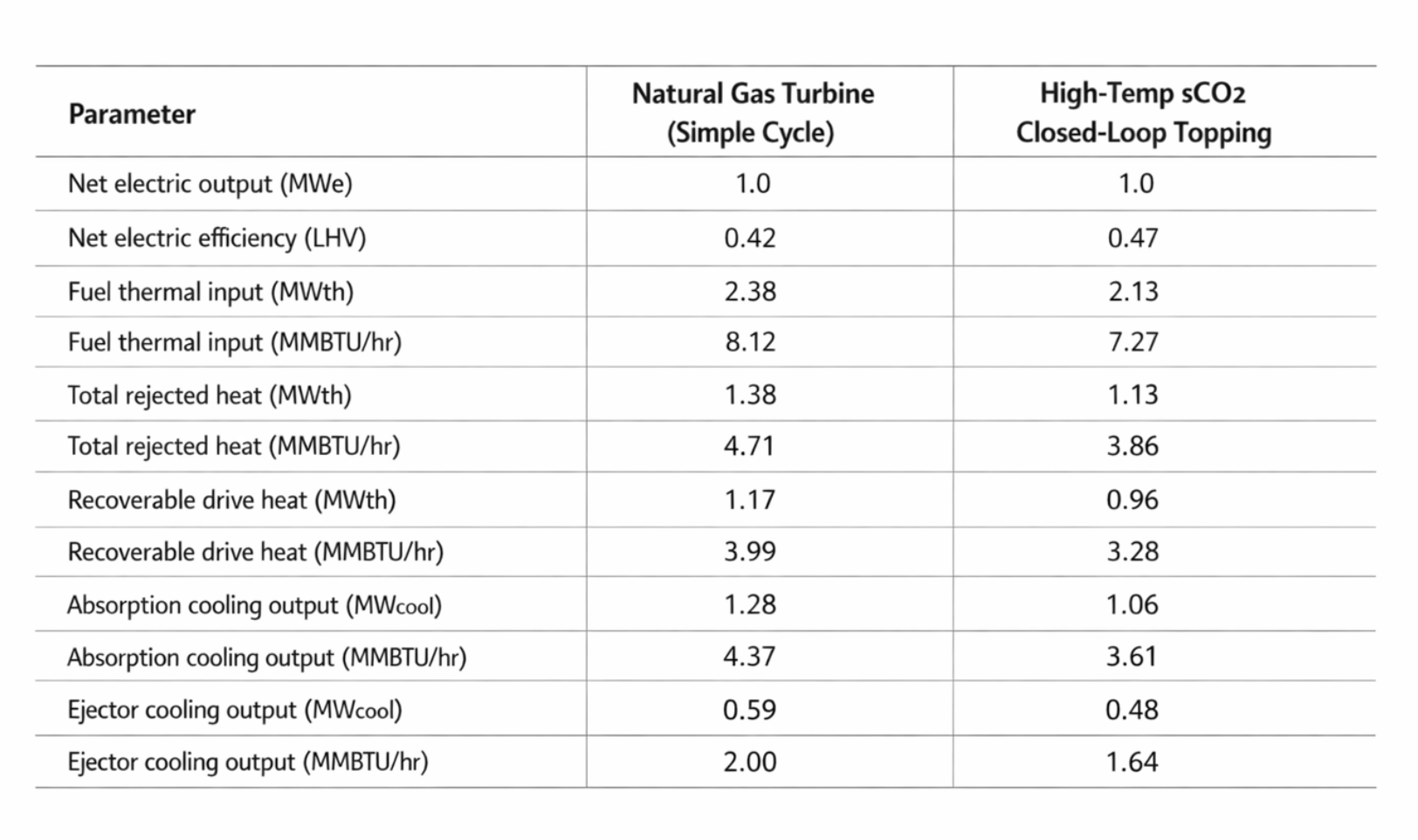
Thermodynamic Comparison Table Below is a side-by-side thermodynamic comparison table for a 1.0 MWe module, contrasting a conventional natural gas simple-cycle turbine versus a high-temperature sCO₂ closed-loop topping cycle (natural-gas-heated), with the bottoming function focused on cooling.Key basis and assumptions (so the table is internally consistent)Net electric output basis: 1.0 MWeFuel basis: Natural gas LHVAmbient for cooling: 70°F (21°C) dry coolerGas turbine net electrical efficiency (simple cycle, data-center prime power class): 42%sCO₂ net electrical efficiency (high-temp recuperated, 700–750°C TIT class): 47%Recoverable “drive heat” fraction of rejected heat for cooling: 85% (non-condensing stack design)Cooling COP (thermal):Absorption (double-effect class): 1.1Ejector: 0.5Conversion: 1 kW = 3,412 BTU/hr, 1 MW = 3.412 MMBTU/hrThermodynamic comparison (per 1.0 MWe net)| Parameter | Natural Gas Turbine (Simple Cycle) | High-Temp sCO₂ Closed-Loop Topping (NG-Heated) || -• | -: | -: || Net electric output | 1.00 MWe | 1.00 MWe || Net electric efficiency (LHV) | 0.42 | 0.47 || Fuel thermal input | 2.38 MWth (8.12 MMBTU/hr) | 2.13 MWth (7.27 MMBTU/hr) || Total rejected heat (fuel – electric) | 1.38 MWth (4.71 MMBTU/hr) | 1.13 MWth (3.86 MMBTU/hr) || Recoverable drive heat for cooling (85% of rejected) | 1.17 MWth (3.99 MMBTU/hr) | 0.96 MWth (3.28 MMBTU/hr) || Typical exhaust / waste-heat temperature quality | High exhaust mass flow, ~450–600°C typical | Concentrated exchanger-based recovery; stack can be designed ~150–200°C || Cooling potential via absorption (COP_th=1.1) | 1.28 MWcool (4.37 MMBTU/hr) | 1.06 MWcool (3.61 MMBTU/hr) || Cooling potential via ejector (COP_th=0.5) | 0.59 MWcool (2.00 MMBTU/hr) | 0.48 MWcool (1.64 MMBTU/hr) || Overall useful energy (electric + absorption cooling) | 2.28 “useful MW” equivalent | 2.06 “useful MW” equivalent || Primary constraint / penalty | Ambient derate, intake/exhaust noise, dirty-air sensitivity | High-temp HX and materials, high-pressure CO₂ hardware |“Useful MW equivalent” here is simply MWe + MWcool (not an exergy metric). It’s a practical data-center utility metric.Interpretation (what the table implies)1. Fuel consumption: sCO₂ at 47% net uses ~10–12% less fuel per delivered MWe than a 42% simple-cycle gas turbine (7.27 vs 8.12 MMBTU/hr).2. Cooling from waste heat: the gas turbine rejects more total heat (because it’s less efficient), so it can show more absolute cooling potential if you fully harvest waste heat.However, this “advantage” comes from lower electrical efficiency—you are buying extra cooling with extra fuel.3. Best-in-class value proposition for sCO₂: the strongest case is when you value:silent operation (no large air path),no ambient derate / altitude penalty,immunity to dirty air (no compressor fouling),water-free siting (dry cooling),and a modular, sealed architecture.Optional: “Apples-to-apples cooling” normalizationIf you want the same cooling output as the gas turbine provides (e.g., 1.28 MWcool via absorption), the sCO₂ system can achieve it by:allocating more recoverable heat to the cooling generator (designing for a slightly higher stack or different recovery split), ormodestly increasing module firing rate, while still retaining the operational benefits of the sealed cycle.
|
|
|
| CONTACT Email: greg@infinityturbine.com | AMP | PDF |