
INFINITY TURBINE LLC We specialize in designs, plans, licensing, consulting, design services, and surplus spare parts. We no longer manufacture turbines or CO2 systems. More Info...
Please email for first contact with request for more information
Email: greg@infinityturbine.com
CO2 Ejectors for Data Center Waste Heat Cooling: A Technical Review Hyperscalers are racing to deploy gigawatts of AI compute, but the grid can't keep up and large gas turbines are backordered half a decade out. Infinity Turbine's Cluster Mesh Supercritical CO₂ system offers a radical alternative: modular, silent, trailer-deployable prime power that scales the way software does... More Info
From the Feher Cycle to the Cluster Mesh: A History of Supercritical CO₂ Power... More Info
Cooling a Data Center Pod with Its Own Waste Heat: A 100 kW Ejector Design Study More Info
Portable Gas Turbine Prime Power More Info
Cluster Mesh Supercritical CO2 Power System for Data Centers and AI Pairing Cluster Mesh Supercritical CO2 Power System with Small Modular Reactors enables hyperscalers to convert high-grade nuclear heat into ultra-efficient, dispatchable power with a compact, modular footprint tailored for AI-scale demand. More Info
ORC and Products Index Infinity Turbine ORC Index... More Info
AMD Helios Cooling Strategy Using Transcritical CO2 and a Cluster Mesh sCO2 Turbine Generator Cell More Info
|
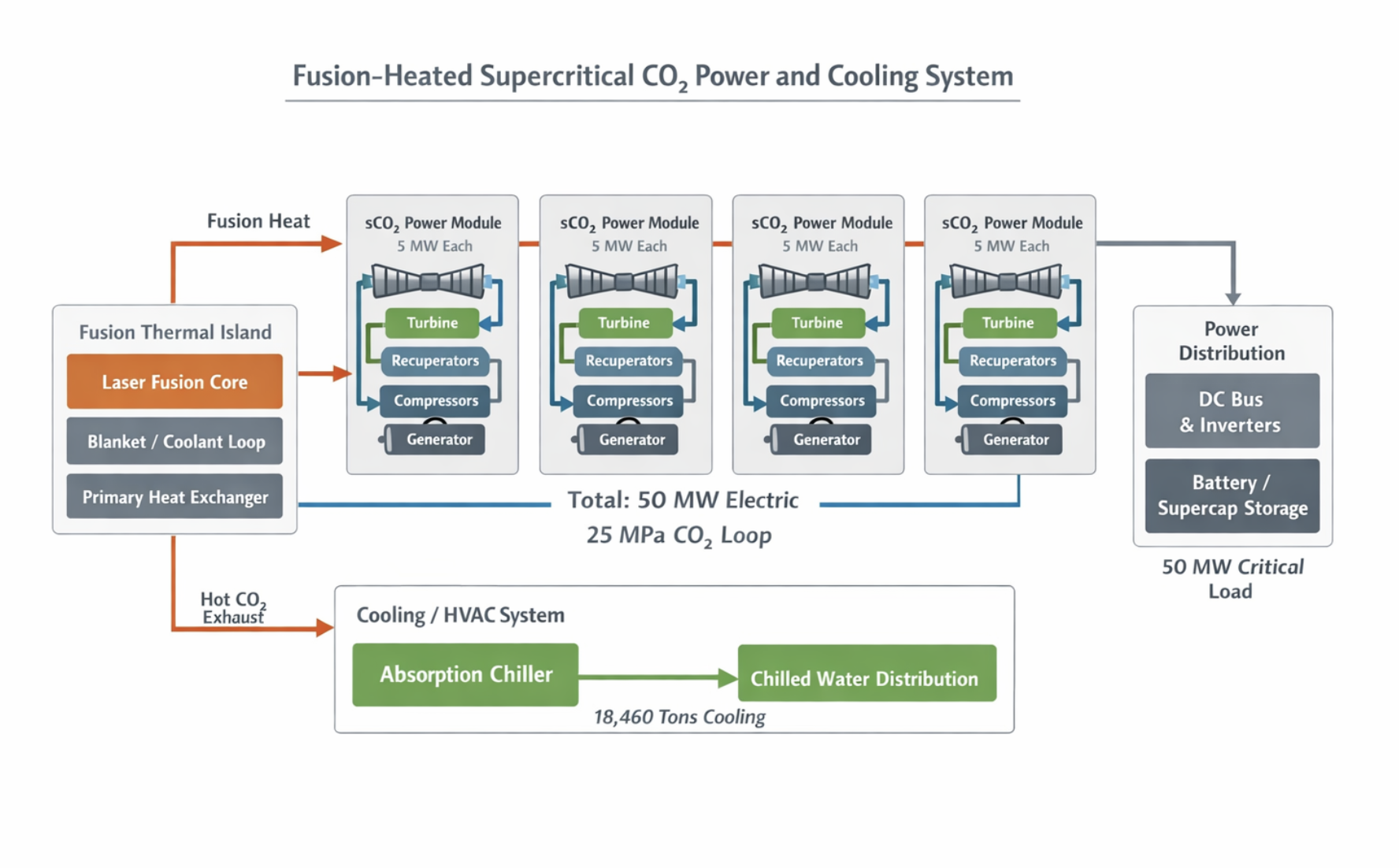
Fusion-Heated Supercritical CO2 Power Blocks for AI Data Centers A 50 MW Prime Power Reference Architecture with Integrated Cooling Cascade Laser fusion can supply extremely high-grade thermal energy, but converting that energy into reliable, efficient prime power for AI data centers requires a power block that is compact, controllable, and modular. This article presents a concrete 50 MW reference architecture using a supercritical CO2 Brayton cycle at 25 MPa, paired with a bottoming cooling cascade that maximizes total site efficiency while delivering both electricity and cooling from the same thermal source.Why supercritical CO2 is the right interface for fusion heatLaser-driven fusion systems can deliver heat at temperatures far beyond what any turbine or heat exchanger can tolerate. The practical engineering solution is therefore to down-temper fusion heat through a blanket and primary heat exchanger into a controlled supercritical CO2 loop.Supercritical CO2 power blocks are uniquely suited for this role because they offer:• High power density and compact turbomachinery.• High efficiency in recuperated Brayton configurations.• Low water consumption with dry cooling compatibility.• Modular scalability for N plus one data center reliability.For data centers, availability and controllability matter more than absolute peak thermodynamic efficiency. The supercritical CO2 Brayton cycle provides the best balance of these attributes for fusion-based prime power.50 MW Reference Architecture OverviewNet electrical output• 50 MW• Maximum CO2 pressure• 25 MPa• Turbine inlet temperature target 700 to 800 degrees C classArchitecture philosophyInstead of one large turbine, the system uses modular blocks for redundancy and manufacturability.• Ten identical power blocks rated at 5 MW each.• Nine blocks operate continuously for 45 MW.• One block remains in hot standby for N plus one redundancy.This allows continuous maintenance without loss of data center power availability.Fusion Thermal Interface• Fusion core output is absorbed in a blanket system.• Blanket outlet thermal fluid temperature is controlled and stabilized.• Heat is transferred to the CO2 loop through a high temperature primary heat exchanger.The CO2 loop never sees radiation exposure and operates as a conventional industrial closed loop power system.Supercritical CO2 Power Block Configuration• Each 5 MW module uses a recuperated Brayton cycle with recompression.Nominal CO2 pressure range• 25 MPa at turbine inlet• 8 to 9 MPa at turbine outletCycle elements per module• Primary heater heat exchanger• High pressure turbine• Low temperature recuperator• High temperature recuperator• Main compressor• Recompression compressor• Gas cooler• GeneratorEach module operates independently with common thermal supply headers and electrical bus connection.Electrical PerformancePer 5 MW module• Thermal input approximately 11.5 MW thermal• Electrical output 5 MW electric• Module efficiency approximately 43 percentFor the full plant• Thermal input approximately 115 MW thermal• Electrical output 50 MW electricThis efficiency level is conservative and compatible with long-life materials and high availability operation.Heat Rejection and Cascade OpportunityAfter power generation, approximately 65 MW thermal remains available in the CO2 exhaust and gas cooler streams.Instead of rejecting this heat directly to ambient, it is cascaded into a cooling production system for the data center.Bottoming Cooling Cycle SelectionTwo candidate options are considered:• Absorption cooling• Ejector coolingAbsorption cooling characteristics• Typical coefficient of performance approximately 0.7 to 1.2 depending on working pair and temperature.• Stable operation over wide load ranges.• Commercially mature technology.• High reliability and predictable maintenance.Ejector cooling characteristics• Typical coefficient of performance approximately 0.25 to 0.6.• Simple hardware.• Highly sensitive to operating point.• Lower overall cooling yield per unit of heat.Selected solutionFor a fusion and sCO2 prime power system, absorption cooling is the most efficient and controllable bottoming solution.---Cooling Cascade Reference DesignAvailable thermal for cooling approximately 65 MW thermal.Assume absorption cooling coefficient of performance of 1.0 for conservative design.Cooling output approximately 65 MW cooling.Conversion reference1 MW cooling equals approximately 284 tons of refrigeration.Therefore65 MW cooling equals approximately 18,460 tons of refrigeration.This cooling capacity can support approximately 65 to 80 MW of IT load depending on data center cooling architecture and approach temperature.Full Energy Utilization SummaryFusion thermal input• 115 MW thermalElectrical output• 50 MW electricCooling output• 65 MW cooling equivalentEffective site utilization of thermal energy approaches full conversion into useful work products.Data Center Integration Strategy• The data center is connected to a DC bus fed by grid forming inverters from each CO2 module.• Short duration battery or supercapacitor storage provides millisecond to minute buffering.• The thermal system runs in steady state while electrical storage handles fast load transients.• Cooling is delivered directly into liquid cooling distribution units and secondary chilled water loops.Advantages Over Gas Turbine Prime Power• No combustion emissions.• No large water consumption.• Higher power density.• Integrated cooling production.• Better suitability for modular scaling.• Lower acoustic and vibration footprint.Reliability and Maintenance Philosophy• Fusion island is isolated from the CO2 island.• CO2 modules are hot swappable.• Cooling modules are redundant and sectionalized.• Electrical bus is segmented for fault isolation.This architecture matches data center uptime expectations rather than traditional power plant maintenance assumptions.Why this architecture is ideal for AI data centersAI data centers demand electricity and cooling in nearly equal measure. Traditional power plants provide electricity and reject heat. This fusion-heated supercritical CO2 architecture converts heat into electricity first, and then converts the remaining heat into cooling, maximizing total site efficiency and minimizing wasted energy.The result is a prime power platform that behaves less like a power plant and more like an integrated energy appliance for AI infrastructure.Closing PerspectiveLaser fusion offers extraordinary thermal energy potential, but only when paired with a realistic and controllable conversion system does it become economically valuable. A modular supercritical CO2 Brayton architecture with an absorption cooling cascade represents one of the most practical and scalable paths to turn fusion heat into dependable prime power for the AI era.
|
|
|
|
Financial Pro Forma 50 MW Fusion Heated Supercritical CO2 Prime Power Plant With Absorption Cooling Cascade for AI Data Centers Below is a data-center-grade financial pro forma model for the 50 MW Fusion-Heated sCO2 + Absorption CoolingFinancial Pro Forma50 MW Fusion Heated Supercritical CO2 Prime Power PlantWith Absorption Cooling Cascade for AI Data CentersSystem Capacity SummaryNet electrical output50 MWAnnual operating hours8,500 hoursAnnual electrical generation425,000 MWh per yearCooling output65 MW coolingApproximately 18,460 tons refrigerationCapital Cost AssumptionsFusion thermal island including blanket and heat interface$150,000,000sCO2 power blocks 10 modules at 5 MW$2,500 per kW installedTotal $125,000,000Absorption cooling plant and distribution$800 per ton coolingTotal $14,800,000Electrical power electronics and DC bus$20,000,000Balance of plant, installation, buildings, controls$40,000,000Total project capital costApproximately $350,000,000Installed cost per kW electric$7,000 per kWOperating Cost AssumptionsFusion fuel and consumables$5 per MWhOperations and maintenance labor$6 per MWhMaintenance and spares$7 per MWhInsurance and compliance$3 per MWhTotal operating cost$21 per MWhAnnual operating cost425,000 MWh times $21 per MWh$8,925,000 per yearRevenue ModelElectricity ValueData center avoided grid power value$120 per MWhAnnual electricity value425,000 MWh times $120 per MWh$51,000,000 per yearCooling ValueData center cooling typically consumes approximately 0.3 kW to 0.5 kW per kW IT.Assume avoided chiller power of 20 MW average.Annual avoided cooling electricity20 MW times 8,500 hours170,000 MWhCooling electricity value at $120 per MWh$20,400,000 per yearTotal Annual ValueElectricity value$51,000,000Cooling value$20,400,000Total annual site energy value$71,400,000 per yearNet Operating IncomeAnnual value$71,400,000Minus operating cost$8,925,000Net operating income$62,475,000 per yearFinancial ReturnsSimple Payback$350,000,000 divided by $62,475,000Approximately 5.6 yearsInternal Rate of Return EstimateAssuming20 year plant lifeFlat revenueNo tax creditsEstimated project IRRApproximately 15 to 17 percentWith Data Center Power PremiumIf electricity value increases to $150 per MWhElectric revenue becomes$63,750,000Cooling value remains$20,400,000Total annual value$84,150,000Net operating income$75,225,000Payback4.6 yearsIRRApproximately 18 to 21 percentSensitivity SummaryElectric price $100 per MWhPayback approximately 6.7 yearsElectric price $150 per MWhPayback approximately 4.6 yearsCooling COP improvement to 1.2Cooling value increases to approximately $24,500,000 per yearInvestor PositioningThis system behaves economically as:A power plantA cooling plantA reliability assetA carbon free infrastructure platformThe dual monetization of electricity and cooling is the core financial advantage.Comparison to Gas Turbine Data Center PowerGas turbine plus electric chiller requires:Fuel purchaseCarbon permittingWater coolingChiller electricity penaltyThis fusion sCO2 system:Eliminates fuel volatilityEliminates combustion emissionsProduces cooling directlyImproves total site energy utilizationModular Expansion EconomicsEach additional 5 MW module adds:Capital approximately $30,000,000Annual value approximately $7,140,000Incremental payback remains under 5.5 years per moduleThis supports phased data center expansion.Investor Risk ProfilePrimary risksFusion thermal system maturityHeat exchanger lifetime validationRegulatory classificationMitigationsModular redundancyThermal bufferingIndependent sCO2 islandsBattery ride throughLong Term Strategic ValueOnce fusion thermal hardware matures, the sCO2 and cooling architecture becomes a standardized conversion platform.The data center operator effectively owns a private zero fuel cost power and cooling plant.Closing Investor SummaryA 50 MW fusion heated supercritical CO2 prime power system with absorption cooling delivers:Net operating income exceeding $60 million per yearPayback under 6 yearsIRR above 15 percentCooling and power in one integrated assetModular scalabilityData center grade reliabilityThis architecture is financially competitive even before carbon credits or grid services revenue are added. |
|
Investor Executive Summary Fusion Heated Supercritical CO2 Prime Power for AI Data CentersOpportunityAI data centers face three escalating challengesPower availabilityCooling capacityGrid reliability and cost volatilityThe market requires a new class of on-site prime power that delivers both electricity and cooling from a single integrated energy platform.SolutionA modular 50 MW fusion-heated supercritical CO2 Brayton power plant with an absorption cooling cascade.Fusion provides high grade thermal energy.Supercritical CO2 converts heat into electricity efficiently and compactly.Remaining heat is converted directly into data center cooling.This architecture converts nearly all thermal energy into useful site products.System OverviewNet electric output50 MWCooling output65 MW coolingApproximately 18,460 tons refrigerationArchitectureTen modular 5 MW sCO2 power blocksN plus one redundancy25 MPa closed loop CO2 systemAbsorption cooling bottoming cycleDesigned specifically for AI data center uptime and scalability.Why This MattersTraditional power plants reject heat.Data centers spend large amounts of electricity to remove heat.This system converts heat into power first, then converts remaining heat into cooling.The data center becomes an energy recycling machine instead of an energy disposal site.Economic PerformanceTotal project capital costApproximately 350 million dollarsAnnual electrical production425,000 MWhAnnual electricity value51 million dollarsAnnual cooling value20.4 million dollarsTotal annual site energy value71.4 million dollarsAnnual operating cost8.9 million dollarsNet operating income62.5 million dollars per yearFinancial ReturnsSimple paybackApproximately 5.6 yearsProject internal rate of return15 to 17 percent base caseWith power price premiumIRR increases to 18 to 21 percentModular expansion preserves returns for each additional 5 MW block.Strategic AdvantagesNo combustion emissionsNo fuel price volatilityLow water consumptionIntegrated cooling productionModular redundancyHigh power density footprintThis is a power plant and cooling plant in one asset.Competitive PositionCompared to gas turbines plus chillersLower operating riskHigher site energy utilizationLower carbon exposureHigher infrastructure efficiencyCompared to grid dependencyImproved reliabilityPredictable long term energy costOn site energy sovereigntyMarket FitPrimary marketsAI data centersHyperscale cloud campusesHigh performance computing facilitiesNational security computing sitesSecondary marketsIndustrial campusesResearch facilitiesIsolated grid regionsScalability50 MW blocks can scale to100 MW campuses250 MW campusesGigawatt class energy hubsThe conversion platform remains identical. Only the number of modules changes.Risk ManagementKey risksFusion thermal system maturityPrimary heat exchanger lifetimeRegulatory classificationMitigation strategyThermal isolation between fusion and CO2Modular redundancyIndependent power blocksElectrical ride through storageThe sCO2 and cooling architecture remains valuable even as fusion evolves.Long Term VisionThis architecture creates a standardized thermal to power and cooling conversion platform.As fusion matures, this system becomes the bridge that makes fusion commercially usable for real infrastructure.Investor TakeawayThis is not a science project.It is a commercial energy conversion platform designed for AI infrastructure.It deliversHigh return infrastructure economicsDual monetization of power and coolingModular scalabilityFuture proof compatibility with fusionClosing StatementThe fusion heated supercritical CO2 power block with absorption cooling represents a new category of data center infrastructure.It is not only a power plant.It is an energy efficiency engine for the AI economy. |
| CONTACT Email: greg@infinityturbine.com | AMP | PDF |