
INFINITY TURBINE LLC We specialize in designs, plans, licensing, consulting, design services, and surplus spare parts. We no longer manufacture turbines or CO2 systems. More Info...
Please email for first contact with request for more information
Email: greg@infinityturbine.com
CO2 Ejectors for Data Center Waste Heat Cooling: A Technical Review Hyperscalers are racing to deploy gigawatts of AI compute, but the grid can't keep up and large gas turbines are backordered half a decade out. Infinity Turbine's Cluster Mesh Supercritical CO₂ system offers a radical alternative: modular, silent, trailer-deployable prime power that scales the way software does... More Info
From the Feher Cycle to the Cluster Mesh: A History of Supercritical CO₂ Power... More Info
Cooling a Data Center Pod with Its Own Waste Heat: A 100 kW Ejector Design Study More Info
Portable Gas Turbine Prime Power More Info
Cluster Mesh Supercritical CO2 Power System for Data Centers and AI Pairing Cluster Mesh Supercritical CO2 Power System with Small Modular Reactors enables hyperscalers to convert high-grade nuclear heat into ultra-efficient, dispatchable power with a compact, modular footprint tailored for AI-scale demand. More Info
ORC and Products Index Infinity Turbine ORC Index... More Info
AMD Helios Cooling Strategy Using Transcritical CO2 and a Cluster Mesh sCO2 Turbine Generator Cell More Info
|
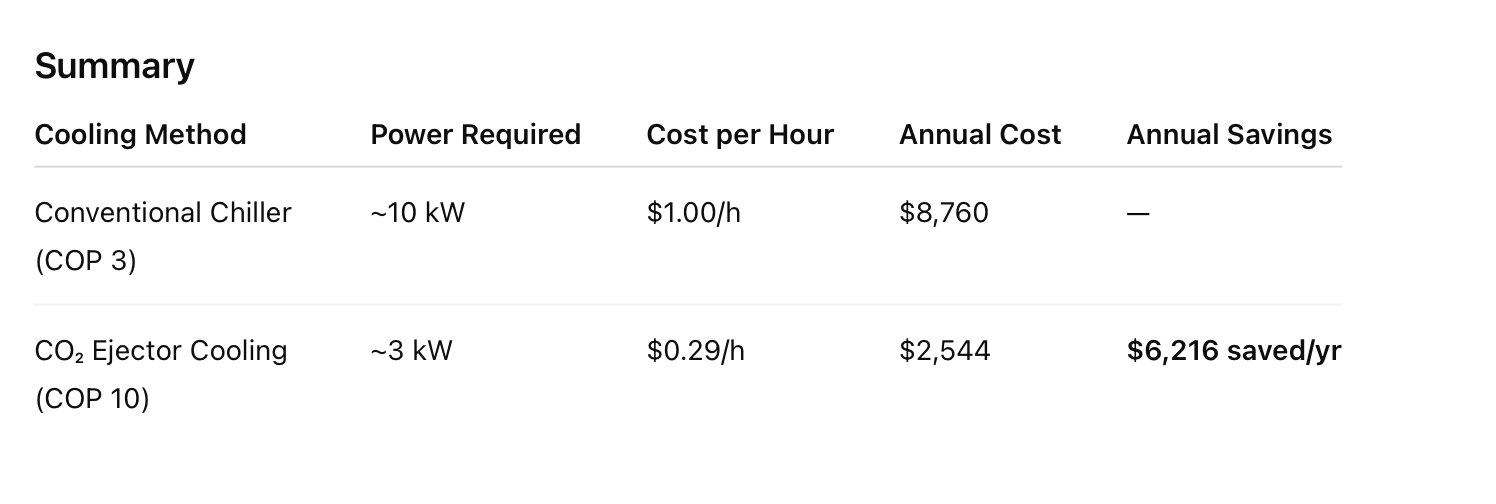
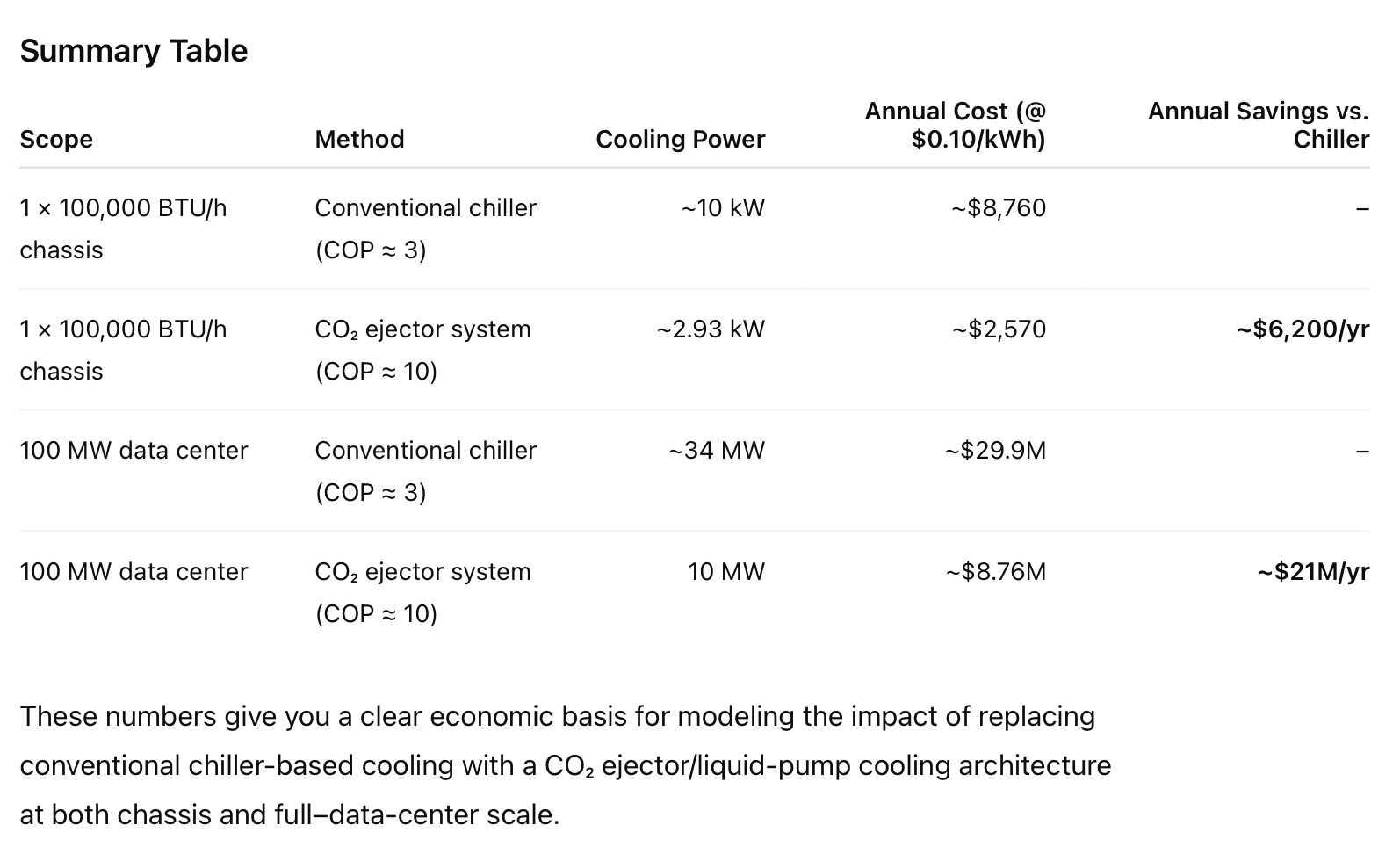
Revolutionizing Data Center Cooling with CO2 Ejector Technology Data centers are under increasing pressure to reduce operating costs and energy consumption. By replacing conventional chiller systems with a CO2 ejector and liquid-pump architecture, operators can dramatically reduce cooling power requirements. This article explains the process and provides clear numerical results for annual savings at both the server and facility scale.Traditional data center cooling relies on electrically driven chillers and compressors. These systems use significant power because they depend on mechanical compression to lift heat from server equipment to the ambient environment. In contrast, a CO2 ejector and liquid-pump cooling system uses the natural thermodynamic behavior of carbon dioxide during expansion and recompression. This enables cooling at a fraction of the energy input, particularly when high density compute hardware such as the NVIDIA H100 provides a constant and predictable waste-heat source.A single server chassis producing one hundred thousand BTU per hour generates the equivalent of twenty nine point three kilowatts of heat. A conventional chiller system with a coefficient of performance of approximately three requires a power input of about ten kilowatts to remove this heat. At an electricity cost of ten cents per kilowatt hour, this results in an operating cost of approximately one dollar per hour. Over a full year of continuous operation, this becomes eight thousand seven hundred sixty dollars.A CO2 ejector and liquid-pump system operates differently. Instead of mechanical compression, the system heats liquid CO2 from approximately five degrees Celsius to sixty degrees Celsius using the waste heat from the server chassis. This CO2 is pressurized above its critical pressure of approximately seventy three point eight bar. When expanded through an ejector or throttling device from about one hundred bar to about thirty bar, the CO2 undergoes a temperature drop of approximately fifty to sixty degrees Celsius. The resulting cold CO2 at approximately zero to five degrees Celsius can then be routed back to the servers to provide cooling. Because only a liquid pump is used to raise the CO2 pressure, the required power input is low. With a realistic coefficient of performance of approximately ten, the system needs only two point nine three kilowatts of electrical power to remove the same twenty nine point three kilowatts of heat.At ten cents per kilowatt hour, the CO2 system costs about twenty nine cents per hour to operate. The annual cost is approximately two thousand five hundred seventy dollars. The annual savings compared to a conventional chiller approach is therefore approximately six thousand two hundred dollars per server chassis equivalent of one hundred thousand BTU per hour.This efficiency gain becomes much more significant when scaled across a large facility. A one hundred megawatt data center produces one hundred thousand kilowatts of heat. In conventional chiller systems with a coefficient of performance of three, the required cooling power is about thirty three thousand kilowatts. With continuous annual operation, energy use is about two hundred ninety eight million nine hundred seventy six thousand kilowatt hours per year. At ten cents per kilowatt hour, the annual cooling cost is approximately twenty nine point nine million dollars.Under the CO2 ejector and liquid-pump method, cooling the same one hundred megawatts of heat requires only ten thousand kilowatts of electrical power when operating at a coefficient of performance of ten. Annual energy use becomes eighty seven million six hundred thousand kilowatt hours. At ten cents per kilowatt hour, the annual cost is about eight point seven six million dollars. The annual savings for a one hundred megawatt data center is therefore approximately twenty one million dollars.The magnitude of these savings demonstrates the transformational potential of supercritical CO2 based cooling systems. By eliminating mechanical compression and leveraging the thermodynamic pressure drop of CO2, the system reduces both operating cost and electrical load. This method improves power usage effectiveness while providing a pathway to higher density computing without proportional increases in cooling cost.Data centers seeking long term reductions in operating expenses, power draw, and environmental impact should evaluate CO2 ejector cooling as a compelling alternative to conventional chiller infrastructure. |
|
|
| CONTACT Email: greg@infinityturbine.com | AMP | PDF |