
INFINITY TURBINE LLC We specialize in designs, plans, licensing, consulting, design services, and surplus spare parts. We no longer manufacture turbines or CO2 systems. More Info...
Please email for first contact with request for more information
Email: greg@infinityturbine.com
CO2 Ejectors for Data Center Waste Heat Cooling: A Technical Review Hyperscalers are racing to deploy gigawatts of AI compute, but the grid can't keep up and large gas turbines are backordered half a decade out. Infinity Turbine's Cluster Mesh Supercritical CO₂ system offers a radical alternative: modular, silent, trailer-deployable prime power that scales the way software does... More Info
From the Feher Cycle to the Cluster Mesh: A History of Supercritical CO₂ Power... More Info
Cooling a Data Center Pod with Its Own Waste Heat: A 100 kW Ejector Design Study More Info
Portable Gas Turbine Prime Power More Info
Cluster Mesh Supercritical CO2 Power System for Data Centers and AI Pairing Cluster Mesh Supercritical CO2 Power System with Small Modular Reactors enables hyperscalers to convert high-grade nuclear heat into ultra-efficient, dispatchable power with a compact, modular footprint tailored for AI-scale demand. More Info
ORC and Products Index Infinity Turbine ORC Index... More Info
AMD Helios Cooling Strategy Using Transcritical CO2 and a Cluster Mesh sCO2 Turbine Generator Cell More Info
|
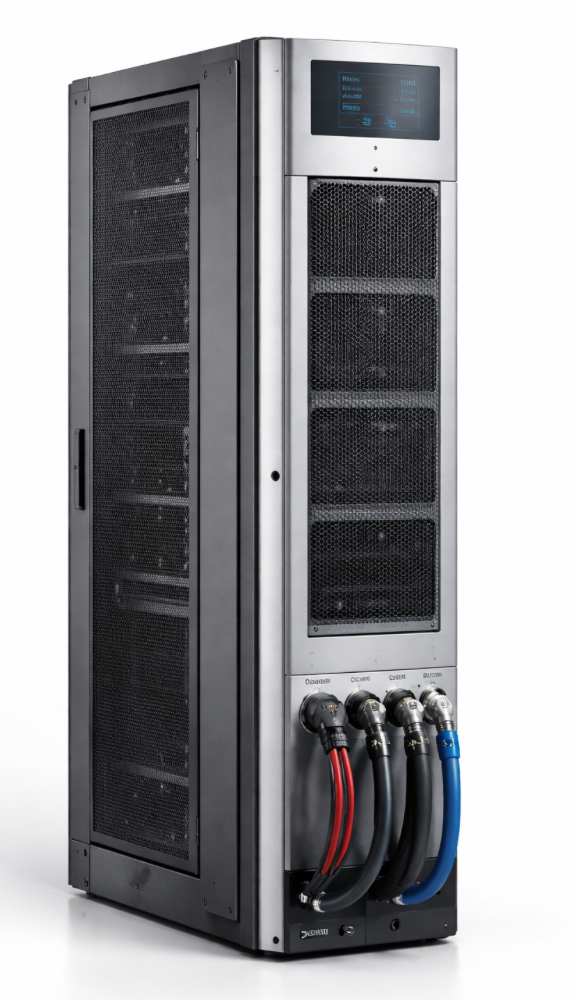
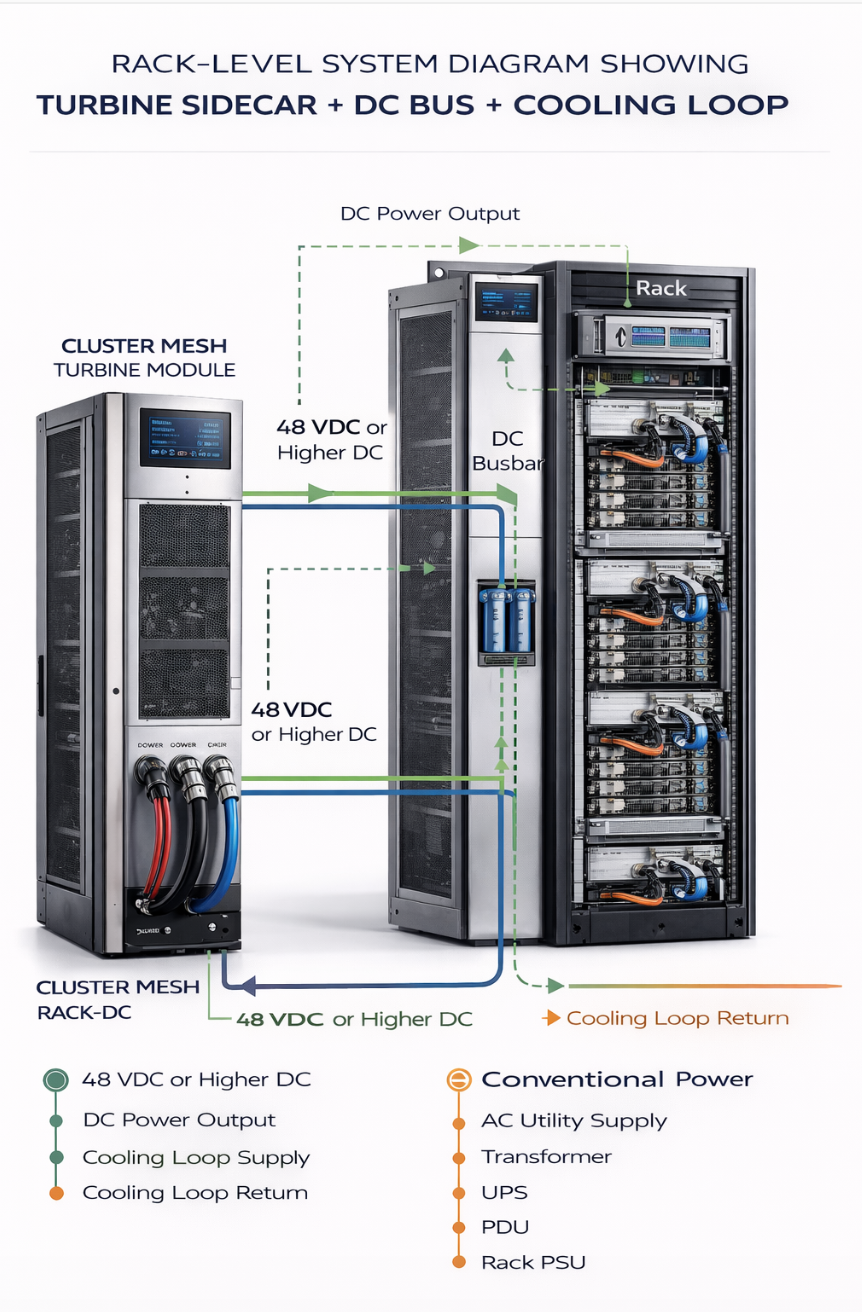
Hyperscaler Rack-Level DC Power Generation Using Supercritical CO2 with Busbar and Buffer Replace centralized AC power chains with rack-level DC generation: Cluster Mesh turbines paired with DC busbars and buffer storage redefine efficiency, resilience, and density for next-generation AI data centers.1. Introduction: The Shift to Rack-Level Power DomainsModern AI data centers are rapidly transitioning from centralized AC distribution toward rack-level power architectures. The traditional model—medium voltage AC stepped down through UPS systems and converted again at the server—introduces multiple inefficiencies, thermal losses, and infrastructure complexity.A new approach leverages Cluster Mesh turbine generators integrated at the rack level to produce direct current (DC) power, distributed via busbars at 48 VDC or higher voltage DC architectures. This eliminates the need for per-server AC power supply units (PSUs) and significantly simplifies the electrical chain.2. Cluster Mesh Rack-DC Architecture Overview The proposed architecture places power generation adjacent to the rack (sidecar or rear-mounted module) rather than embedding it within compute slots.Core Components1. Cluster Mesh Turbine Module (25–100 kW per rack)• Supercritical CO2 or ORC-based microturbine array• Outputs regulated DC power• Modular (1–4 × 25 kW units)2. DC Bus (48 V or High Voltage DC)• Rack-level busbar distribution• Designed for high current (48 V) or reduced current (higher voltage DC)3. Energy Buffer Layer• Lithium-titanate battery or supercapacitor• Handles transient GPU loads and ride-through• Stabilizes turbine output4. Compute Sleds (DC Input Only)• No AC PSU• Local DC-DC conversion (point-of-load regulators)5. Cooling Module (Dedicated Blade or Sidecar)• Liquid cooling CDU• Removes heat from GPUs and turbine electronics• Optionally integrates waste heat recovery loop3. Electrical Architecture FlowConventional Path (Legacy)MV AC → Transformer → UPS → PDU → Rack PSU → Server VRMsCluster Mesh Rack-DC PathThermal Input → Cluster Mesh Turbine → DC Regulation → DC Bus → Buffer → Compute Nodes (POL only)4. Voltage Strategy: 48 V vs Higher Voltage DC48 VDC (Baseline)• Proven (OCP Open Rack standard)• High current at scale• Mature ecosystemHigher Voltage DC (Emerging)• Reduced copper losses• Lower current → smaller conductors• Better for 50–100 kW+ racksEngineering Recommendation:• Use 48 VDC for compatibility and early deployment• Transition to higher-voltage DC bus (e.g., 300–800 VDC class) for ultra-high-density AI racks5. Efficiency GainsEach eliminated conversion stage improves total system efficiency.Conventional Loss Points• Transformer losses• UPS double conversion• AC distribution losses• Server PSU lossesCluster Mesh Gains• Direct DC generation• Fewer conversion steps• Reduced thermal load• Lower parasitic lossesEstimated improvement:5% to 15% total system efficiency gain depending on configuration.6. Thermal Integration AdvantageThe Cluster Mesh architecture enables co-design of power and cooling:• Turbine waste heat can be reused or rejected efficiently• Cooling loops can serve both compute and power modules• Enables closed-loop thermal optimizationThis is particularly valuable for AI workloads where thermal density exceeds 100 kW per rack.7. Transient Load ManagementAI workloads exhibit rapid power swings.Solution:• DC buffer layer absorbs spikes• Turbine operates at steady-state optimal efficiency• Decouples mechanical generation from digital load dynamics8. Reliability and ModularityAdvantages• Rack-level fault isolation• Modular turbine replacement• Reduced dependency on centralized UPS systems• Black-start capable racks (with buffer)Design Considerations• Redundant turbine modules (N+1 per rack group)• Hot-swappable power sidecar• Sealed working fluid systems9. Deployment ModelRack-Level Power IndependenceEach rack becomes a semi-autonomous power node:• Local generation• Local buffering• Local coolingData Center Impact• Reduced central electrical infrastructure• Faster deployment timelines• Scalable power blocks10. Architecture Comparison Table| Parameter | Cluster Mesh Rack-DC Architecture | Conventional MV AC → UPS → PSU Architecture || ------------------------• | --------------------------------• | ------------------------------------------• || Primary Energy Input | Thermal (waste heat, NG, etc.) | Grid electricity (AC) || Power Conversion Stages | Minimal (DC generation → POL) | Multiple (AC→DC→AC→DC→POL) || Rack Input Power | DC (48 V or higher) | AC (208–480 V) || Server PSU Requirement | Eliminated | Required per server || Efficiency | High (fewer conversions) | Lower (stacked losses) || Thermal Load | Reduced | Higher due to PSU losses || Infrastructure Complexity | Lower | High (UPS, transformers, PDUs) || Scalability | Modular per rack | Centralized scaling || Fault Isolation | Rack-level | System-level dependencies || Transient Handling | Buffer-based (fast response) | UPS + PSU response || Cooling Integration | Integrated with power system | Separate systems || Space Utilization | Slight overhead (power sidecar) | PSU occupies server space || Maintenance | Modular turbine units | Distributed PSU failures || Deployment Speed | Fast, modular | Slow, infrastructure heavy || Suitability for AI Loads | High | Increasingly constrained |11. Key Engineering InsightThe real innovation is not just replacing AC with DC—it is redefining the rack as the fundamental power unit.Cluster Mesh turbines enable:• Power generation at the point of consumption• Elimination of redundant conversion hardware• Integration of thermal and electrical systemsThis aligns with the future of hyperscale design, where AI racks become self-contained compute, power, and cooling nodes.12. ConclusionA Cluster Mesh Rack-DC architecture using 48 V or higher DC with buffer storage represents a fundamental shift in data center design.It delivers:• Higher efficiency• Lower complexity• Improved scalability• Better alignment with AI power density trendsWhile implementation requires careful attention to buffering, serviceability, and thermal design, the architecture is technically sound and aligned with the trajectory of hyperscale infrastructure.
|
|
|
|
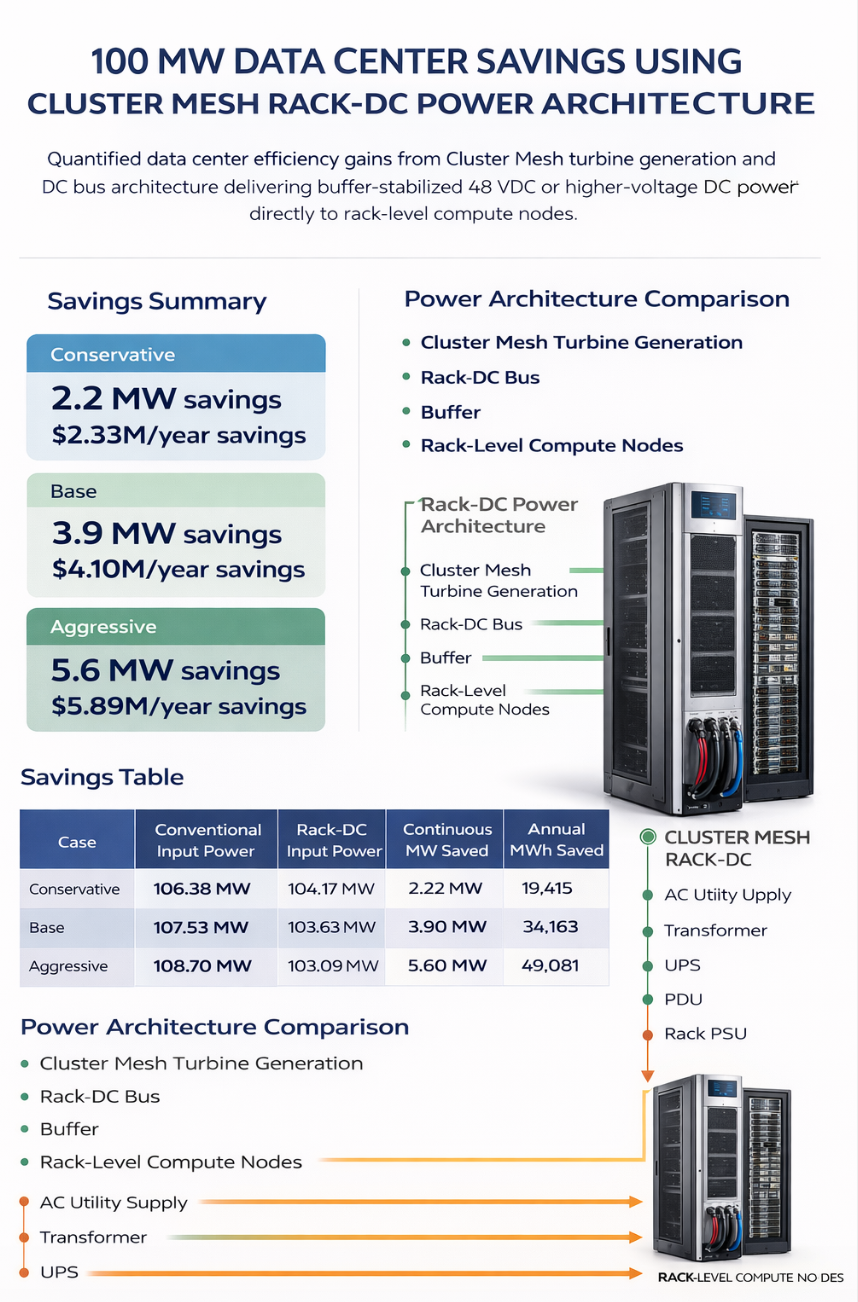
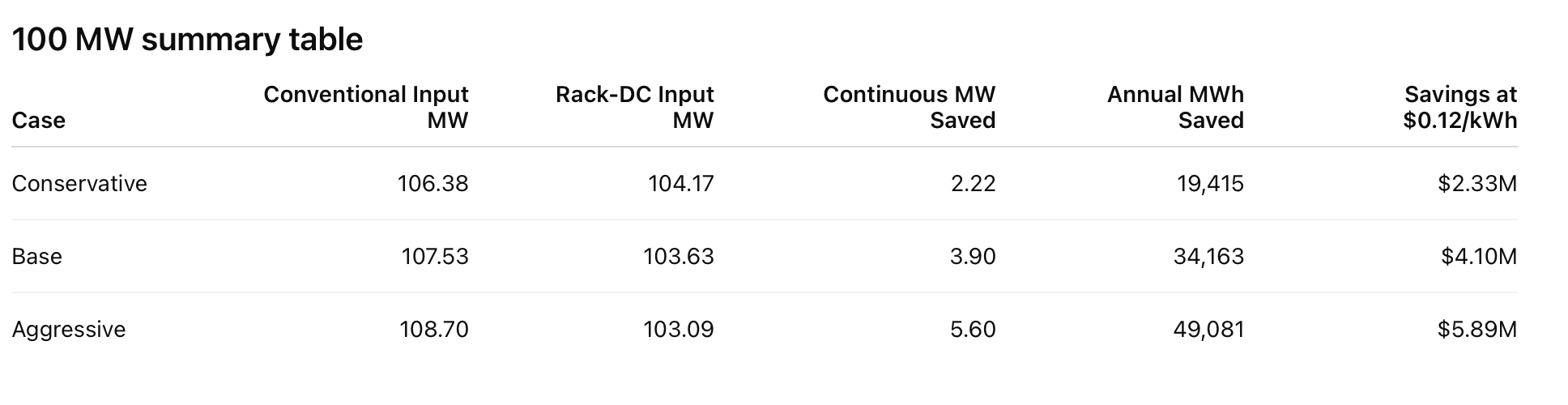
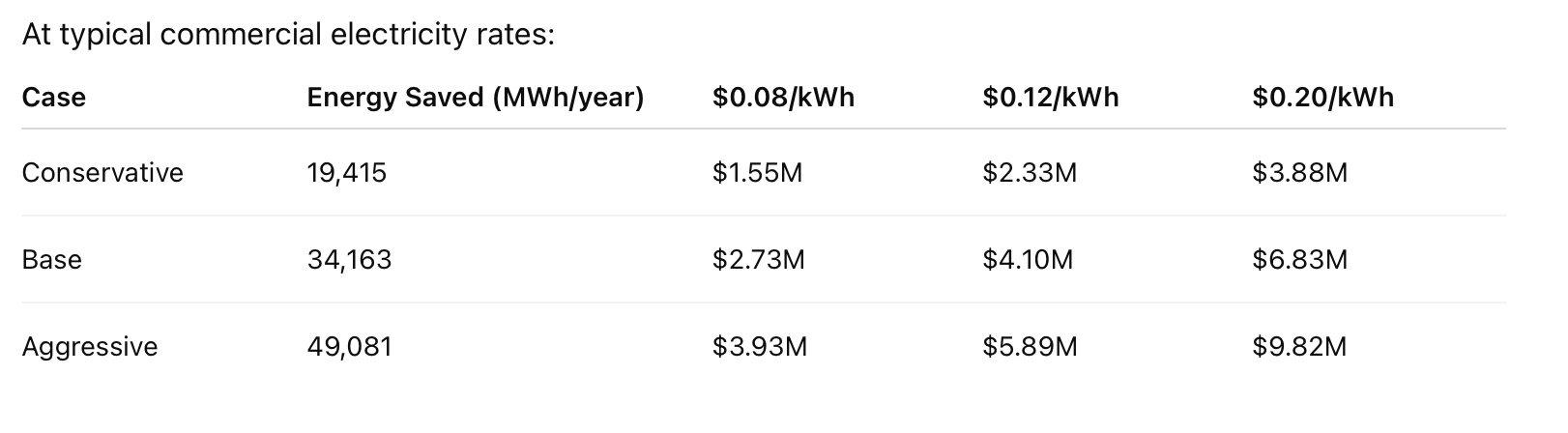
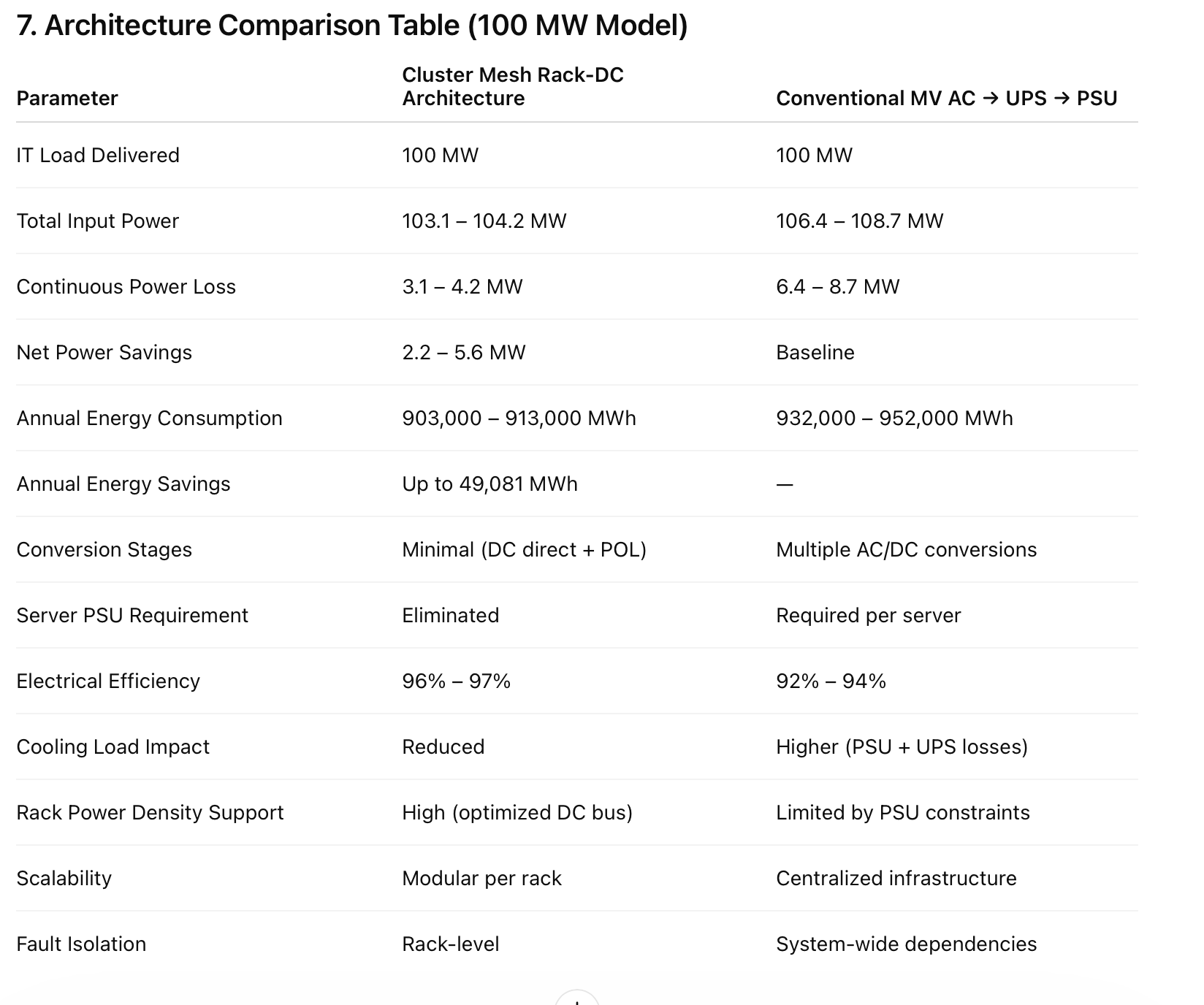
100 MW Data Center Savings Using Cluster Mesh Rack-DC Power Architecture Quantified savings for a 100 MW AI data center using Cluster Mesh rack-level DC power architecture. Reduce conversion losses, eliminate server PSUs, and achieve multi-megawatt efficiency gains.A 100 MW AI data center can eliminate multiple megawatts of continuous losses by replacing traditional AC power chains with Cluster Mesh rack-level DC architecture—delivering millions in annual savings and redefining hyperscale efficiency.1. Executive SummaryAs AI data centers scale beyond 100 MW, traditional AC power architectures are becoming increasingly inefficient due to layered power conversions and distributed losses. A Cluster Mesh Rack-DC architecture, using sidecar turbine modules with 48 V or higher-voltage DC distribution and buffer storage, fundamentally changes the power delivery model.By eliminating the per-server AC PSU stage and reducing total conversion steps, this architecture delivers 2% to 5.6% total electrical savings, equivalent to 2.2 MW to 5.6 MW of continuous power reduction in a 100 MW facility.2. Baseline: Conventional Power ArchitectureTypical hyperscale data centers use:MV AC → Transformer → UPS → PDU → Rack PSU → Server VRMsThis architecture introduces losses at every stage:• Transformer and switchgear losses• UPS double-conversion losses• Distribution losses• Server-level AC-DC PSU inefficienciesThese losses compound at scale and directly increase both electrical consumption and cooling demand.3. Proposed Architecture: Cluster Mesh Rack-DCThe Cluster Mesh approach shifts power generation and conversion to the rack level:Thermal Input → Cluster Mesh Turbine → DC Regulation → Rack DC Bus → Buffer → Compute Nodes (POL only)Key Characteristics• Sidecar-mounted 25–100 kW turbine modules per rack• 48 VDC or higher-voltage DC busbar distribution• Elimination of server PSUs• Integrated energy buffer (battery or supercapacitor)• Co-designed power + cooling architecture4. 100 MW Data Center Model AssumptionsTo quantify savings, the following efficiency ranges are used:| Architecture | Efficiency Range || --------------------• | ---------------• || Conventional AC Chain | 92% – 94% || Cluster Mesh Rack-DC | 96% – 97% |All results below assume 100 MW delivered to IT load.5. Quantified Power SavingsContinuous Power Reduction• Conservative Case: 2.22 MW saved• Base Case: 3.90 MW saved• Aggressive Case: 5.60 MW savedAnnual Energy Savings• 19,415 MWh to 49,081 MWh per yearThis represents a permanent reduction in facility power draw without reducing compute capacity.6. Annual Cost SavingsAt typical commercial electricity rates:| Case | Energy Saved (MWh/year) | $0.08/kWh | $0.12/kWh | $0.20/kWh || -----------• | ----------------------• | --------• | --------• | --------• || Conservative | 19,415 | $1.55M | $2.33M | $3.88M || Base | 34,163 | $2.73M | $4.10M | $6.83M || Aggressive | 49,081 | $3.93M | $5.89M | $9.82M |7. Architecture Comparison Table (100 MW Model)| Parameter | Cluster Mesh Rack-DC Architecture | Conventional MV AC → UPS → PSU || -------------------------• | --------------------------------• | -----------------------------• || IT Load Delivered | 100 MW | 100 MW || Total Input Power | 103.1 – 104.2 MW | 106.4 – 108.7 MW || Continuous Power Loss | 3.1 – 4.2 MW | 6.4 – 8.7 MW || Net Power Savings | 2.2 – 5.6 MW | Baseline || Annual Energy Consumption | 903,000 – 913,000 MWh | 932,000 – 952,000 MWh || Annual Energy Savings | Up to 49,081 MWh | — || Conversion Stages | Minimal (DC direct + POL) | Multiple AC/DC conversions || Server PSU Requirement | Eliminated | Required per server || Electrical Efficiency | 96% – 97% | 92% – 94% || Cooling Load Impact | Reduced | Higher (PSU + UPS losses) || Rack Power Density Support | High (optimized DC bus) | Limited by PSU constraints || Scalability | Modular per rack | Centralized infrastructure || Fault Isolation | Rack-level | System-wide dependencies |8. Secondary BenefitsReduced Cooling LoadEvery watt of electrical loss becomes heat. By removing multiple conversion stages:• Lower heat rejection requirement• Improved liquid cooling efficiency• Reduced HVAC and CDU loadInfrastructure Simplification• Reduced need for large centralized UPS systems• Less copper and fewer transformers• Faster deployment timelinesModular ScalingEach rack becomes a semi-independent power node:• Easier expansion• Improved redundancy• Reduced single points of failure9. Strategic PositioningThis architecture aligns with broader hyperscale trends:• Movement toward higher-voltage DC distribution• Elimination of redundant conversion layers• Increasing rack power density (50 kW → 100 kW → beyond)The Cluster Mesh system extends this trend by introducing localized generation + DC distribution + integrated cooling at the rack level.10. ConclusionFor a 100 MW AI data center, the Cluster Mesh Rack-DC architecture provides:• 2.2 MW to 5.6 MW continuous power savings• $1.5M to $9.8M annual cost reduction• Reduced thermal load and infrastructure complexityThe key innovation is not just DC power—it is redefining the rack as a self-contained power, cooling, and compute unit.This approach positions data centers for the next generation of AI workloads, where efficiency, density, and modularity are critical to scaling.
|
|
|
|
|
|
|
| CONTACT Email: greg@infinityturbine.com | AMP | PDF |