
INFINITY TURBINE LLC We specialize in designs, plans, licensing, consulting, design services, and surplus spare parts. We no longer manufacture turbines or CO2 systems. More Info...
Please email for first contact with request for more information
Email: greg@salgenx.com
CO2 Ejectors for Data Center Waste Heat Cooling: A Technical Review Hyperscalers are racing to deploy gigawatts of AI compute, but the grid can't keep up and large gas turbines are backordered half a decade out. Infinity Turbine's Cluster Mesh Supercritical CO₂ system offers a radical alternative: modular, silent, trailer-deployable prime power that scales the way software does... More Info
From the Feher Cycle to the Cluster Mesh: A History of Supercritical CO₂ Power... More Info
Cooling a Data Center Pod with Its Own Waste Heat: A 100 kW Ejector Design Study More Info
Portable Gas Turbine Prime Power More Info
Cluster Mesh Supercritical CO2 Power System for Data Centers and AI Pairing Cluster Mesh Supercritical CO2 Power System with Small Modular Reactors enables hyperscalers to convert high-grade nuclear heat into ultra-efficient, dispatchable power with a compact, modular footprint tailored for AI-scale demand. More Info
ORC and Products Index Infinity Turbine ORC Index... More Info
AMD Helios Cooling Strategy Using Transcritical CO2 and a Cluster Mesh sCO2 Turbine Generator Cell More Info
|
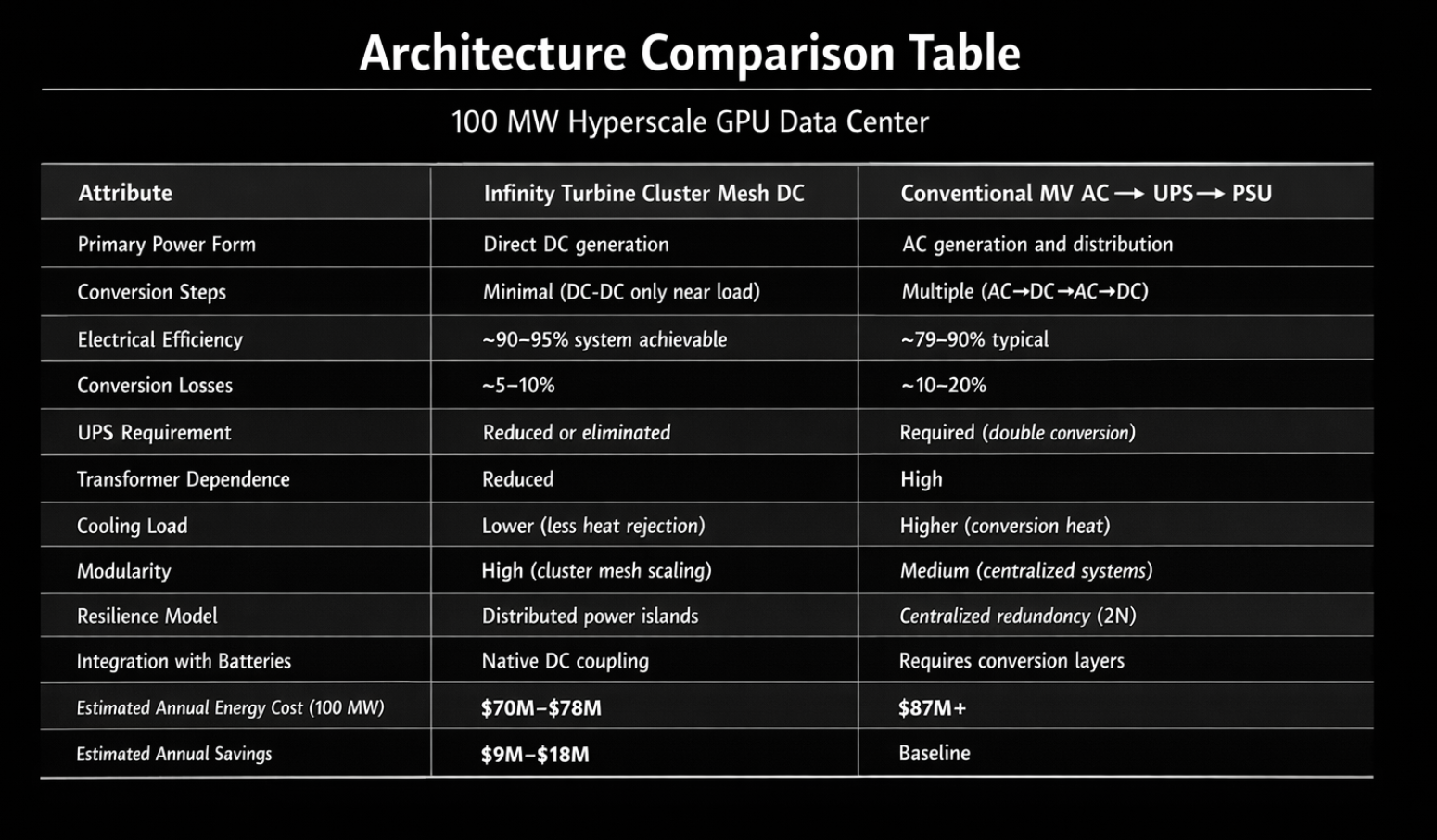
The Shift from AC to DC in AI Data Centers AI data centers are pushing electrical infrastructure to its limits. The traditional AC power chain is no longer optimal for GPU-driven workloads. A DC-native architecture using Infinity Turbine’s Cluster Mesh system offers a path to higher efficiency, lower costs, and scalable modular power—potentially saving tens of millions per year at hyperscale.The Shift from AC to DC in AI Data CentersModern hyperscale data centers—especially those designed for AI and GPU workloads—are fundamentally DC environments. Every GPU ultimately operates on low-voltage DC, yet most facilities still rely on a legacy AC distribution chain that introduces multiple conversion stages and associated losses.A typical AC architecture includes:Utility AC → Medium Voltage Distribution → Transformer → UPS (AC→DC→AC) → PDU → Server PSU (AC→DC) → Voltage RegulatorsEach step introduces inefficiencies. In fact:• Electrical distribution losses alone can account for 10–12% of total energy consumption ([ENERGY STAR][1])• Total conversion chains can result in ~12% energy lost as heat ([Reuters][2])• End-to-end efficiency in some systems can drop to ~79% ([Eaton][3])This lost energy is paid for twice: once as wasted electricity and again as additional cooling load.Infinity Turbine Cluster Mesh as a DC Power SourceThe Infinity Turbine Cluster Mesh system introduces a fundamentally different architecture:Direct DC generation at the source, using modular supercritical CO2 turbine systems or equivalent thermal-to-electric conversion.Instead of producing AC and converting it repeatedly, the system delivers DC directly into a shared bus or localized power island.Core ArchitectureCluster Mesh DC Power Flow:• Thermal input (waste heat, natural gas, solar thermal)• Cluster Mesh turbine modules• Direct DC output (high-voltage DC bus)• Battery or DC buffer integration• Rack-level DC-DC conversion• GPU chipset voltage regulationThis approach eliminates multiple conversion steps and aligns power delivery with the actual needs of AI hardware.Why DC Architecture Is Gaining MomentumRecent industry developments confirm this shift. High-voltage DC (such as 800 VDC systems) is emerging as a preferred architecture because it:• Reduces conversion stages• Improves efficiency by 8–12%• Lowers infrastructure complexity and cooling demand ([TechRadar][4])This aligns directly with the Cluster Mesh concept: modular, distributed, DC-native generation close to the load.Efficiency Gains and Loss ReductionConventional AC System Loss BreakdownTypical losses include:• UPS inefficiency: 6–10% loss ([CSE Magazine][5])• PSU conversion: 5–20% loss ([Semiconductor Engineering][6])• PDU and transformer losses: 2–3% ([ENERGY STAR][7])Combined system-level losses can easily exceed 10–15% before power even reaches the GPU silicon.DC Cluster Mesh AdvantageBy eliminating or reducing:• Double-conversion UPS• Multiple AC/DC transitions• Transformer stagesA Cluster Mesh DC architecture can realistically recover:8% to 15% of total electrical energyAdditionally, reduced heat generation lowers cooling demand, amplifying total system savings.Even a 10% efficiency gain at the electrical layer can translate into ~10% total facility energy savings due to reduced HVAC load ([Data Center Efficiency][8])100 MW Data Center Savings AnalysisBaseline Assumptions• Facility size: 100 MW• Annual operation: 24/7• Annual energy use: 100 MW × 24 × 365 = 876,000 MWh/year• Electricity cost: $0.10/kWhAnnual Energy Cost876,000,000 kWh × $0.10 = $87.6 million/yearScenario 1: Conservative Savings (8%)Energy saved:876,000,000 × 0.08 = 70,080,000 kWhAnnual savings:= $7.0 million/yearScenario 2: Moderate Savings (12%)Energy saved:= 105,120,000 kWhAnnual savings:= $10.5 million/yearScenario 3: Aggressive Optimization (15%)Energy saved:= 131,400,000 kWhAnnual savings:= $13.1 million/yearSecondary Savings (Cooling Reduction)Because lost electrical energy becomes heat:• Cooling load decreases proportionally• Cooling typically represents 40–54% of total power use ([Nlyte][9])This can add another:• $2M–$5M/year in avoided cooling costsTotal Estimated Savings| Scenario | Electrical Savings | Cooling Savings | Total Annual Savings || Conservative | $7M | $2M | $9M/year || Moderate | $10.5M | $3.5M | $14M/year || Aggressive | $13.1M | $5M | $18M+/year |Strategic Advantages for Hyperscale Operators1. Alignment with GPU Power ArchitectureGPUs operate on DC. A DC-native facility removes unnecessary electrical translation layers.2. Modular Power ScalingCluster Mesh allows incremental deployment of generation aligned with compute growth.3. Improved Power Usage Effectiveness (PUE)Reducing electrical losses directly improves PUE, which approaches 1.0 in optimized systems. ([Wikipedia][10])4. Reduced Infrastructure Footprint• Fewer transformers• Smaller UPS systems• Lower switchgear complexity5. Enhanced Integration with Energy StorageDC architecture seamlessly integrates with:• Battery systems• Saltwater flow batteries (e.g., Salgenx)• Renewable sourcesEngineering ConsiderationsWhile the advantages are substantial, implementation requires:• High-voltage DC distribution (to avoid excessive current)• Advanced DC protection systems (arc mitigation, fast disconnects)• Rack-level DC-DC conversion standardization• Hybrid AC/DC interface for grid interconnectionConclusionThe transition from AC-centric to DC-native data center architecture is not theoretical—it is already underway.Infinity Turbine’s Cluster Mesh power generation system aligns directly with this evolution by:• Generating DC at the source• Eliminating redundant conversion stages• Enabling modular, distributed power architecturesFor a 100 MW hyperscale AI data center, the financial impact is substantial:$9 million to $18+ million per year in savings, with additional gains in scalability, efficiency, and resilience.As GPU density continues to rise and energy becomes the dominant operating cost, DC-native power architectures—especially those paired with localized generation like Cluster Mesh—will likely define the next generation of hyperscale infrastructure.[1]: https://www.energystar.gov/products/data_center_equipment/16-more-ways-cut-energy-waste-data-center/reduce-energy-losses-uninterruptible-power-supply-ups-systems Reduce Energy Loss from Uninterruptible Power Supply ...[2]: https://www.reuters.com/technology/onsemi-aims-improve-ai-power-efficiency-with-silicon-carbide-chips-2024-06-05/ Onsemi aims to improve AI power efficiency with silicon carbide chips[3]: https://www.eaton.com/content/dam/eaton/markets/healthcare/knowledge-center/white-paper/is-an-energy-wasting-data-center-draining-your-bottom-line.pdf Is an energy wasting data center draining your bottom line?[4]: https://www.techradar.com/pro/why-800vdc-is-the-emergent-electrical-backbone-of-next-generation-data-centers Why 800VDC is the emergent electrical backbone of next-generation data centers[5]: https://www.csemag.com/evaluating-ups-system-efficiency/ Evaluating UPS system efficiency[6]: https://semiengineering.com/power-delivery-challenged-by-data-center-architectures/ Power Delivery Challenged By Data Center Architectures[7]: https://www.energystar.gov/products/data_center_equipment/16-more-ways-cut-energy-waste-data-center/reduce-energy-losses-power-distribution-units-pdus Reduce Energy Losses from Power Distribution Units (PDUs)[8]: https://datacenters.lbl.gov/direct-current-dc-power Direct Current (DC) Power • Data Center[9]: https://www.nlyte.com/blog/data-center-rack-power-costs-a-condensed-analysis/ Data Center Rack Power Costs: A Condensed Analysis[10]: https://en.wikipedia.org/wiki/Power_usage_effectiveness Power usage effectiveness |
|
|
Cluster Mesh Supercritical CO₂ Power Systems A Replacement Architecture for Gas Turbine Power in Data Centers Executive SummaryHyperscale data centers are entering a new era where power density, efficiency, deployment speed, and environmental constraints are converging. Conventional air-breathing gas turbine generators—while proven—introduce limitations in efficiency, noise, footprint, and thermal integration.The Cluster Mesh Supercritical CO₂ (sCO₂) power system represents a next-generation alternative:• Higher thermodynamic efficiency potential• Compact, modular architecture• Closed-loop operation (no air intake/exhaust noise)• Native integration with heat recovery and cooling systemsThis paper demonstrates how a closed-loop sCO₂ cluster mesh system can replace traditional gas turbines for data center power generation.1. Conventional Gas Turbine Limitations in Data CentersAir-breathing gas turbines (Brayton cycle with air) are widely used but present structural constraints:Key Limitations1. Efficiency Ceiling• Typical simple-cycle gas turbine: ~30–40% efficiency• Combined cycle improves this but adds complexity and footprint2. Noise Profile• High acoustic output due to:• air intake compression• combustion turbulence• high-velocity exhaust• Requires:• large silencers• acoustic enclosures• setback distances3. Open Loop Dependency• Requires continuous air intake and exhaust• Performance impacted by:• ambient temperature• altitude• air quality4. Large Physical Footprint• Turbine + intake + exhaust + HRSG systems• Not modular at rack-level or container-scale2. Supercritical CO₂ Cluster Mesh ArchitectureCore ConceptA closed-loop Brayton cycle using supercritical CO₂ replaces air with a dense, high-efficiency working fluid.Key properties of CO₂:• Critical point: ~31°C, 7.38 MPa• Near-critical region → low compression work• High density → compact turbomachinery Result: higher efficiency with smaller equipment3. Thermodynamic Efficiency AdvantageEfficiency ComparisonSimple gas turbine 30–40% Combined cycle gas turbine 50–60% sCO₂ Brayton cycle 45–50%+ (potential >50%) • sCO₂ cycles can reach ~45% efficiency at ~550°C • Advanced systems target >50% efficiency • Efficiency improvements vs conventional cycles:• +5% to +10% absolute gains Why sCO₂ is More Efficient1. Reduced compression work• Near-critical CO₂ behaves like a dense fluid• Requires less energy to compress 2. High recuperation efficiency• Closed loop allows internal heat reuse3. Single-phase cycle• No phase change losses (unlike steam systems)4. Power Density and Modular ScalingsCO₂ systems are:• Up to 10× smaller than conventional systems • High power density due to fluid density• Scalable via cluster mesh topologyCluster Mesh AdvantageInstead of:• One large turbineYou deploy:• Many small (e.g., 25–100 kW) turbines in parallelBenefits:• Redundancy• Load following• Rack-level integration available5. Closed-Loop CO₂ vs Open Air-Breathing TurbineStructural DifferenceGas Turbine • Working fluid Air (open loop - with noise)• Intake and exhaust required• Noise (very high)• Environmental sensitivity High sCO₂ Cluster Mesh • Working fluid CO₂ (closed loop)• Intake and exhaust (none - however natural gas burner will require input air)• Noise (very low)• Environmental sensitivity Low 6. Noise Advantage (Critical for Data Centers)Gas Turbine Noise Sources• Compressor stages• Combustion chamber• Exhaust plumeTypical outcomes:• Requires sound attenuation infrastructure• Limits placement near urban or campus data centerssCO₂ Closed Loop Noise ProfileCluster Mesh CO₂ systems:• No intake air• No exhaust plume• Fully enclosed pressure loop Result:• Near-silent operation• Only mechanical noise from:• bearingsThis is a major advantage for hyperscale and edge deployments.7. Cooling and Thermal IntegrationA major advantage for data centers:Gas Turbine:• Waste heat is external• Requires separate cooling systemssCO₂ Cluster Mesh:• Heat is already in a closed thermodynamic loop• Enables:• direct heat recovery• ejector or absorption cooling• pressure-drop cooling integration8. Fuel Flexibility and Heat Source IndependencesCO₂ systems are:• Heat-source agnostic • Compatible with:• natural gas• hydrogen• waste heat• nuclear (SMR)• solar thermalThis allows:• hybrid power architectures• integration with future energy systems9. Reliability and MaintenanceGas Turbine• High-temperature combustion• Blade wear• Air contamination issues• Inlet air cooling required for high ambient temperaturessCO₂ System• Closed loop:• no particulate ingestion• reduced oxidation• Fewer moving partsPotential:• Lower maintenance• Higher uptime10. Deployment Model for Data CentersTraditional• Centralized generation• High-voltage distribution• UPS → PSU conversion chainCluster Mesh Model• Distributed generation:• rack-level or row-level• Direct DC integration (optional)• Integrated cooling + power11. Economic ImplicationsKey Cost Advantages• Higher efficiency → lower fuel cost• Smaller footprint → reduced CAPEX• Reduced cooling load → lower OPEX• Modular scaling → faster deployment12. Strategic Implications for HyperscalersThe transition from gas turbines to sCO₂ cluster mesh systems enables:• On-site generation without noise constraints• Integration with AI data center thermal loads• Reduced dependence on grid infrastructure• Future compatibility with SMRs and waste heat• Reduced regulatory and community resistanceConclusionThe Cluster Mesh Supercritical CO₂ power system represents a fundamental shift in data center power architecture:• Higher efficiency• Smaller, modular systems• Near-zero acoustic footprint• Closed-loop reliability• Integrated thermal managementWhile gas turbines remain dominant today, their open-loop, high-noise, and large-footprint limitations make them increasingly incompatible with next-generation data center requirements.The closed-loop sCO₂ cluster mesh system is not just an alternative—it is a native architecture for future AI-scale data centers. |
| CONTACT Email: greg@infinityturbine.com | AMP | PDF |