
INFINITY TURBINE LLC We specialize in designs, plans, licensing, consulting, design services, and surplus spare parts. We no longer manufacture turbines or CO2 systems. More Info...
Please email for first contact with request for more information
Email: greg@infinityturbine.com
Infinity Turbine CO2 Turbine Development and Testing Cart Supercritical CO2 Turbine Development Cart using high pressure filter canisters for rapid prototyping and commercialization for 1-25 kWh Power Generation... More Info
ORC and sCO2 Performance Charts: R134a, R245fa, CO2 – 2026 Edition Updated 2026 edition of Infinity Turbine’s ORC and supercritical CO2 performance curves: R134a, R245fa and CO2 charts, CO2 heat-rate tables from 100 to 700 °C, sCO2 turbine types, and data-center applications. 62-page PDF... More Info
Supercritical CO2 Turbine Generator Plans (Transcritical) Rankine Cycle Lab format for development ... More Info
Matra Concentrated Solar Project Using Infinity Turbine Generator for Power Production Solar thermal power production using a reflective dish concentrator... More Info
Cluster Mesh Supercritical CO2 Power System for Data Centers and AI Pairing Cluster Mesh Supercritical CO2 Power System with Small Modular Reactors enables hyperscalers to convert high-grade nuclear heat into ultra-efficient, dispatchable power with a compact, modular footprint tailored for AI-scale demand. More Info
ORC and Products Index Infinity Turbine ORC Index... More Info
A Generator Without Magnets Switched Reluctance is the simplest rotating electrical machine there is: a rotor of stacked steel laminations with salient teeth, and a stator carrying concentrated coils. The rotor has no magnets, no windings, no bars and no slip rings... More Info
|
|
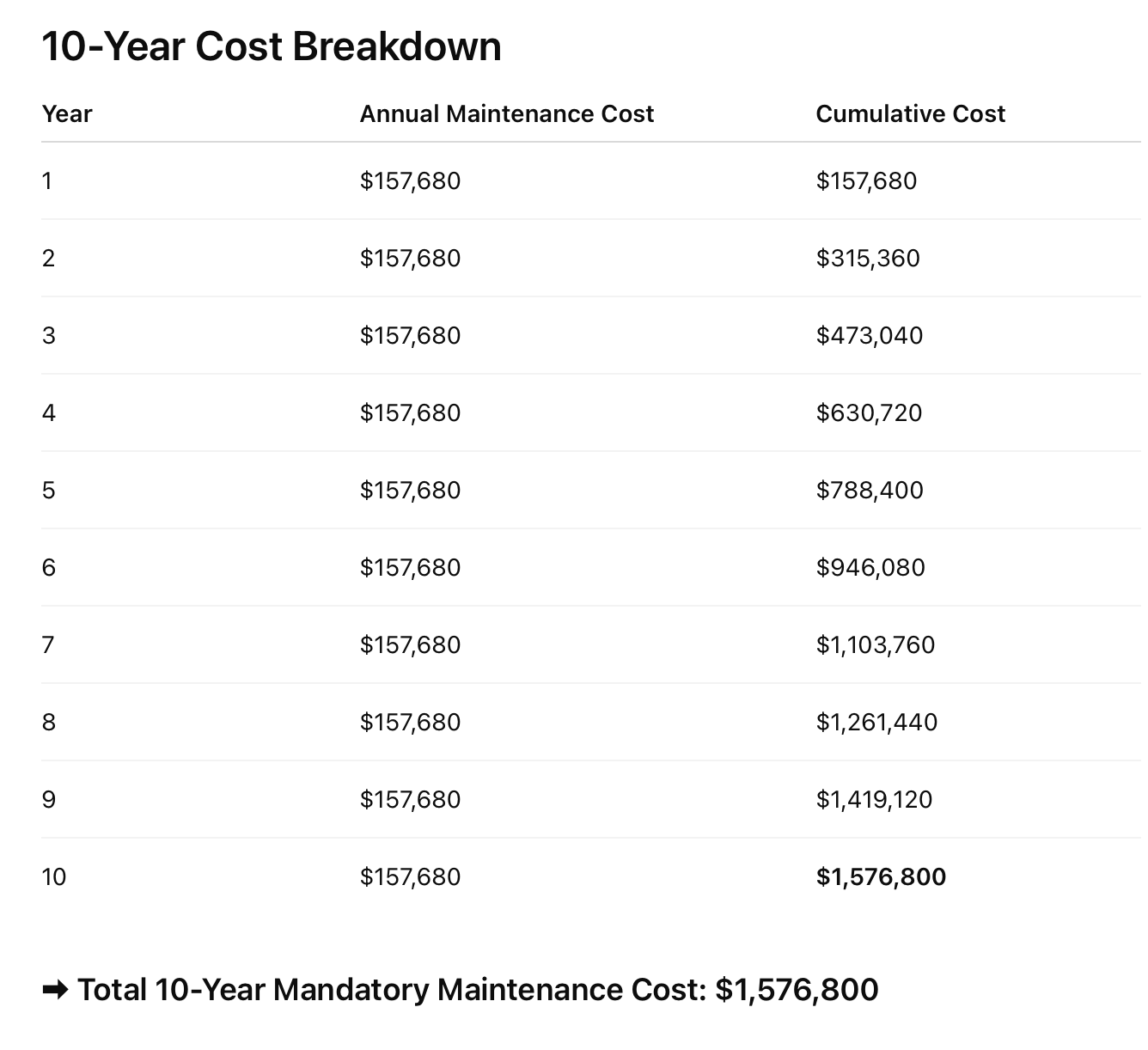
10-Year Financial Impact of Capstone C1000 Forced Maintenance Contracts Understanding the 10-Year Cost of Capstone C1000 Forced Maintenance ContractsThe Capstone C1000 microturbine produces 1,000 kW continuously and has earned a reputation for reliability. However, its business model requires every owner to enter a mandatory maintenance contract priced using the formula 0.018 × 365 × 1000 × 24, resulting in a recurring annual fee of $157,680. Many competing systems do not impose this requirement, giving them a financial advantage before any energy is produced.Over a 10-year lifecycle, the total paid under this contract reaches $1,576,800. When applying a standard energy-industry discount rate of 5 percent, the present value of these payments is approximately $1.22 million. This represents the real economic burden borne by the owner. If the same annual funds were reinvested at 5 percent instead of being paid out, the future value would exceed $2.03 million. These figures clearly show that the forced maintenance structure substantially increases lifetime ownership costs.Beyond the direct expense, there are additional intangible losses. The mandatory service contract eliminates the ability to choose third-party maintenance providers, raises the effective levelized cost of energy, and reduces operational flexibility. In contrast, systems that allow customers to self-service or select independent technicians avoid these financial penalties and deliver materially stronger long-term value.Understanding these cost dynamics is essential when comparing energy technologies. While the Capstone C1000 performs reliably, its service-contract business model imposes a significant economic burden that should be carefully evaluated by buyers and investors. |
|
Capstone C1000 Annual Maintenance Cost Analysis Capstone C1000 Annual Maintenance Cost AnalysisAnnual Maintenance Charge FormulaCapstone’s forced maintenance contract cost is calculated as:Cost = 0.018 × 365 × 1,000 × 24Let’s compute it:• 365 × 1,000 × 24 = 8,760,000• 0.018 × 8,760,000 = $157,680 per yearSo the annual mandatory maintenance cost for the Capstone C1000 is: ➡ Annual Cost: $157,680 per year--- 10-Year Cost Breakdown| Year | Annual Maintenance Cost | Cumulative Cost || ---- | ----------------------- | --------------- || 1 | $157,680 | $157,680 || 2 | $157,680 | $315,360 || 3 | $157,680 | $473,040 || 4 | $157,680 | $630,720 || 5 | $157,680 | $788,400 || 6 | $157,680 | $946,080 || 7 | $157,680 | $1,103,760 || 8 | $157,680 | $1,261,440 || 9 | $157,680 | $1,419,120 || 10 | $157,680 | $1,576,800 |Total 10-Year Mandatory Maintenance Cost: $1,576,800 Financial Impact Analysis 1. Present Value (PV) of 10 Years of PaymentsAssume a discount rate of 5%, typical for energy-finance analysis.PV of an annuity:PV = P × [(1 − (1+r)^−n) / r]Where:P = 157,680r = 0.05n = 10PV ≈ $1,218,500 MeaningA competitor that does not require a forced contract is effectively saving the customer $1.22 million in today’s dollars. 2. Future Value (FV) of the PaymentsUsing 5% annual compounding:FV = P × [((1+r)^n − 1) / r]FV ≈ $2,034,100MeaningIf that same annual cost were retained and reinvested at 5%, the customer would have $2.03 million instead of giving it to Capstone.Other Hidden Costs of This Forced Contract1. Lost Opportunity CostFunds could be invested in:• Additional generation assets• Energy storage• Grid-offsetting technologies• Efficiency improvementsThese all produce yield or savings, meaning the real cost is even higher.2. Reduced Operational FlexibilityCustomers lose:• Ability to self-service• Ability to use third-party service vendors• Ability to negotiate maintenance pricingThis limits total cost control.3. Increased Levelized Cost of Energy (LCOE)Adding $157,680/year increases:• LCOE of the power produced• Total cost per kWh• Payback period & ROI for the turbine projectThis makes the Capstone C1000 less competitive than systems without forced-maintenance pricing.Final SummaryOver a 10-year period, the Capstone C1000 forced maintenance program costs:• $1,576,800 total paid• $1,218,500 present value loss• $2,034,100 future value lossSystems that do not require these mandatory contracts provide customers with over $2 million in lifetime economic advantage. |
| CONTACT Email: greg@infinityturbine.com | AMP | PDF |