
INFINITY TURBINE LLC We specialize in designs, plans, licensing, consulting, design services, and surplus spare parts. We no longer manufacture turbines or CO2 systems. More Info...
Please email for first contact with request for more information
Email: greg@infinityturbine.com
CO2 Ejectors for Data Center Waste Heat Cooling: A Technical Review Hyperscalers are racing to deploy gigawatts of AI compute, but the grid can't keep up and large gas turbines are backordered half a decade out. Infinity Turbine's Cluster Mesh Supercritical CO₂ system offers a radical alternative: modular, silent, trailer-deployable prime power that scales the way software does... More Info
From the Feher Cycle to the Cluster Mesh: A History of Supercritical CO₂ Power... More Info
Cooling a Data Center Pod with Its Own Waste Heat: A 100 kW Ejector Design Study More Info
Portable Gas Turbine Prime Power More Info
Cluster Mesh Supercritical CO2 Power System for Data Centers and AI Pairing Cluster Mesh Supercritical CO2 Power System with Small Modular Reactors enables hyperscalers to convert high-grade nuclear heat into ultra-efficient, dispatchable power with a compact, modular footprint tailored for AI-scale demand. More Info
ORC and Products Index Infinity Turbine ORC Index... More Info
AMD Helios Cooling Strategy Using Transcritical CO2 and a Cluster Mesh sCO2 Turbine Generator Cell More Info
Zeolites Review Article |

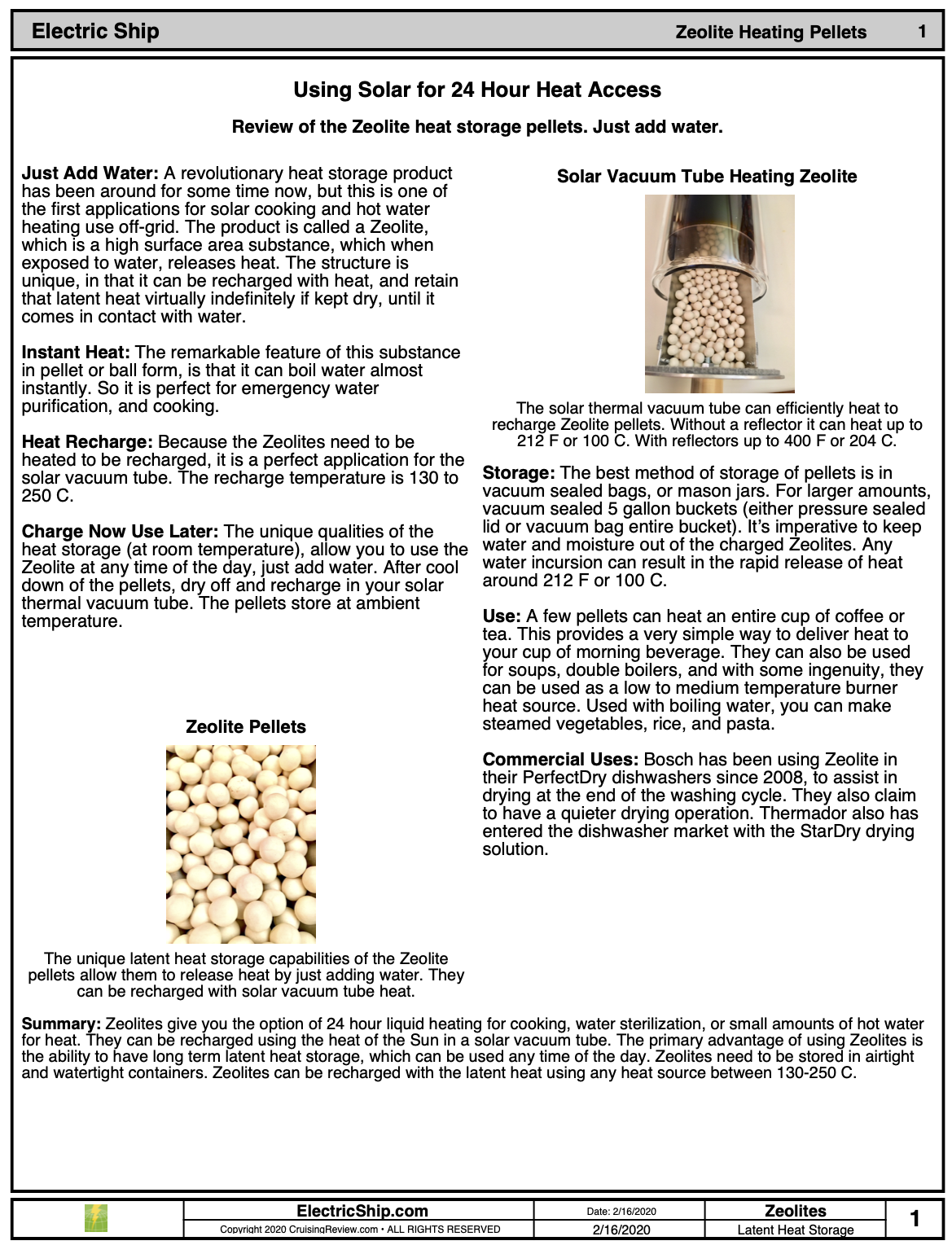
The unique latent heat storage capabilities of the Zeolite pellets allow them to release heat by just adding water. They can be recharged with solar vacuum tube heat. |
Review of the Zeolite heat storage pellets. Just Add Water: A revolutionary heat storage product has been around for some time now, but this is one of the first applications for solar cooking and hot water heating use off-grid. The product is called a Zeolite, which is a high surface area substance, which when exposed to water, releases heat. The structure is unique, in that it can be recharged with heat, and retain that latent heat virtually indefinitely if kept dry, until it comes in contact with water. Instant Heat: The remarkable feature of this substance in pellet or ball form, is that it can boil water almost instantly. So it is perfect for emergency water purification, and cooking. Heat Recharge: Because the Zeolites need to be heated to be recharged, it is a perfect application for the solar vacuum tube. The recharge temperature is 130 to 250 C.Charge Now Use Later: The unique qualities of the heat storage (at room temperature), allow you to use the Zeolite at any time of the day, just add water. After cool down of the pellets, dry off and recharge in your solar thermal vacuum tube. The pellets store at ambient temperature.
|

The solar thermal vacuum tube can efficiently heat to recharge Zeolite pellets. Without a reflector it can heat up to 212 F or 100 C. With reflectors up to 400 F or 204 C. |
Storage: The best method of storage of pellets is in vacuum sealed bags, or mason jars. For larger amounts, vacuum sealed 5 gallon buckets (either pressure sealed lid or vacuum bag entire bucket). It’s imperative to keep water and moisture out of the charged Zeolites. Any water incursion can result in the rapid release of heat around 212 F or 100 C.
|

The solar vacuum tube can efficiently heat to recharge Zeolite pellets. Without a reflector it can heat up to 212 F or 100 C. With reflectors up to 400 F or 204 C. |
Commercial Uses: Bosch has been using Zeolite in their PerfectDry dishwashers since 2008, to assist in drying at the end of the washing cycle. They also claim to have a quieter drying operation. Thermador also has entered the dishwasher market with the StarDry drying solution.
|
|
Zeolites give you the option of 24 hour liquid heating for cooking, water sterilization, or small amounts of hot water for heat. |
Summary: Zeolites give you the option of 24 hour liquid heating for cooking, water sterilization, or small amounts of hot water for heat. They can be recharged using the heat of the Sun in a solar vacuum tube. The primary advantage of using Zeolites is the ability to have long term latent heat storage, which can be used any time of the day. Zeolites need to be stored in airtight and watertight containers. Zeolites can be recharged with the latent heat using any heat source between 130-250 C.
|
|
Pioneering Renewable Energy Storage: Saltgenx Sand Battery Revolution In the quest for sustainable and renewable energy solutions, Saltgenx, a division of Infinity Turbine, is making significant strides with an innovative approach to energy storage and utilization. The development of a sand battery represents a groundbreaking leap in thermal (heat) storage technology, leveraging the abundant and eco-friendly material of sand to store heat generated from various sources, including solar thermal energy, renewable sources, waste heat, or flare gas from oil fields.How It WorksAt the heart of Saltgenxs technology is an insulated tank filled with sand. This tank acts as a repository for heat, which is captured from different heat sources and then stored in the sand. The fundamental principle behind this is quite straightforward yet profoundly effective: sands inherent ability to retain heat for extended periods makes it an ideal medium for thermal storage.Multifaceted ApplicationsThe applications of Saltgenxs sand battery technology are as diverse as they are revolutionary, ranging from desalination to power generation. Heres a closer look at these innovative uses:1. Desalination: In regions where fresh water is scarce, Saltgenxs sand battery offers a sustainable solution by using stored heat to vaporize saltwater. The process involves spraying saltwater onto the hot sand, where it vaporizes. The vapor is then condensed into fresh water, with the incoming saltwater cooling the exiting vapor through a heat exchanger. This method promises an efficient and renewable way to produce fresh water.2. Graphene Sand for Construction: The sand battery technology also paves the way for advancements in construction materials. By heating sand with simple sugar or other carbonaceous materials and activated carbon (charcoal) to around 700°C, graphene-coated sand can be produced. This graphene sand can then be mixed with cement to create a stronger, more durable form of concrete suitable for construction and 3D printing. Saltgenx is also developing a continuous kiln process for this purpose, which could revolutionize the construction industry by providing a stronger, more sustainable alternative to traditional materials.3. Producer Water Treatment: The oil and gas industry often deals with producer water, a byproduct of drilling operations. Saltgenxs sand battery can utilize flare gas—a waste product often burned off due to lack of storage or pipeline access—to heat sand and evaporate this water. The condensed water is purified, while contaminants are trapped in the sand, which can then be safely disposed of. This process not only recycles waste heat but also addresses the environmental issue of water contamination.4. ORC Power Generation: Another application of the stored heat in the sand battery is in generating power through the Organic Rankine Cycle (ORC). By circulating thermal oil through a simple pipe heat exchanger within the heated sand, the thermal oil becomes a heat source for powering an ORC turbine generator. This method can produce electrical power, hydraulic power, or other mechanical outputs, offering a renewable way to generate power from stored heat.A Sustainable FutureSaltgenxs sand battery technology stands as a testament to the potential of innovative thinking in addressing some of the most pressing environmental and energy challenges of our time. By harnessing the power of sand to store and utilize heat from renewable and waste sources, Saltgenx is not only contributing to the global energy transition but also paving the way for new methods of water purification, construction, and power generation. As this technology continues to develop and find new applications, it holds the promise of a more sustainable and energy-efficient world. |
|
zeolite heat storage and retrieval |
Using Solar for 24 Hour Heat Access. Just add water. Zeolites give you the option of 24 hour liquid heating for cooking, water sterilization, or small amounts of hot water for heat. They can be recharged using the heat of the Sun in a solar vacuum tube. The primary advantage of using Zeolites is the ability to have long term latent heat storage, which can be used any time of the day. Zeolites need to be stored in airtight and watertight containers. Zeolites can be recharged with the latent heat using any heat source between 130-250 C. Zeolites (pdf) |
| CONTACT Email: greg@infinityturbine.com | AMP | PDF |