
INFINITY TURBINE LLC We specialize in designs, plans, licensing, consulting, design services, and surplus spare parts. We no longer manufacture turbines or CO2 systems. More Info...
Please email for first contact with request for more information
Email: greg@infinityturbine.com
CO2 Ejectors for Data Center Waste Heat Cooling: A Technical Review Hyperscalers are racing to deploy gigawatts of AI compute, but the grid can't keep up and large gas turbines are backordered half a decade out. Infinity Turbine's Cluster Mesh Supercritical CO₂ system offers a radical alternative: modular, silent, trailer-deployable prime power that scales the way software does... More Info
From the Feher Cycle to the Cluster Mesh: A History of Supercritical CO₂ Power... More Info
Cooling a Data Center Pod with Its Own Waste Heat: A 100 kW Ejector Design Study More Info
Portable Gas Turbine Prime Power More Info
Cluster Mesh Supercritical CO2 Power System for Data Centers and AI Pairing Cluster Mesh Supercritical CO2 Power System with Small Modular Reactors enables hyperscalers to convert high-grade nuclear heat into ultra-efficient, dispatchable power with a compact, modular footprint tailored for AI-scale demand. More Info
ORC and Products Index Infinity Turbine ORC Index... More Info
AMD Helios Cooling Strategy Using Transcritical CO2 and a Cluster Mesh sCO2 Turbine Generator Cell More Info
|
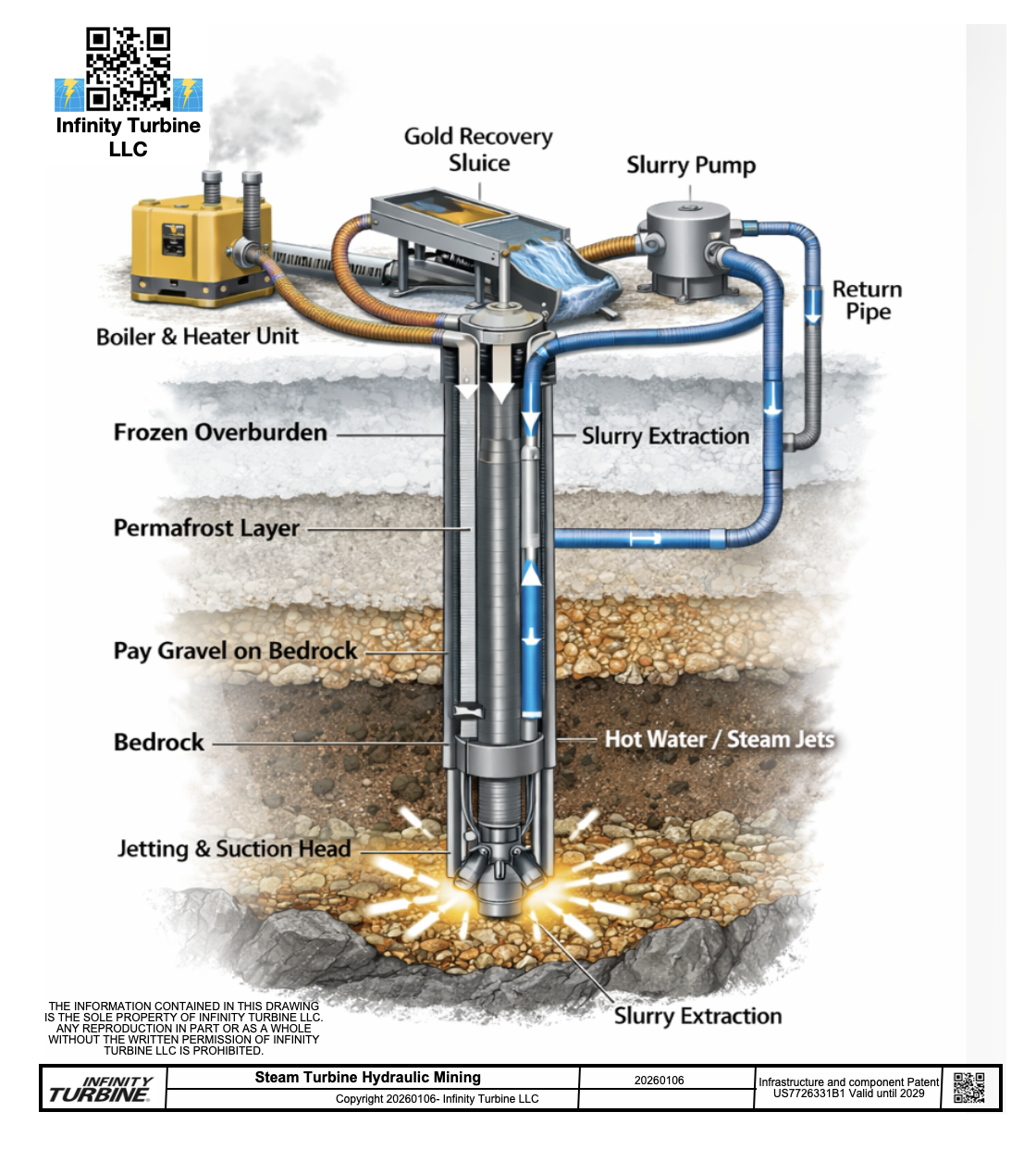
Winter Placer Gold Mining Using Borehole Hydraulic Jetting in Permafrost Placer gold mining in Alaska and the Yukon is traditionally limited to short summer seasons due to frozen ground and permafrost. This article examines a novel winter mining concept that uses drilled wells, hot water hydraulic jets, and closed loop slurry circulation to recover gold directly from bedrock while leaving frozen overburden in place.---IntroductionPlacer gold deposits in Alaska and the Yukon are commonly controlled by bedrock geometry, with the majority of recoverable gold concentrated in a thin zone at or immediately above bedrock. Conventional mining methods require large scale removal of frozen overburden, thawing of muck, and extensive material handling, all of which limit operations to a brief summer window.This article evaluates a winter mining concept that applies borehole hydraulic jetting to access bedrock pay zones through a drilled well. The approach uses hot water or steam to locally thaw and mobilize material at the bedrock interface, pumps the resulting slurry to surface gold recovery equipment, and reinjects the process water back into the well in a closed loop. The permafrost remains intact above the working zone, acting as a structural roof and eliminating the need for stripping.---Concept OverviewThe proposed system consists of the following core elements:A vertical well drilled through frozen overburden to bedrockSteel casing cemented through the permafrost intervalAn open or screened interval at the bedrock contactHigh pressure hydraulic jets delivering hot water or steam downwardA suction intake lifting slurry to surfaceSurface gold recovery equipmentA reheating and reinjection loopAt bedrock, the hot water jets disaggregate gravel, thaw ice cement, and wash gold from bedrock irregularities. The mobilized slurry is lifted through a return pipe to surface recovery equipment, after which the water is reheated and reinjected. Overburden remains frozen and undisturbed.---Geological ApplicabilityThis method is best suited to placer deposits with the following characteristics:Gold strongly concentrated on or within the top 10 to 60 centimeters of bedrockLimited large boulders at the bedrock interfaceModerate clay content that does not dominate slurry behaviorPay streaks that are laterally continuous and drill definedDeposits where gold is widely disseminated through thick gravel columns are poor candidates, as the system is optimized for selective bedrock mining rather than bulk excavation.---Engineering Design for a Go No Go PilotA pilot system must be engineered for control, recovery efficiency, and ground stability. A practical pilot configuration would include:Cased well to just above bedrock to prevent thaw migrationControlled open hole or screened interval limited to the pay zoneDownhole jet and suction assembly designed to work laterally along bedrockReverse circulation to control slurry velocityA downhole sump or trap to prevent coarse gold lossInstrumentation for pressure, temperature, flow rate, and slurry densitySurface systems should include:A classifier or grizzly to protect pumpsPrimary gold recovery such as a sluice with miner moss or rubber mattingSecondary fine gold recovery such as a centrifugal concentrator if warrantedHeat exchanger and boiler sized for continuous operation---Expected Production Rates for a Six Inch Diameter WellProduction rates depend on slurry velocity, solids concentration, and jet effectiveness. Reasonable engineering estimates for a six inch diameter return line are as follows:Internal diameter approximately 0.15 metersCross sectional area approximately 0.018 square metersAt conservative slurry velocities:At 1.5 meters per second flow rate is approximately 0.027 cubic meters per secondEquivalent to approximately 100 cubic meters per hour of slurryAssuming a solids content of 10 to 15 percent by volume:Effective material excavation rate of 10 to 15 cubic meters per hourEquivalent to approximately 13 to 20 cubic yards per hourAt higher velocities and optimized jetting, short term rates of 20 to 30 cubic yards per hour may be achievable, but wear, energy cost, and recovery efficiency increase rapidly beyond this range.These rates are comparable to small mechanized placer operations but achieved with minimal surface disturbance.---Energy ConsiderationsThe dominant energy load is thawing frozen gravel and maintaining slurry temperature. Key factors include:Latent heat required to melt ground iceHeat loss to surrounding permafrostPump power for slurry liftJet pressure requirementsWithout access to low cost fuel or waste heat, fuel consumption may exceed economic limits. A pilot must measure fuel per cubic yard processed as a primary viability metric.---Gold Recovery ConsiderationsGold recovery is the primary technical risk. Without deliberate engineering, coarse gold can settle in the wellbore or bedrock fractures, while fine gold may remain suspended and bypass recovery.Mitigation strategies include:Controlled slurry velocity matched to target particle sizesPeriodic downhole cleanout of the sumpSurface recovery systems designed for both coarse and fine goldRegular cleanups to track gold distribution by size fraction---Go No Go Pilot Test MatrixA pilot program should be structured to rapidly answer viability questions. The following test matrix is recommended:Material throughputCubic yards per hour at steady state operationEnergy efficiencyGallons of fuel or kilowatt hours per cubic yardGold recoveryPercent recovery by size fraction coarse medium fineGround stabilityEvidence of sloughing loss of returns or subsidenceEquipment wearPump nozzle and line wear rate per operating hourOperational reliabilityHours of continuous operation between shutdownsEnvironmental controlWater loss turbidity and containment performanceA go decision requires acceptable performance in all categories, not just gold recovery.---Overall AssessmentThe borehole hydraulic jetting concept represents a technically plausible approach to selective winter placer mining in permafrost regions. Its strongest advantage is eliminating large scale overburden removal while targeting the highest value portion of placer deposits.However, the method is deposit specific and engineering intensive. Gold recovery efficiency, hole stability, boulder management, and energy cost determine success. A carefully instrumented pilot program is essential before any commercial deployment.Used selectively in the right geological setting, this approach could extend placer mining into the winter season and materially reduce surface disturbance and material handling costs. |
|
| CONTACT Email: greg@infinityturbine.com | AMP | PDF |