
A two-stage supercritical CO₂ bucket turbine with a 58 kW high-speed permanent-magnet generator on the same shaft, sealed inside the CO₂ envelope. It turns about 480,000 BTU/h of heat at up to 650 °C into about 45 kW of gross 3-phase power, with no gearbox, no oil system and no shaft seal to atmosphere.
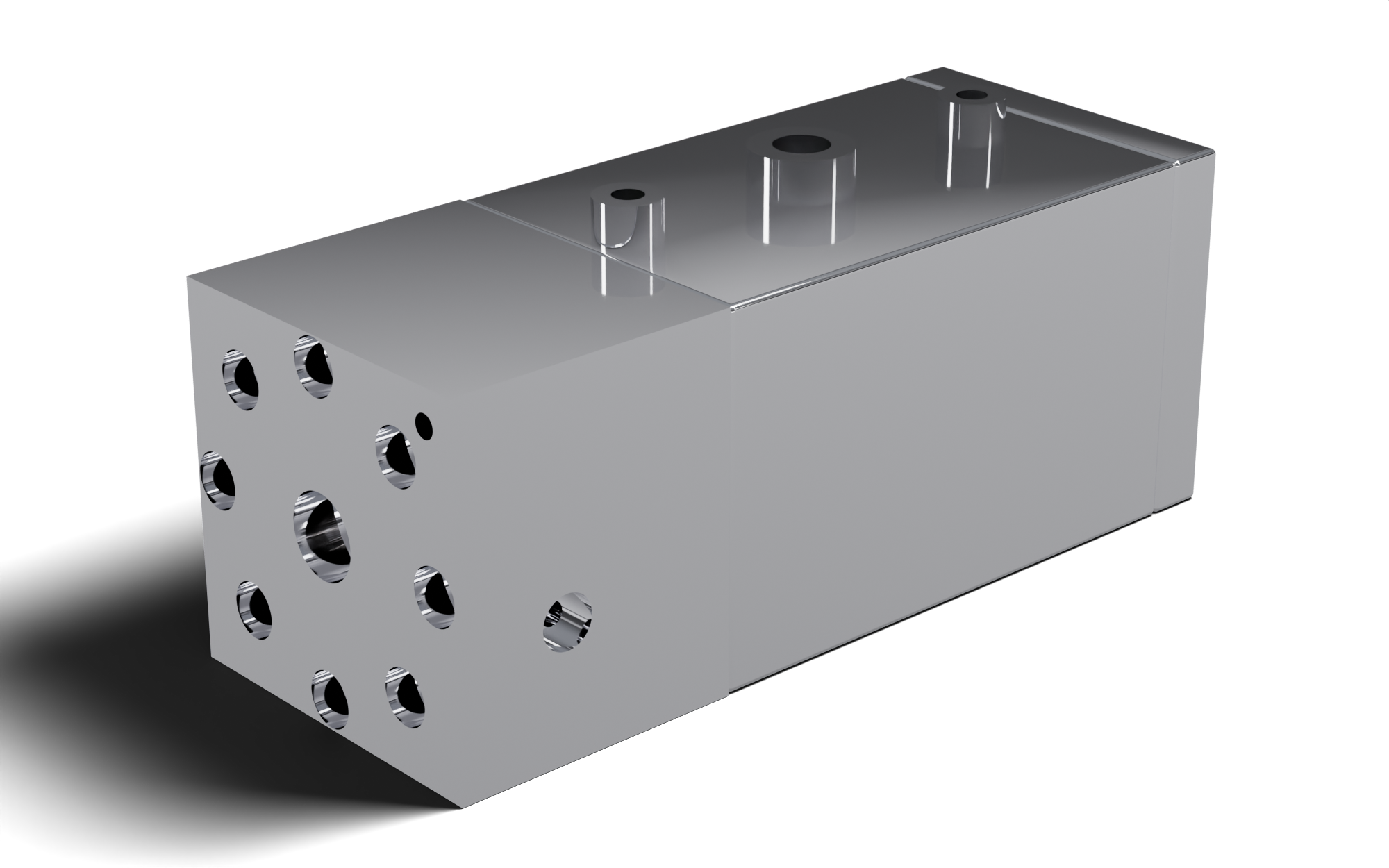
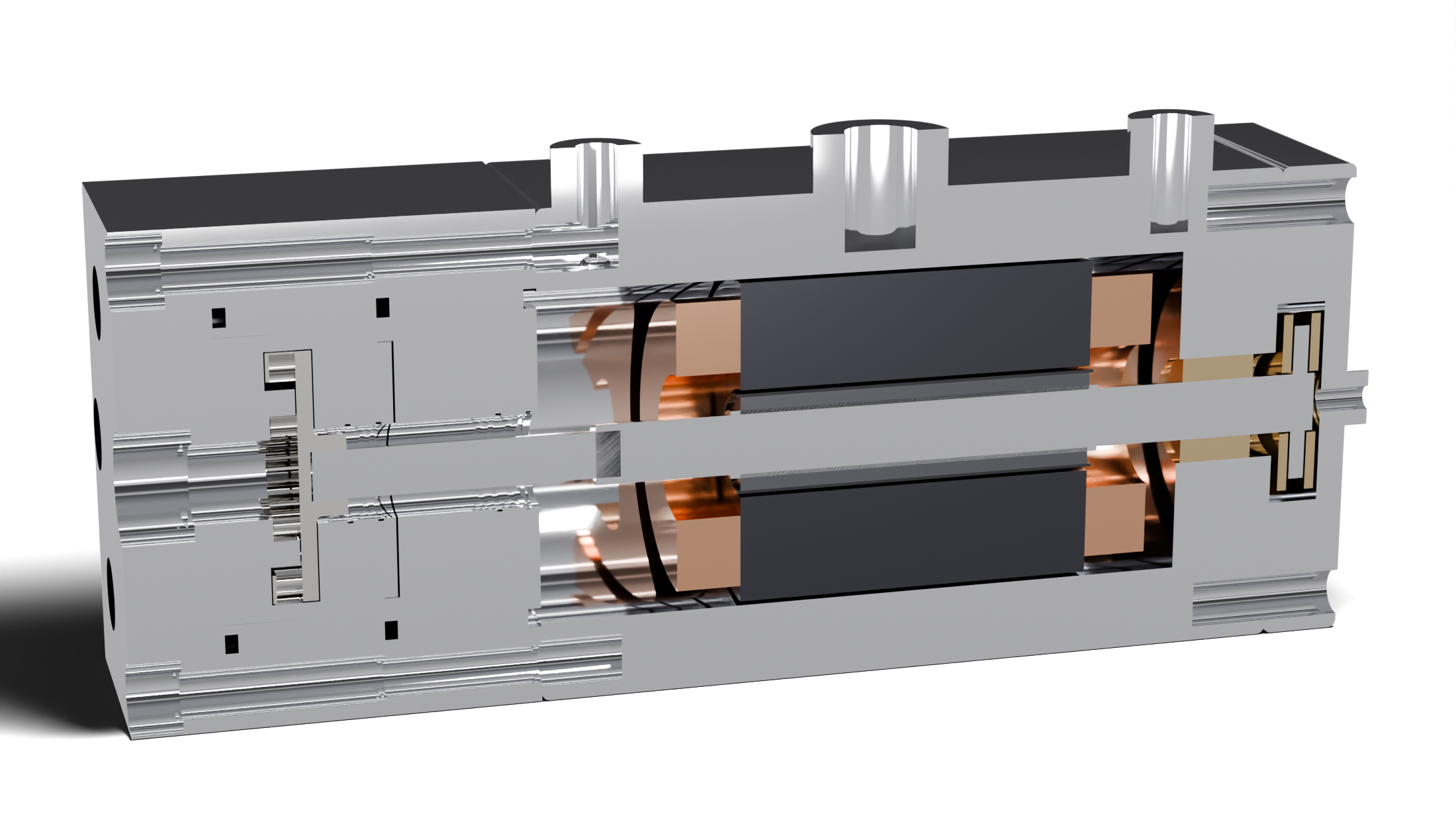
A turbine at over 40,000 rpm is only useful with a generator that can run at that speed. The CO2T-800 plans include the full high-speed generator package: the 58 kW generator specification ready to send out for quotes, its hermetic housing and rotor layout, and the bearing system. The generator sits directly on the turbine shaft, so there is no gearbox, no coupling and no seal to leak CO₂.
Choose the route that suits your shop, budget and schedule. All three cover the turbine and high-speed generator; the buyer supplies the power electronics and the balance of system.
An assembled CO2T-800 turbine and high-speed generator, ready to connect to your CO₂ loop and your own power electronics.
The major turbine and generator parts, machined and ready for you to assemble, balance and test.
The engineering package for building the CO2T-800 in volume, in your own plant or for your market.
Balance of system. The heat exchangers and other balance-of-system components cost more than the turbine-generator itself, typically several times more. These include the CO₂ heater or heat-recovery exchanger, recuperator, condenser and cooler, feed pump, piping, valves, controls and power electronics. Budget for them separately.
The CO2T-800 is designed for volume and for metals that can be bought anywhere. With a 650 °C limit, the casing is stainless steel (316H / 347H), the rotor and shaft are A286 iron-based alloy, and the generator is a frameless kit from the high-speed motor supply chain. No cast nickel superalloys or Inconel casings are needed. As volume rises from 1,000 to 10,000 units a year, the estimated cost of the turbine and generator falls from about $8,400 to about $6,100, or from $187 to $136 per kW of gross output.
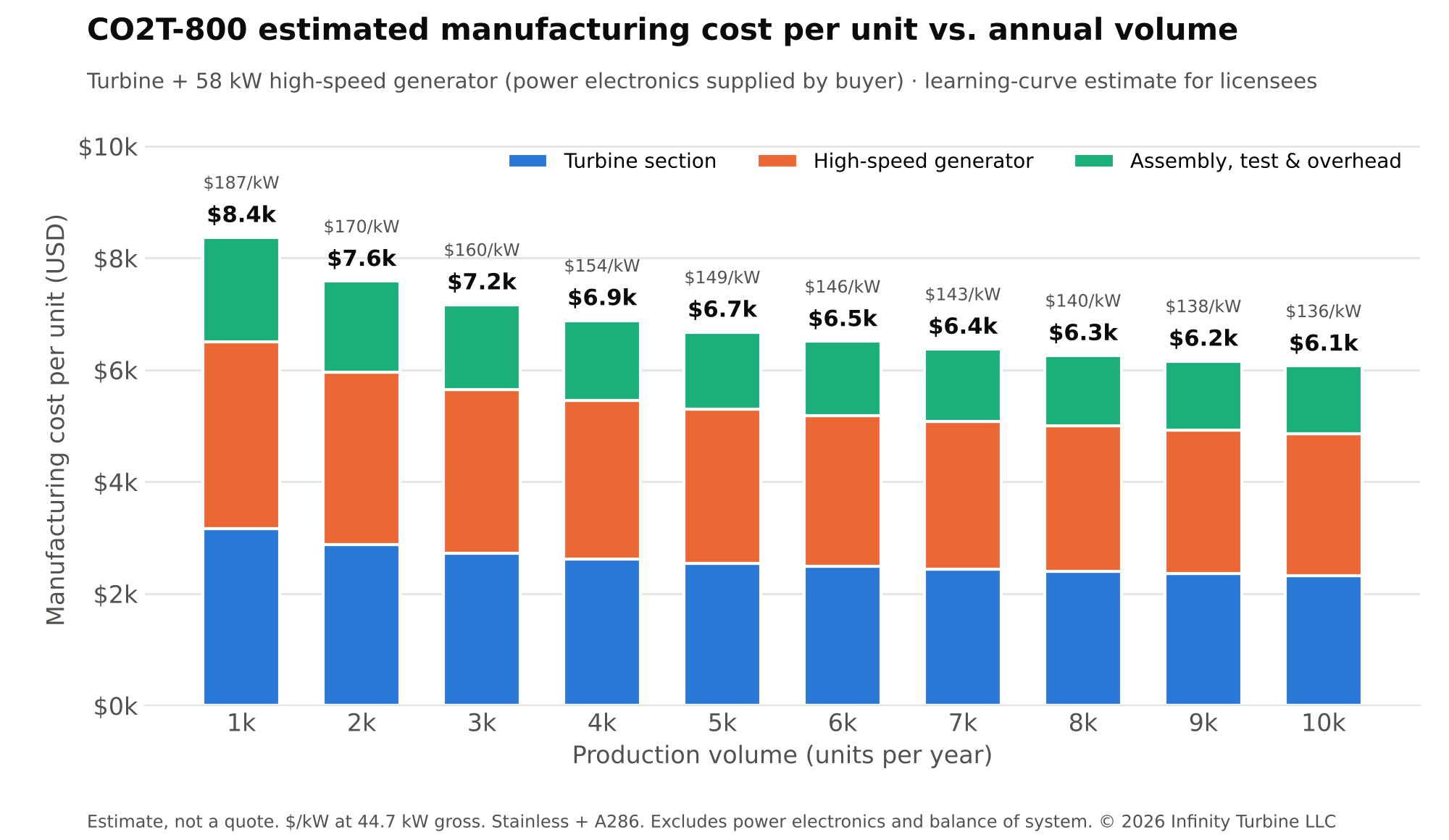
| Units per year | Turbine section | High-speed generator | Assembly, test & overhead | Cost per unit | Per kW gross | Annual build cost |
|---|---|---|---|---|---|---|
| 1,000 | $3,160 | $3,350 | $1,860 | $8,370 | $187 | $8.4 M |
| 2,000 | $2,880 | $3,080 | $1,630 | $7,590 | $170 | $15.2 M |
| 3,000 | $2,730 | $2,930 | $1,510 | $7,170 | $160 | $21.5 M |
| 4,000 | $2,620 | $2,830 | $1,430 | $6,880 | $154 | $27.5 M |
| 5,000 | $2,550 | $2,750 | $1,380 | $6,680 | $149 | $33.4 M |
| 6,000 | $2,490 | $2,690 | $1,330 | $6,510 | $146 | $39.1 M |
| 7,000 | $2,440 | $2,640 | $1,290 | $6,370 | $143 | $44.6 M |
| 8,000 | $2,400 | $2,600 | $1,260 | $6,260 | $140 | $50.1 M |
| 9,000 | $2,360 | $2,560 | $1,230 | $6,150 | $138 | $55.4 M |
| 10,000 | $2,330 | $2,530 | $1,210 | $6,070 | $136 | $60.7 M |
Cost basis. These are bottom-up engineering estimates, not quotes. The 1,000-unit build is priced line by line:
Costs then fall with each doubling of volume: to 96 % for raw material, 88 % for forging and machining, 92 % for purchased parts and 85 % for labor. Per-kW figures use 44.7 kW gross at 650 °C. Not included: power electronics, the turbine trip valve, the balance of system (heat exchangers, CO₂ heater, recuperator, feed pump, condenser, piping), installation, licensing fees and margin. The balance of system costs more than the turbine-generator.
The CO2T-800 runs on heat from 100 °C up to its 650 °C limit. At lower temperatures the buyer's power electronics slow the shaft, from 42,400 rpm at 650 °C down to about 18,600 rpm at 100 °C. That keeps the buckets at the best speed ratio to the CO₂ jets. All outputs are gross: the power at the generator terminals.
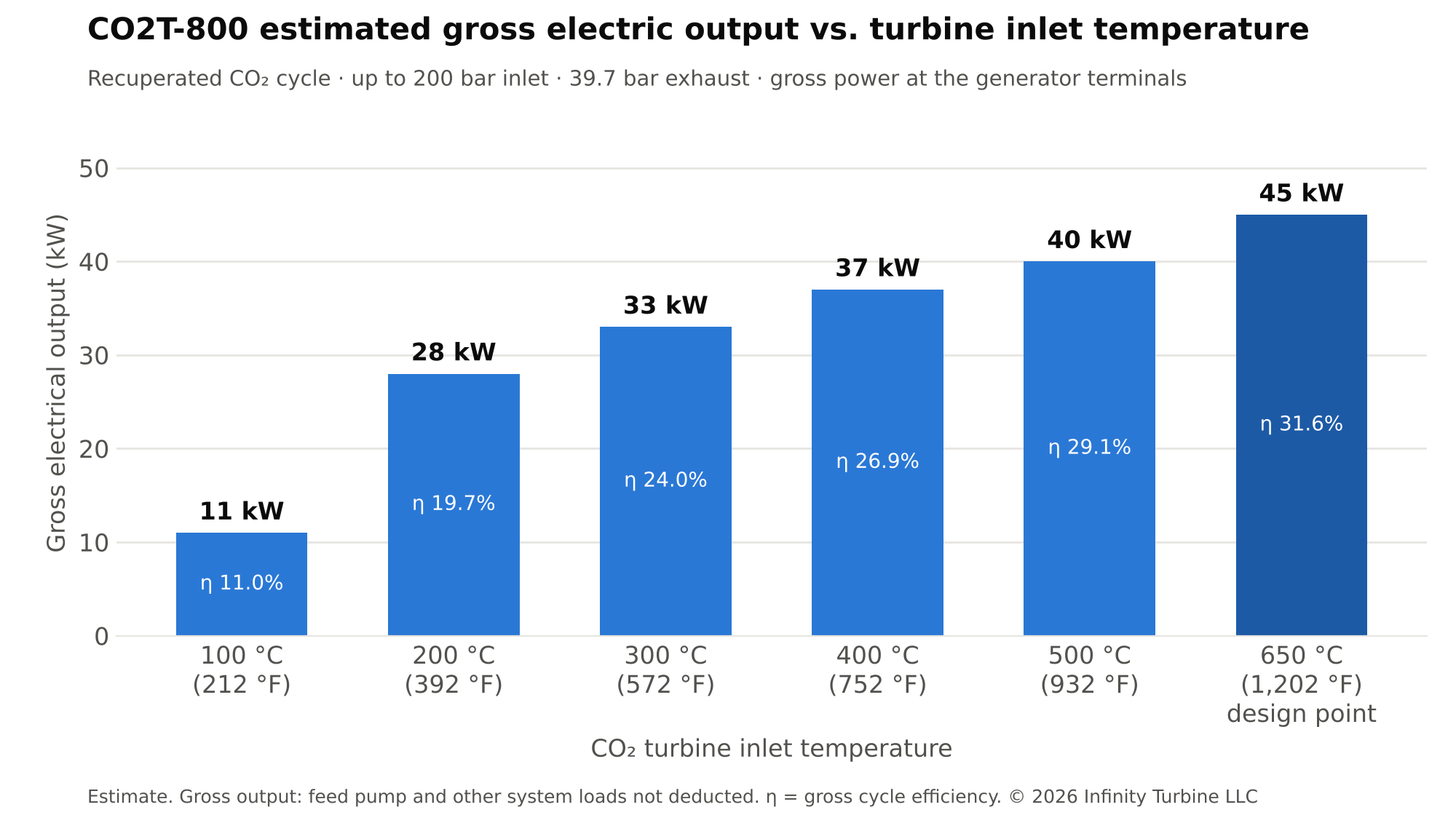
| CO₂ turbine inlet | Gross output | Gross efficiency | Heat input | Heat input | Heat rate | Heat rate | Inlet pressure | CO₂ flow | Shaft speed |
|---|---|---|---|---|---|---|---|---|---|
| kW | % | kWth | BTU/h | BTU/kWh | kJ/kWh | bar (psi) | kg/s | rpm | |
| 100 °C (212 °F) | 11 | 11.0 | 97 | 330,000 | 30,900 | 32,600 | 128 (1,860) | 0.39 | 18,600 |
| 200 °C (392 °F) | 28 | 19.7 | 140 | 479,000 | 17,300 | 18,200 | 200 (2,900) | 0.48 | 26,900 |
| 300 °C (572 °F) | 33 | 24.0 | 137 | 467,000 | 14,200 | 15,000 | 200 (2,900) | 0.41 | 31,600 |
| 400 °C (752 °F) | 37 | 26.9 | 137 | 467,000 | 12,700 | 13,400 | 200 (2,900) | 0.37 | 35,200 |
| 500 °C (932 °F) | 40 | 29.1 | 138 | 472,000 | 11,700 | 12,400 | 200 (2,900) | 0.34 | 38,300 |
| 650 °C (1,202 °F) design | 45 | 31.6 | 142 | 483,000 | 10,800 | 11,400 | 200 (2,900) | 0.31 | 42,400 |
Gross output is the 3-phase power at the generator terminals. The CO₂ feed pump, power-electronics losses and other system loads are not deducted. Heat rate = heat into the CO₂ ÷ gross output. Plan on about 100–140 kWth (330,000–480,000 BTU/h) of usable heat per turbine, at a source temperature about 50 °C (90 °F) above the turbine inlet temperature you want. On a wood-fired boiler at 75 % efficiency, the 650 °C heat rate on fuel is about 14,400 BTU/kWh (15,200 kJ/kWh) gross.
| CO₂ turbine inlet | Min. source temp. | Source cooled to ≈ | Flue / exhaust gas flow | or pressurized hot water | Wood fuel (75 % boiler) |
|---|---|---|---|---|---|
| 100 °C | 150 °C (300 °F) | 45 °C (113 °F) | — | 13 L/min (3.5 gpm) | 31 kg/h (68 lb/h) |
| 200 °C | 250 °C (480 °F) | 80 °C (176 °F) | — | 12 L/min (3.1 gpm) | 45 kg/h (98 lb/h) |
| 300 °C | 350 °C (660 °F) | 115 °C (239 °F) | 1,900 kg/h | — | 43 kg/h (96 lb/h) |
| 400 °C | 450 °C (840 °F) | 155 °C (311 °F) | 1,500 kg/h | — | 43 kg/h (96 lb/h) |
| 500 °C | 550 °C (1,020 °F) | 210 °C (410 °F) | 1,300 kg/h | — | 44 kg/h (97 lb/h) |
| 650 °C | 700 °C (1,290 °F) | 315 °C (599 °F) | 1,200 kg/h | — | 45 kg/h (99 lb/h) |
Gas flow assumes flue or engine exhaust gas (cp ≈ 1.12 kJ/kg·K). Wood fuel assumes air-dried wood at about 4.2 kWh/kg (≈15 % moisture). At 650 °C the CO₂ returns from the recuperator at about 285 °C. On a fired boiler, add a combustion-air preheater to recover the remaining flue heat.
Infinity Turbine supplies the turbine and the high-speed generator. At 650 °C the generator delivers variable-frequency 3-phase AC, about 440 V at 707 Hz, through a hermetic feedthrough. That power can't go straight to the grid or a battery, so the buyer supplies the power electronics shown here, sized for about 50 kW.
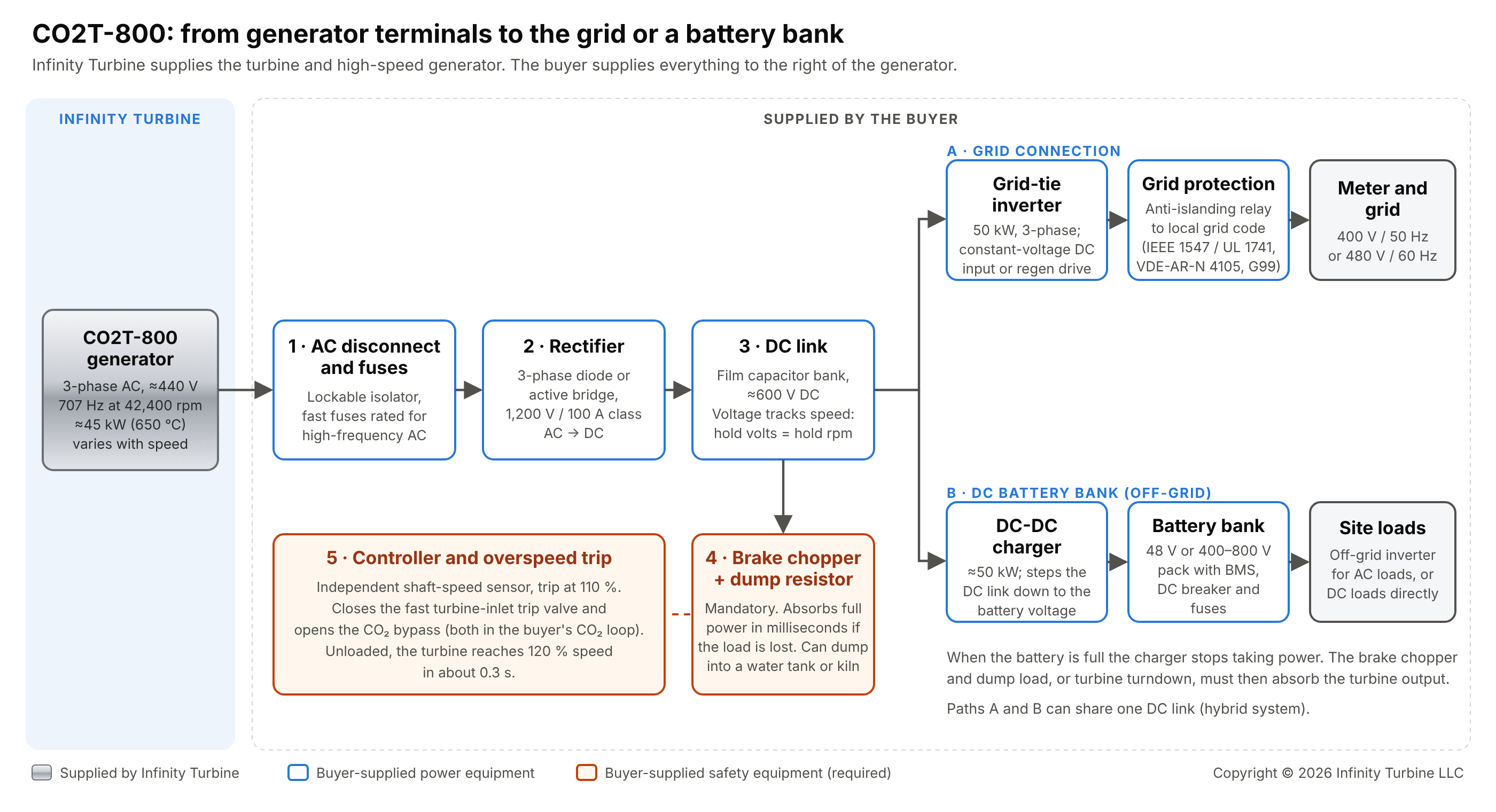
Overspeed protection is the buyer's responsibility and is mandatory. If the load is lost (grid trip, inverter fault or a full battery), an impulse turbine heads for about twice design speed and reaches its 120 % limit in about 0.3 seconds. The buyer must provide a brake chopper with a dump resistor on the DC link, an independent shaft-speed trip at 110 %, and a fast-closing turbine-inlet trip valve with a CO₂ bypass in the CO₂ loop.
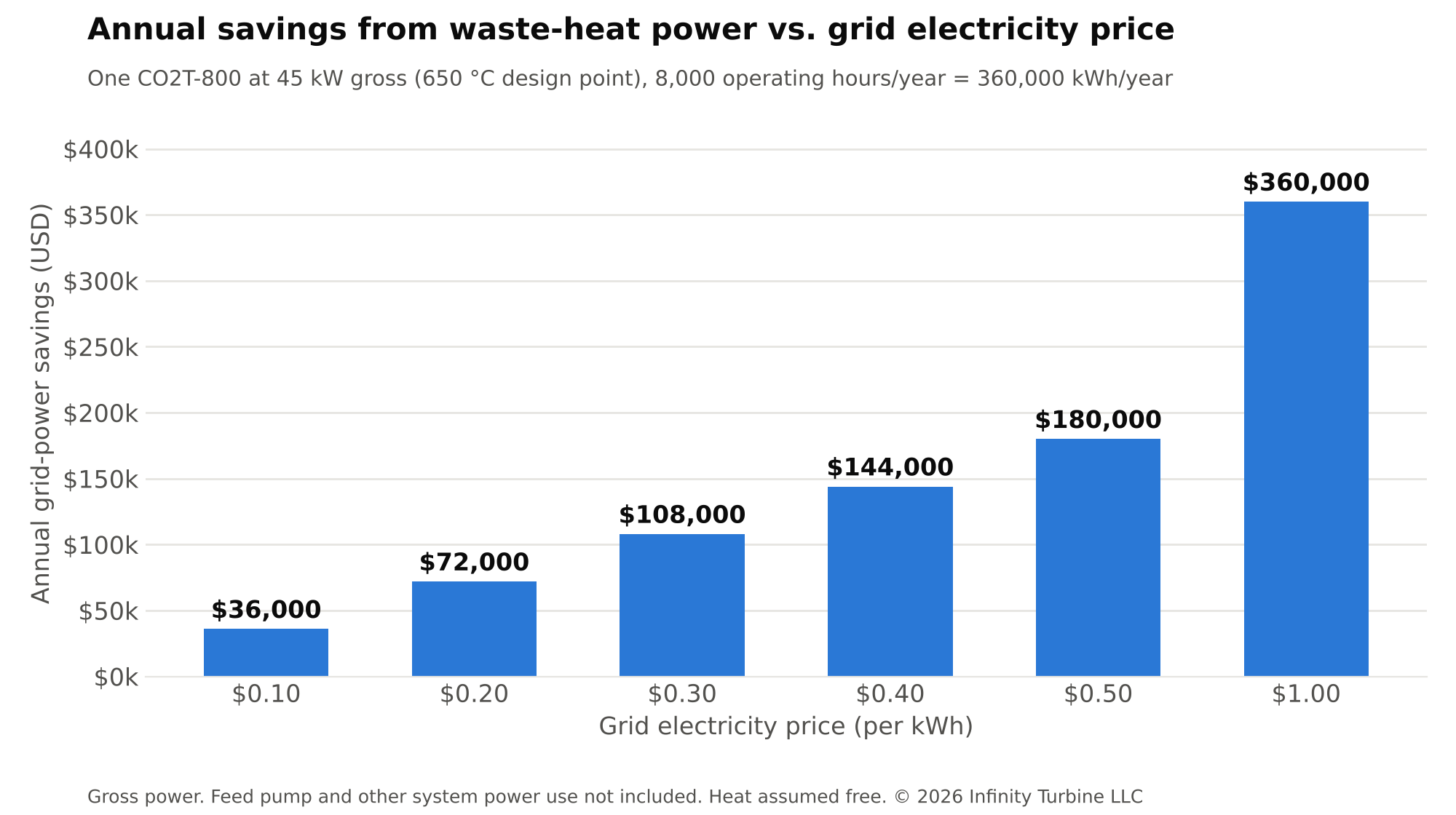
When the heat is already being thrown away, or the fuel is free wood on site, every kilowatt-hour the CO2T-800 makes is one you don't buy from the grid or a diesel genset. At 45 kW gross and 8,000 hours a year, one unit makes about 360,000 kWh a year.
| Turbine inlet / gross output | $0.10/kWh | $0.20/kWh | $0.30/kWh | $0.40/kWh | $0.50/kWh | $1.00/kWh |
|---|---|---|---|---|---|---|
| 100 °C · 11 kW | $8,800 | $17,600 | $26,400 | $35,200 | $44,000 | $88,000 |
| 200 °C · 28 kW | $22,400 | $44,800 | $67,200 | $89,600 | $112,000 | $224,000 |
| 300 °C · 33 kW | $26,400 | $52,800 | $79,200 | $105,600 | $132,000 | $264,000 |
| 400 °C · 37 kW | $29,600 | $59,200 | $88,800 | $118,400 | $148,000 | $296,000 |
| 500 °C · 40 kW | $32,000 | $64,000 | $96,000 | $128,000 | $160,000 | $320,000 |
| 650 °C · 45 kW | $36,000 | $72,000 | $108,000 | $144,000 | $180,000 | $360,000 |
Savings are based on gross power at the generator terminals. The feed pump and any other system power use are not included, and would reduce the savings. $0.40–$1.00/kWh is typical of diesel-generated power at remote sites, islands, mines and off-grid camps. Savings assume the heat is waste or free and exclude maintenance, financing and incentives. The turbine-generator is the smaller part of the investment. The balance of system (heat exchangers, CO₂ heater, recuperator, feed pump, condenser, piping, controls and power electronics) costs more than the turbine-generator, so base payback on the full installed cost.
The best sites have a steady heat stream of about 100–140 kWth (330,000–480,000 BTU/h) that runs most of the year. Output rises with temperature up to the 650 °C limit, so sources at 500 °C and above get the most out of it.
| Heat source | Typical temperature | Expected gross output | Fit | Why it works |
|---|---|---|---|---|
| Wood-fired, biomass and pellet boilers with a CO₂ coil | 800–1,100 °C flame | 45 kW | Best | On-site wood heats the CO₂ to 650 °C |
| Incinerators, thermal oxidizers, flares | 500–900 °C | 40–45 kW | Best | Very hot gas that is usually vented; power for the site from heat already being made |
| Solid oxide fuel cell exhaust | 600–800 °C | 43–45 kW | Best | High-grade exhaust raises total system efficiency |
| Small gas turbine and microturbine exhaust | 450–600 °C | 39–43 kW | Best | Hot, steady exhaust; a bottoming cycle for existing units |
| Kilns, furnaces, ovens (ceramics, glass, metals, heat treat) | 300–700 °C flue gas | 33–45 kW | Best | Large, continuous flue losses; a compact CO₂ heater fits in the flue duct |
| Biomass gasifiers and pyrolysis units | 500–800 °C | 40–45 kW | Strong | Syngas or char combustion heat on sites with free feedstock |
| Reciprocating engine exhaust (gensets, CHP, landfill and biogas engines) | 400–550 °C | 37–42 kW | Strong | Runs around the clock; adds power without burning more fuel |
| Industrial process heat, dryers, thermal oil systems | 200–350 °C | 28–35 kW | Good | Uses heat already circulated on site |
| Geothermal brine and hot wells | 100–200 °C | 11–28 kW | Good | Steady 24/7 heat; below about 150 °C the smaller CO2T turbine is the better match |
| Data center and HVAC low-grade heat | 30–60 °C | — | Not suited | Too cold for this turbine; use a heat pump or a low-temperature CO₂ cycle |
For sources hotter than 650 °C, the CO₂ heater is designed so the CO₂ never exceeds the 650 °C turbine limit.
The CO2T-800 doesn't care where the heat comes from. That makes it a fit for remote sites that now burn diesel for power.
A pressure-rated CO₂ coil in a wood-fired boiler of about 480,000 BTU/h heats the CO₂ to 650 °C. With a combustion-air preheater the boiler stack stays cool. Use firewood, chips, pellets or sawmill waste at camps, mines, farms and remote communities.
Parabolic troughs (300–400 °C) give 33–37 kW gross; towers and dishes (550–650 °C) give 42–45 kW. Plan on roughly 300 m² of collector aperture per turbine in 1,000 W/m² sun.
Brine at 150–250 °C runs the turbine at 100–200 °C inlet for 11–28 kW gross per unit, 24 hours a day. For wells below about 150 °C, the smaller CO2T turbine is the better match.
Charge a hot store from surplus solar or wind electricity, or from a burner, and run the turbine at night. Molten salt at about 565 °C gives roughly 42 kW gross; hot sand or rock at 650 °C and above gives 45 kW.
Burners firing used oil, stranded associated gas or landfill gas supply 650 °C heat at oil fields, workshops and landfills.
Heat from the CO₂ condenser above 40 °C, plus the generator cooling water, can heat buildings, provide hot water or dry lumber in a kiln.
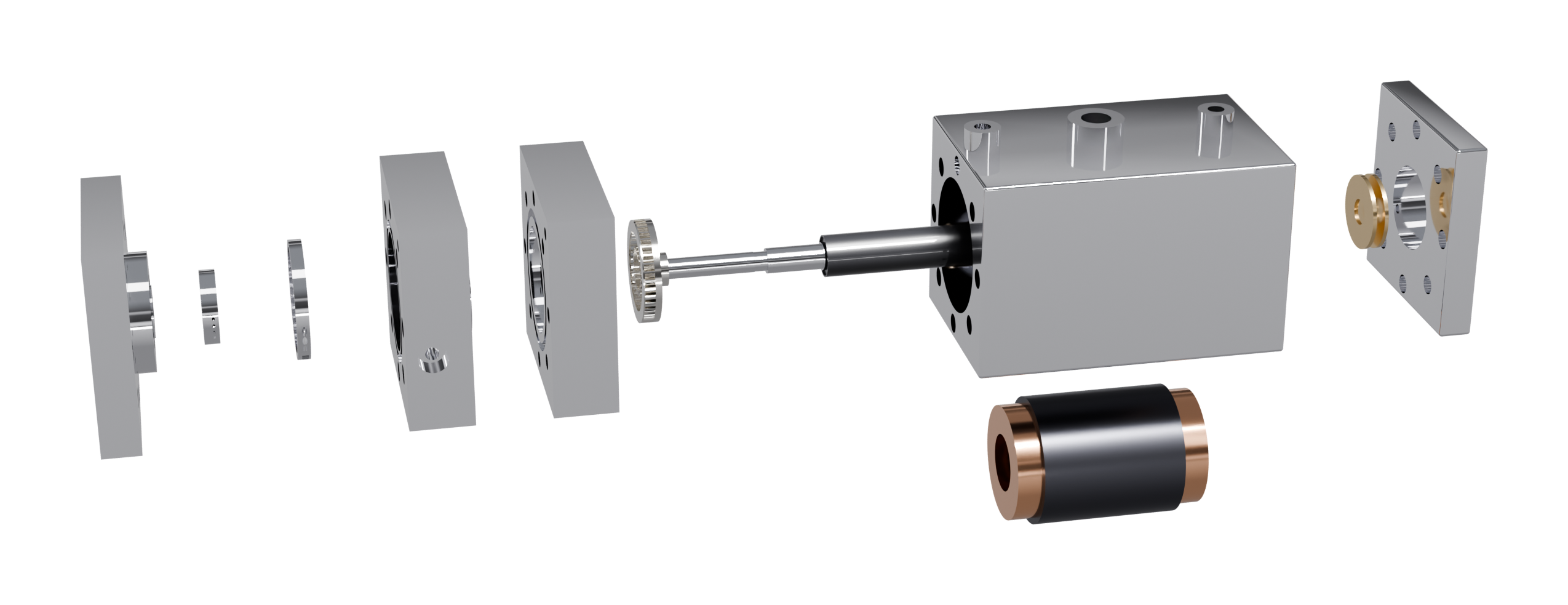
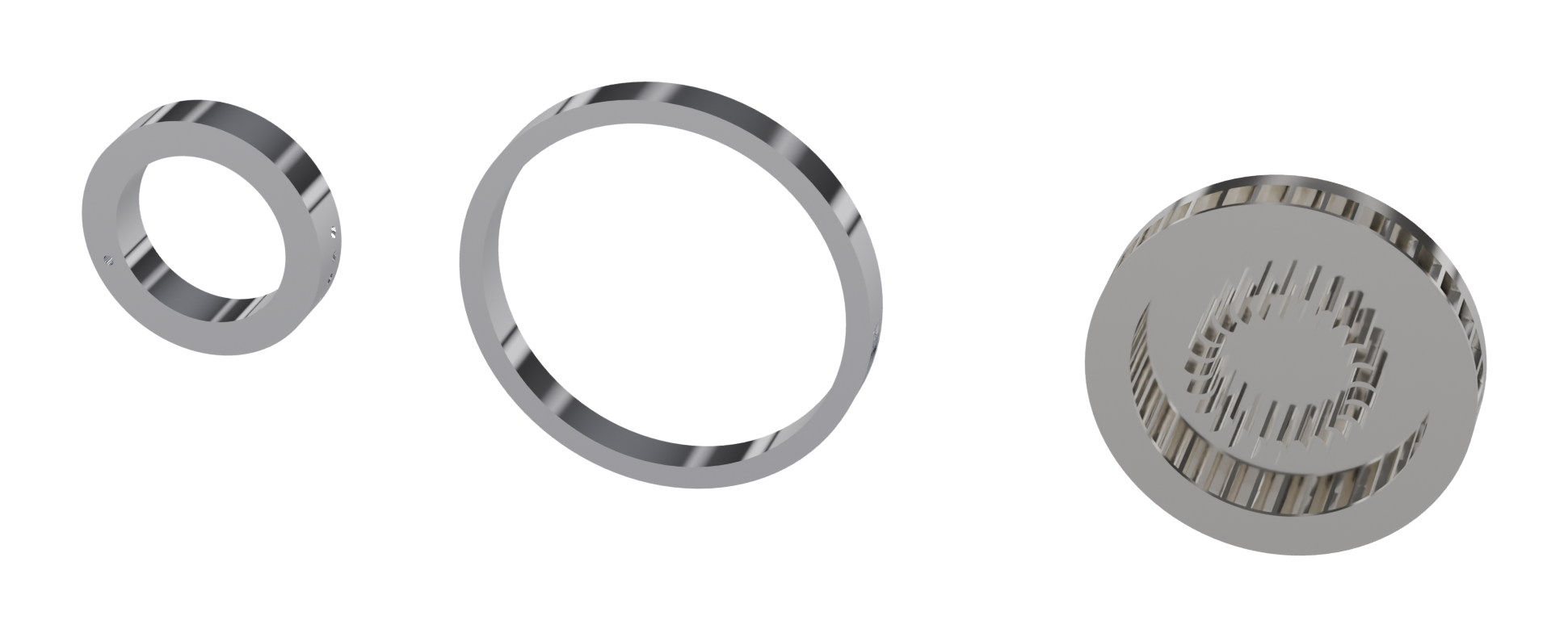
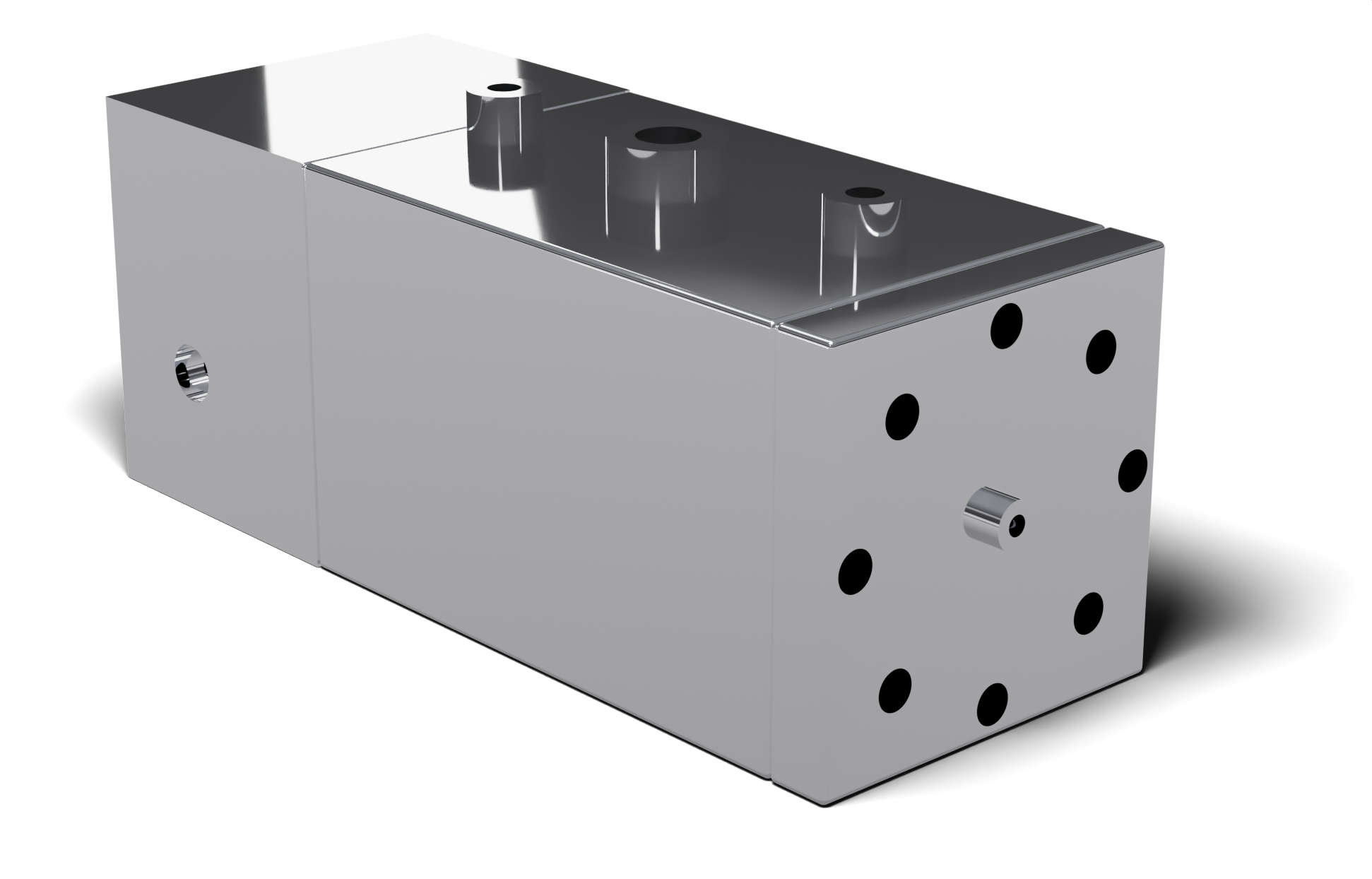
The CO2T-800 scales Infinity Turbine's CO2T bucket turbine by 2.4×. It uses modular bolted-block construction, with an integrated high-speed generator module on the same shaft as the turbine.
Tell us your heat source, its temperature and flow, and your electricity cost. We'll tell you what the CO2T-800 can make on your site.
Performance basis. Figures are engineering estimates from a recuperated transcritical CO₂ cycle model (CoolProp properties). Design point: 200 bar / 650 °C maximum inlet, 39.7 bar exhaust (5 °C condensing). Assumptions: turbine isentropic efficiency 60 % at the best bucket-to-jet speed ratio, recuperator effectiveness 0.85, generator 95 %. All outputs are gross power at the generator terminals; the CO₂ feed pump, power-electronics losses and other system loads are not deducted. Below 650 °C the shaft speed is reduced, within the generator's torque rating, to hold the best speed ratio. Inlet pressure is optimized up to 200 bar. Warmer cooling water raises the condensing pressure and lowers output. The A286 rotor needs a stress and creep check at 650 °C before manufacture. Rendered images show a concept model: the CO2T turbine parts scaled 2.4×, plus a generator module drawn to the design dimensions. Actual output depends on site conditions and testing.
| CONTACT Email: greg@infinityturbine.com | AMP |