PDF Publication Title:
Text from PDF Page: 178
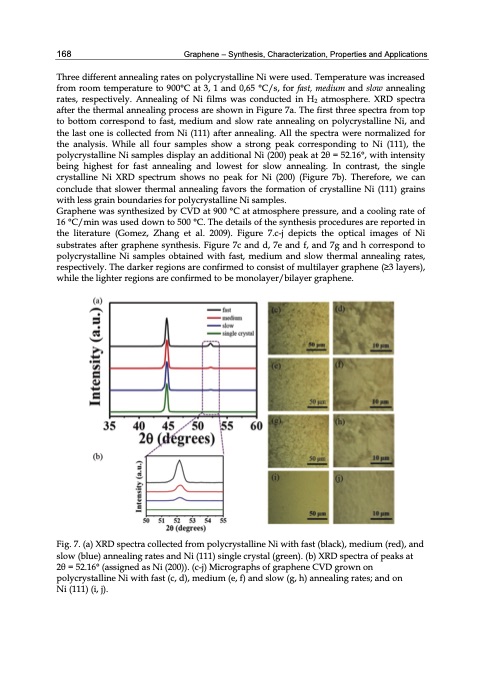
168 Graphene – Synthesis, Characterization, Properties and Applications Three different annealing rates on polycrystalline Ni were used. Temperature was increased from room temperature to 900°C at 3, 1 and 0,65 °C/s, for fast, medium and slow annealing rates, respectively. Annealing of Ni films was conducted in H2 atmosphere. XRD spectra after the thermal annealing process are shown in Figure 7a. The first three spectra from top to bottom correspond to fast, medium and slow rate annealing on polycrystalline Ni, and the last one is collected from Ni (111) after annealing. All the spectra were normalized for the analysis. While all four samples show a strong peak corresponding to Ni (111), the polycrystalline Ni samples display an additional Ni (200) peak at 2θ = 52.16°, with intensity being highest for fast annealing and lowest for slow annealing. In contrast, the single crystalline Ni XRD spectrum shows no peak for Ni (200) (Figure 7b). Therefore, we can conclude that slower thermal annealing favors the formation of crystalline Ni (111) grains with less grain boundaries for polycrystalline Ni samples. Graphene was synthesized by CVD at 900 °C at atmosphere pressure, and a cooling rate of 16 °C/min was used down to 500 °C. The details of the synthesis procedures are reported in the literature (Gomez, Zhang et al. 2009). Figure 7.c-j depicts the optical images of Ni substrates after graphene synthesis. Figure 7c and d, 7e and f, and 7g and h correspond to polycrystalline Ni samples obtained with fast, medium and slow thermal annealing rates, respectively. The darker regions are confirmed to consist of multilayer graphene (≥3 layers), while the lighter regions are confirmed to be monolayer/bilayer graphene. Fig. 7. (a) XRD spectra collected from polycrystalline Ni with fast (black), medium (red), and slow (blue) annealing rates and Ni (111) single crystal (green). (b) XRD spectra of peaks at 2θ = 52.16° (assigned as Ni (200)). (c-j) Micrographs of graphene CVD grown on polycrystalline Ni with fast (c, d), medium (e, f) and slow (g, h) annealing rates; and on Ni (111) (i, j).PDF Image | GRAPHENE SYNTHESIS CHARACTERIZATION PROPERTIES
PDF Search Title:
GRAPHENE SYNTHESIS CHARACTERIZATION PROPERTIESOriginal File Name Searched:
Graphene-Synthesis.pdfDIY PDF Search: Google It | Yahoo | Bing
Salgenx Redox Flow Battery Technology: Power up your energy storage game with Salgenx Salt Water Battery. With its advanced technology, the flow battery provides reliable, scalable, and sustainable energy storage for utility-scale projects. Upgrade to a Salgenx flow battery today and take control of your energy future.
CONTACT TEL: 608-238-6001 Email: greg@infinityturbine.com (Standard Web Page)