
PDF Publication Title:
Text from PDF Page: 179
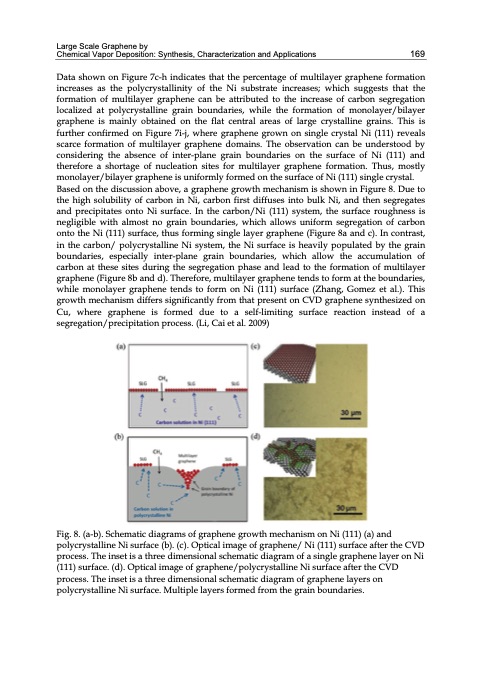
Large Scale Graphene by Chemical Vapor Deposition: Synthesis, Characterization and Applications 169 Data shown on Figure 7c-h indicates that the percentage of multilayer graphene formation increases as the polycrystallinity of the Ni substrate increases; which suggests that the formation of multilayer graphene can be attributed to the increase of carbon segregation localized at polycrystalline grain boundaries, while the formation of monolayer/bilayer graphene is mainly obtained on the flat central areas of large crystalline grains. This is further confirmed on Figure 7i-j, where graphene grown on single crystal Ni (111) reveals scarce formation of multilayer graphene domains. The observation can be understood by considering the absence of inter-plane grain boundaries on the surface of Ni (111) and therefore a shortage of nucleation sites for multilayer graphene formation. Thus, mostly monolayer/bilayer graphene is uniformly formed on the surface of Ni (111) single crystal. Based on the discussion above, a graphene growth mechanism is shown in Figure 8. Due to the high solubility of carbon in Ni, carbon first diffuses into bulk Ni, and then segregates and precipitates onto Ni surface. In the carbon/Ni (111) system, the surface roughness is negligible with almost no grain boundaries, which allows uniform segregation of carbon onto the Ni (111) surface, thus forming single layer graphene (Figure 8a and c). In contrast, in the carbon/ polycrystalline Ni system, the Ni surface is heavily populated by the grain boundaries, especially inter-plane grain boundaries, which allow the accumulation of carbon at these sites during the segregation phase and lead to the formation of multilayer graphene (Figure 8b and d). Therefore, multilayer graphene tends to form at the boundaries, while monolayer graphene tends to form on Ni (111) surface (Zhang, Gomez et al.). This growth mechanism differs significantly from that present on CVD graphene synthesized on Cu, where graphene is formed due to a self-limiting surface reaction instead of a segregation/precipitation process. (Li, Cai et al. 2009) Fig. 8. (a-b). Schematic diagrams of graphene growth mechanism on Ni (111) (a) and polycrystalline Ni surface (b). (c). Optical image of graphene/ Ni (111) surface after the CVD process. The inset is a three dimensional schematic diagram of a single graphene layer on Ni (111) surface. (d). Optical image of graphene/polycrystalline Ni surface after the CVD process. The inset is a three dimensional schematic diagram of graphene layers on polycrystalline Ni surface. Multiple layers formed from the grain boundaries.PDF Image | GRAPHENE SYNTHESIS CHARACTERIZATION PROPERTIES
PDF Search Title:
GRAPHENE SYNTHESIS CHARACTERIZATION PROPERTIESOriginal File Name Searched:
Graphene-Synthesis.pdfDIY PDF Search: Google It | Yahoo | Bing
Salgenx Redox Flow Battery Technology: Power up your energy storage game with Salgenx Salt Water Battery. With its advanced technology, the flow battery provides reliable, scalable, and sustainable energy storage for utility-scale projects. Upgrade to a Salgenx flow battery today and take control of your energy future.
| CONTACT TEL: 608-238-6001 Email: greg@infinityturbine.com | RSS | AMP |