
PDF Publication Title:
Text from PDF Page: 177
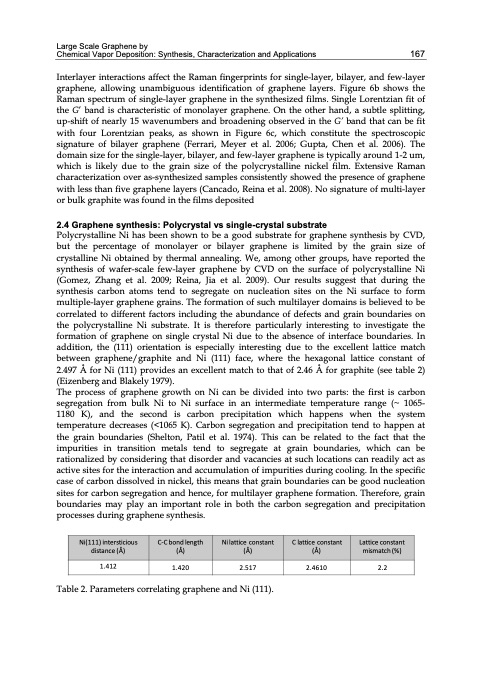
Large Scale Graphene by Chemical Vapor Deposition: Synthesis, Characterization and Applications 167 Interlayer interactions affect the Raman fingerprints for single-layer, bilayer, and few-layer graphene, allowing unambiguous identification of graphene layers. Figure 6b shows the Raman spectrum of single-layer graphene in the synthesized films. Single Lorentzian fit of the G’ band is characteristic of monolayer graphene. On the other hand, a subtle splitting, up-shift of nearly 15 wavenumbers and broadening observed in the G’ band that can be fit with four Lorentzian peaks, as shown in Figure 6c, which constitute the spectroscopic signature of bilayer graphene (Ferrari, Meyer et al. 2006; Gupta, Chen et al. 2006). The domain size for the single-layer, bilayer, and few-layer graphene is typically around 1-2 um, which is likely due to the grain size of the polycrystalline nickel film. Extensive Raman characterization over as-synthesized samples consistently showed the presence of graphene with less than five graphene layers (Cancado, Reina et al. 2008). No signature of multi-layer or bulk graphite was found in the films deposited 2.4 Graphene synthesis: Polycrystal vs single-crystal substrate Polycrystalline Ni has been shown to be a good substrate for graphene synthesis by CVD, but the percentage of monolayer or bilayer graphene is limited by the grain size of crystalline Ni obtained by thermal annealing. We, among other groups, have reported the synthesis of wafer-scale few-layer graphene by CVD on the surface of polycrystalline Ni (Gomez, Zhang et al. 2009; Reina, Jia et al. 2009). Our results suggest that during the synthesis carbon atoms tend to segregate on nucleation sites on the Ni surface to form multiple-layer graphene grains. The formation of such multilayer domains is believed to be correlated to different factors including the abundance of defects and grain boundaries on the polycrystalline Ni substrate. It is therefore particularly interesting to investigate the formation of graphene on single crystal Ni due to the absence of interface boundaries. In addition, the (111) orientation is especially interesting due to the excellent lattice match between graphene/graphite and Ni (111) face, where the hexagonal lattice constant of 2.497 Å for Ni (111) provides an excellent match to that of 2.46 Å for graphite (see table 2) (Eizenberg and Blakely 1979). The process of graphene growth on Ni can be divided into two parts: the first is carbon segregation from bulk Ni to Ni surface in an intermediate temperature range (~ 1065- 1180 K), and the second is carbon precipitation which happens when the system temperature decreases (<1065 K). Carbon segregation and precipitation tend to happen at the grain boundaries (Shelton, Patil et al. 1974). This can be related to the fact that the impurities in transition metals tend to segregate at grain boundaries, which can be rationalized by considering that disorder and vacancies at such locations can readily act as active sites for the interaction and accumulation of impurities during cooling. In the specific case of carbon dissolved in nickel, this means that grain boundaries can be good nucleation sites for carbon segregation and hence, for multilayer graphene formation. Therefore, grain boundaries may play an important role in both the carbon segregation and precipitation processes during graphene synthesis. Table 2. Parameters correlating graphene and Ni (111). Ni(111) intersticious distance (Å) C-C bond length (Å) Ni lattice constant (Å) C lattice constant (Å) Lattice constant mismatch (%) 1.412 1.420 2.517 2.4610 2.2PDF Image | GRAPHENE SYNTHESIS CHARACTERIZATION PROPERTIES
PDF Search Title:
GRAPHENE SYNTHESIS CHARACTERIZATION PROPERTIESOriginal File Name Searched:
Graphene-Synthesis.pdfDIY PDF Search: Google It | Yahoo | Bing
Salgenx Redox Flow Battery Technology: Power up your energy storage game with Salgenx Salt Water Battery. With its advanced technology, the flow battery provides reliable, scalable, and sustainable energy storage for utility-scale projects. Upgrade to a Salgenx flow battery today and take control of your energy future.
| CONTACT TEL: 608-238-6001 Email: greg@infinityturbine.com | RSS | AMP |