PDF Publication Title:
Text from PDF Page: 174
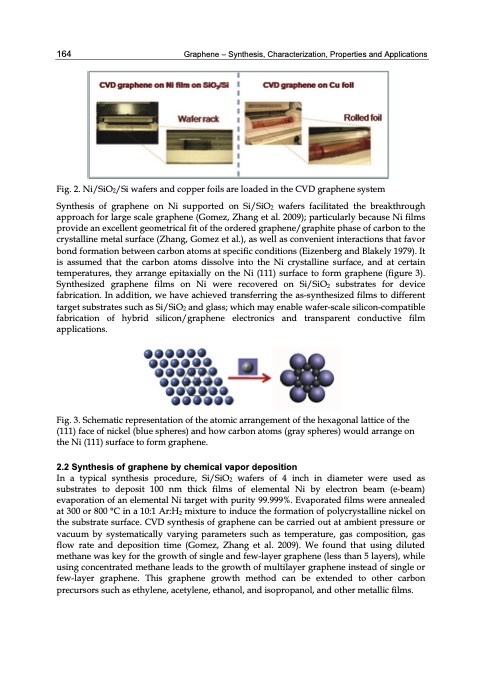
164 Graphene – Synthesis, Characterization, Properties and Applications Fig. 2. Ni/SiO2/Si wafers and copper foils are loaded in the CVD graphene system Synthesis of graphene on Ni supported on Si/SiO2 wafers facilitated the breakthrough approach for large scale graphene (Gomez, Zhang et al. 2009); particularly because Ni films provide an excellent geometrical fit of the ordered graphene/graphite phase of carbon to the crystalline metal surface (Zhang, Gomez et al.), as well as convenient interactions that favor bond formation between carbon atoms at specific conditions (Eizenberg and Blakely 1979). It is assumed that the carbon atoms dissolve into the Ni crystalline surface, and at certain temperatures, they arrange epitaxially on the Ni (111) surface to form graphene (figure 3). Synthesized graphene films on Ni were recovered on Si/SiO2 substrates for device fabrication. In addition, we have achieved transferring the as-synthesized films to different target substrates such as Si/SiO2 and glass; which may enable wafer-scale silicon-compatible fabrication of hybrid silicon/graphene electronics and transparent conductive film applications. Fig. 3. Schematic representation of the atomic arrangement of the hexagonal lattice of the (111) face of nickel (blue spheres) and how carbon atoms (gray spheres) would arrange on the Ni (111) surface to form graphene. 2.2 Synthesis of graphene by chemical vapor deposition In a typical synthesis procedure, Si/SiO2 wafers of 4 inch in diameter were used as substrates to deposit 100 nm thick films of elemental Ni by electron beam (e-beam) evaporation of an elemental Ni target with purity 99.999%. Evaporated films were annealed at 300 or 800 °C in a 10:1 Ar:H2 mixture to induce the formation of polycrystalline nickel on the substrate surface. CVD synthesis of graphene can be carried out at ambient pressure or vacuum by systematically varying parameters such as temperature, gas composition, gas flow rate and deposition time (Gomez, Zhang et al. 2009). We found that using diluted methane was key for the growth of single and few-layer graphene (less than 5 layers), while using concentrated methane leads to the growth of multilayer graphene instead of single or few-layer graphene. This graphene growth method can be extended to other carbon precursors such as ethylene, acetylene, ethanol, and isopropanol, and other metallic films.PDF Image | GRAPHENE SYNTHESIS CHARACTERIZATION PROPERTIES
PDF Search Title:
GRAPHENE SYNTHESIS CHARACTERIZATION PROPERTIESOriginal File Name Searched:
Graphene-Synthesis.pdfDIY PDF Search: Google It | Yahoo | Bing
Salgenx Redox Flow Battery Technology: Power up your energy storage game with Salgenx Salt Water Battery. With its advanced technology, the flow battery provides reliable, scalable, and sustainable energy storage for utility-scale projects. Upgrade to a Salgenx flow battery today and take control of your energy future.
CONTACT TEL: 608-238-6001 Email: greg@infinityturbine.com (Standard Web Page)