
PDF Publication Title:
Text from PDF Page: 173
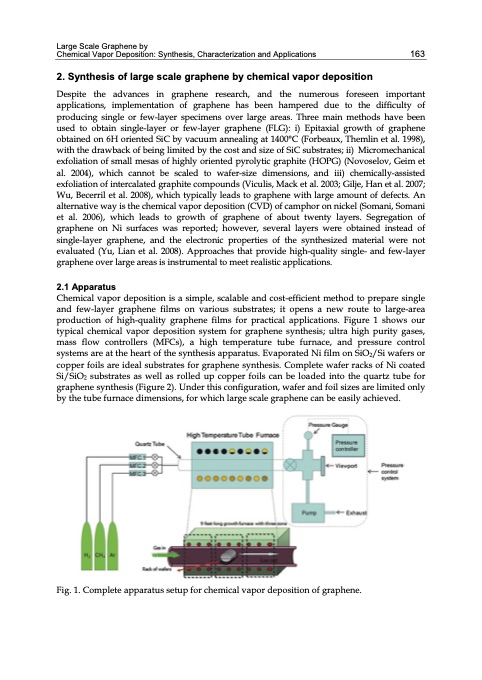
Large Scale Graphene by Chemical Vapor Deposition: Synthesis, Characterization and Applications 163 2. Synthesis of large scale graphene by chemical vapor deposition Despite the advances in graphene research, and the numerous foreseen important applications, implementation of graphene has been hampered due to the difficulty of producing single or few-layer specimens over large areas. Three main methods have been used to obtain single-layer or few-layer graphene (FLG): i) Epitaxial growth of graphene obtained on 6H oriented SiC by vacuum annealing at 1400°C (Forbeaux, Themlin et al. 1998), with the drawback of being limited by the cost and size of SiC substrates; ii) Micromechanical exfoliation of small mesas of highly oriented pyrolytic graphite (HOPG) (Novoselov, Geim et al. 2004), which cannot be scaled to wafer-size dimensions, and iii) chemically-assisted exfoliation of intercalated graphite compounds (Viculis, Mack et al. 2003; Gilje, Han et al. 2007; Wu, Becerril et al. 2008), which typically leads to graphene with large amount of defects. An alternative way is the chemical vapor deposition (CVD) of camphor on nickel (Somani, Somani et al. 2006), which leads to growth of graphene of about twenty layers. Segregation of graphene on Ni surfaces was reported; however, several layers were obtained instead of single-layer graphene, and the electronic properties of the synthesized material were not evaluated (Yu, Lian et al. 2008). Approaches that provide high-quality single- and few-layer graphene over large areas is instrumental to meet realistic applications. 2.1 Apparatus Chemical vapor deposition is a simple, scalable and cost-efficient method to prepare single and few-layer graphene films on various substrates; it opens a new route to large-area production of high-quality graphene films for practical applications. Figure 1 shows our typical chemical vapor deposition system for graphene synthesis; ultra high purity gases, mass flow controllers (MFCs), a high temperature tube furnace, and pressure control systems are at the heart of the synthesis apparatus. Evaporated Ni film on SiO2/Si wafers or copper foils are ideal substrates for graphene synthesis. Complete wafer racks of Ni coated Si/SiO2 substrates as well as rolled up copper foils can be loaded into the quartz tube for graphene synthesis (Figure 2). Under this configuration, wafer and foil sizes are limited only by the tube furnace dimensions, for which large scale graphene can be easily achieved. Fig. 1. Complete apparatus setup for chemical vapor deposition of graphene.PDF Image | GRAPHENE SYNTHESIS CHARACTERIZATION PROPERTIES
PDF Search Title:
GRAPHENE SYNTHESIS CHARACTERIZATION PROPERTIESOriginal File Name Searched:
Graphene-Synthesis.pdfDIY PDF Search: Google It | Yahoo | Bing
Salgenx Redox Flow Battery Technology: Power up your energy storage game with Salgenx Salt Water Battery. With its advanced technology, the flow battery provides reliable, scalable, and sustainable energy storage for utility-scale projects. Upgrade to a Salgenx flow battery today and take control of your energy future.
| CONTACT TEL: 608-238-6001 Email: greg@infinityturbine.com | RSS | AMP |