
PDF Publication Title:
Text from PDF Page: 113
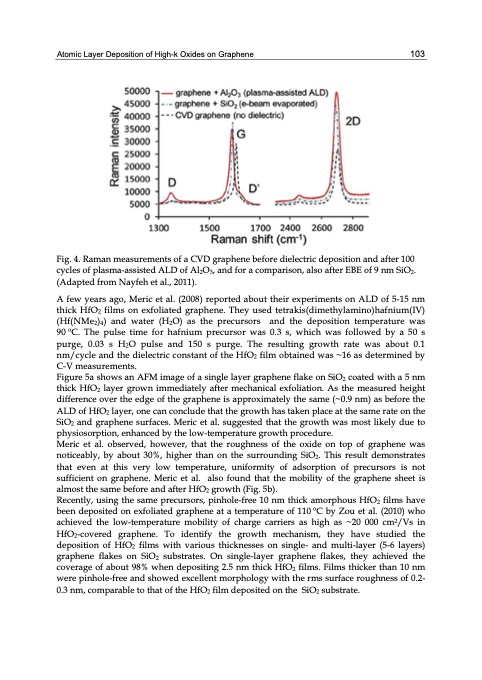
Atomic Layer Deposition of High-k Oxides on Graphene 103 Fig. 4. Raman measurements of a CVD graphene before dielectric deposition and after 100 cycles of plasma-assisted ALD of Al2O3, and for a comparison, also after EBE of 9 nm SiO2. (Adapted from Nayfeh et al., 2011). A few years ago, Meric et al. (2008) reported about their experiments on ALD of 5-15 nm thick HfO2 films on exfoliated graphene. They used tetrakis(dimethylamino)hafnium(IV) (Hf(NMe2)4) and water (H2O) as the precursors and the deposition temperature was 90 oC. The pulse time for hafnium precursor was 0.3 s, which was followed by a 50 s purge, 0.03 s H2O pulse and 150 s purge. The resulting growth rate was about 0.1 nm/cycle and the dielectric constant of the HfO2 film obtained was ~16 as determined by C-V measurements. Figure 5a shows an AFM image of a single layer graphene flake on SiO2 coated with a 5 nm thick HfO2 layer grown immediately after mechanical exfoliation. As the measured height difference over the edge of the graphene is approximately the same (~0.9 nm) as before the ALD of HfO2 layer, one can conclude that the growth has taken place at the same rate on the SiO2 and graphene surfaces. Meric et al. suggested that the growth was most likely due to physiosorption, enhanced by the low-temperature growth procedure. Meric et al. observed, however, that the roughness of the oxide on top of graphene was noticeably, by about 30%, higher than on the surrounding SiO2. This result demonstrates that even at this very low temperature, uniformity of adsorption of precursors is not sufficient on graphene. Meric et al. also found that the mobility of the graphene sheet is almost the same before and after HfO2 growth (Fig. 5b). Recently, using the same precursors, pinhole-free 10 nm thick amorphous HfO2 films have been deposited on exfoliated graphene at a temperature of 110 oC by Zou et al. (2010) who achieved the low-temperature mobility of charge carriers as high as ~20 000 cm2/Vs in HfO2-covered graphene. To identify the growth mechanism, they have studied the deposition of HfO2 films with various thicknesses on single- and multi-layer (5-6 layers) graphene flakes on SiO2 substrates. On single-layer graphene flakes, they achieved the coverage of about 98% when depositing 2.5 nm thick HfO2 films. Films thicker than 10 nm were pinhole-free and showed excellent morphology with the rms surface roughness of 0.2- 0.3 nm, comparable to that of the HfO2 film deposited on the SiO2 substrate.PDF Image | GRAPHENE SYNTHESIS CHARACTERIZATION PROPERTIES
PDF Search Title:
GRAPHENE SYNTHESIS CHARACTERIZATION PROPERTIESOriginal File Name Searched:
Graphene-Synthesis.pdfDIY PDF Search: Google It | Yahoo | Bing
Salgenx Redox Flow Battery Technology: Power up your energy storage game with Salgenx Salt Water Battery. With its advanced technology, the flow battery provides reliable, scalable, and sustainable energy storage for utility-scale projects. Upgrade to a Salgenx flow battery today and take control of your energy future.
| CONTACT TEL: 608-238-6001 Email: greg@infinityturbine.com | RSS | AMP |