
PDF Publication Title:
Text from PDF Page: 011
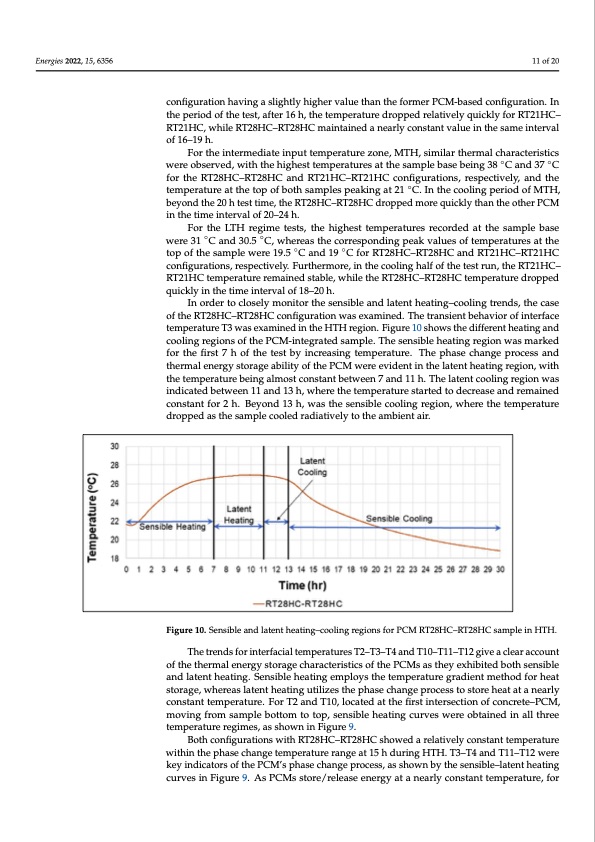
Energies 2022, 15, 6356 11 of 20 Energies 2022, 15, x FOR PEER REVIEW configuration having a slightly higher value than the former PCM-based configuration. In the period of the test, after 16 h, the temperature dropped relatively quickly for RT21HC– RT21HC, while RT28HC–RT28HC maintained a nearly constant value in the same interval of 16–19 h. For the intermediate input temperature zone, MTH, similar thermal characteristics were observed, with the highest temperatures at the sample base being 38 ◦C and 37 ◦C for the RT28HC–RT28HC and RT21HC–RT21HC configurations, respectively, and the temperature at the top of both samples peaking at 21 ◦C. In the cooling period of MTH, beyond the 20 h test time, the RT28HC–RT28HC dropped more quickly than the other PCM in the time interval of 20–24 h. For the LTH regime tests, the highest temperatures recorded at the sample base were 31 ◦C and 30.5 ◦C, whereas the corresponding peak values of temperatures at the top of the sample were 19.5 ◦C and 19 ◦C for RT28HC–RT28HC and RT21HC–RT21HC configurations, respectively. Furthermore, in the cooling half of the test run, the RT21HC– RT21HC temperature remained stable, while the RT28HC–RT28HC temperature dropped quickly in the time interval of 18–20 h. In order to closely monitor the sensible and latent heating–cooling trends, the case of the RT28HC–RT28HC configuration was examined. The transient behavior of interface temperature T3 was examined in the HTH region. Figure 10 shows the different heating and cooling regions of the PCM-integrated sample. The sensible heating region was marked for the first 7 h of the test by increasing temperature. The phase change process and thermal energy storage ability of the PCM were evident in the latent heating region, with the temperature being almost constant between 7 and 11 h. The latent cooling region was indicated between 11 and 13 h, where the temperature started to decrease and remained 12 of 22 constant for 2 h. Beyond 13 h, was the sensible cooling region, where the temperature dropped as the sample cooled radiatively to the ambient air. Figure 10. Sensible and latent heating–cooling regions for PCM RT28HC–RT28HC sample in HTH. Figure 10. Sensible and latent heating–cooling regions for PCM RT28HC–RT28HC sample in HTH. The trends for interfacial temperatures T2–T3–T4 and T10–T11–T12 give a clear ac- The trends for interfacial temperatures T2–T3–T4 and T10–T11–T12 give a clear account count of the thermal energy storage characteristics of the PCMs as they exhibited both of the thermal energy storage characteristics of the PCMs as they exhibited both sensible sensible and latent heating. Sensible heating employs the temperature gradient method and latent heating. Sensible heating employs the temperature gradient method for heat for heat storage, whereas latent heating utilizes the phase change process to store heat at storage, whereas latent heating utilizes the phase change process to store heat at a nearly a nearly constant temperature. For T2 and T10, located at the first intersection of concrete– constant temperature. For T2 and T10, located at the first intersection of concrete–PCM, PCM, moving from sample bottom to top, sensible heating curves were obtained in all moving from sample bottom to top, sensible heating curves were obtained in all three three temperature regimes, as shown in Figure 9. temperature regimes, as shown in Figure 9. Both configurations with RT28HC–RT28HC showed a relatively constant tempera- Both configurations with RT28HC–RT28HC showed a relatively constant temperature ture within the phase change temperature range at 15 h during HTH. T3–T4 and T11–T12 within the phase change temperature range at 15 h during HTH. T3–T4 and T11–T12 were were key indicators of the PCM’s phase change process, as shown by the sensible–latent heating curves in Figure 9. As PCMs store/release energy at a nearly constant temperature, key indicators of the PCM’s phase change process, as shown by the sensible–latent heating curves in Figure 9. As PCMs store/release energy at a nearly constant temperature, for for both the HTH and MTH tests, RT28HC–RT28HC utilized heat to change its phase and store energy while maintaining a constant temperature, whereas RT21HC–RT21HC, which was in a melted state overall, produced by a sensible heating curve with an initially delayed rise in temperature as heat was stored in the PCM until it had fully melted and had changed its phase completely. For LTH, RT28HC–RT28HC remained solid as PCM charging had not started due to the lower-than-melting temperatures. Sensible heatingPDF Image | PCM-Integrated Building Construction
PDF Search Title:
PCM-Integrated Building ConstructionOriginal File Name Searched:
energies-15-06356-v2.pdfDIY PDF Search: Google It | Yahoo | Bing
Turbine and System Plans CAD CAM: Special for this month, any plans are $10,000 for complete Cad/Cam blueprints. License is for one build. Try before you buy a production license. More Info
Waste Heat Power Technology: Organic Rankine Cycle uses waste heat to make electricity, shaft horsepower and cooling. More Info
All Turbine and System Products: Infinity Turbine ORD systems, turbine generator sets, build plans and more to use your waste heat from 30C to 100C. More Info
CO2 Phase Change Demonstrator: CO2 goes supercritical at 30 C. This is a experimental platform which you can use to demonstrate phase change with low heat. Includes integration area for small CO2 turbine, static generator, and more. This can also be used for a GTL Gas to Liquids experimental platform. More Info
Introducing the Infinity Turbine Products Infinity Turbine develops and builds systems for making power from waste heat. It also is working on innovative strategies for storing, making, and deploying energy. More Info
Need Strategy? Use our Consulting and analyst services Infinity Turbine LLC is pleased to announce its consulting and analyst services. We have worked in the renewable energy industry as a researcher, developing sales and markets, along with may inventions and innovations. More Info
Made in USA with Global Energy Millennial Web Engine These pages were made with the Global Energy Web PDF Engine using Filemaker (Claris) software.
Sand Battery Sand and Paraffin for TES Thermo Energy Storage More Info
| CONTACT TEL: 608-238-6001 Email: greg@infinityturbine.com | RSS | AMP |