
PDF Publication Title:
Text from PDF Page: 200
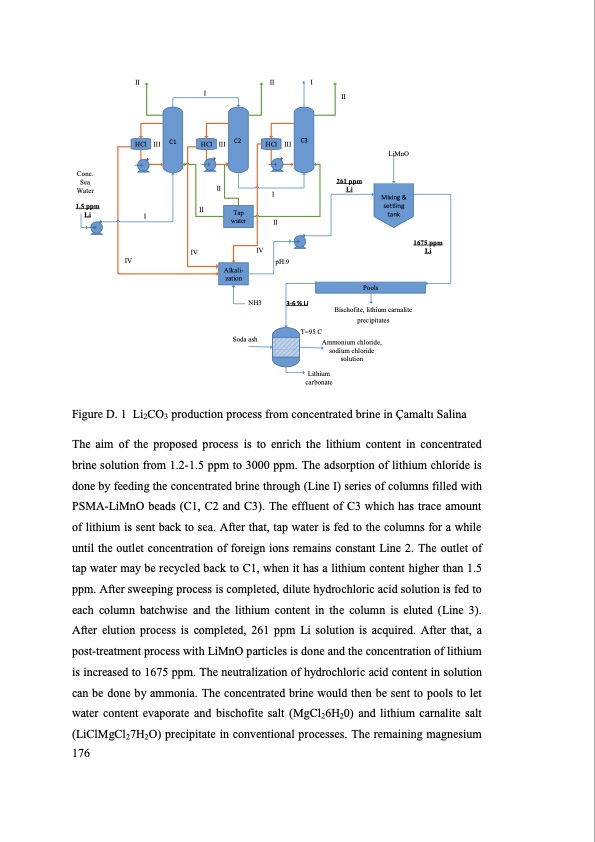
II III I II HCl III C1 I HCl III C2 HCl III C3 Conc. Sea Water 1.5 ppm Li LiMnO Mixing & settling tank Bischofite, lithium carnalite precipitates T=95 C Ammonium chloride, sodium chloride solution Lithium carbonate II 261 ppm II I Li II pH:9 3-6 % Li Tap water IV IV IV NH3 Soda ash 1675 ppm Li Alkali- zation Figure D. 1 Li2CO3 production process from concentrated brine in Çamaltı Salina The aim of the proposed process is to enrich the lithium content in concentrated brine solution from 1.2-1.5 ppm to 3000 ppm. The adsorption of lithium chloride is done by feeding the concentrated brine through (Line I) series of columns filled with PSMA-LiMnO beads (C1, C2 and C3). The effluent of C3 which has trace amount of lithium is sent back to sea. After that, tap water is fed to the columns for a while until the outlet concentration of foreign ions remains constant Line 2. The outlet of tap water may be recycled back to C1, when it has a lithium content higher than 1.5 ppm. After sweeping process is completed, dilute hydrochloric acid solution is fed to each column batchwise and the lithium content in the column is eluted (Line 3). After elution process is completed, 261 ppm Li solution is acquired. After that, a post-treatment process with LiMnO particles is done and the concentration of lithium is increased to 1675 ppm. The neutralization of hydrochloric acid content in solution can be done by ammonia. The concentrated brine would then be sent to pools to let water content evaporate and bischofite salt (MgCl26H20) and lithium carnalite salt (LiClMgCl27H2O) precipitate in conventional processes. The remaining magnesium 176 PoolsPDF Image | SEPARATION OF LITHIUM FROM BRINES
PDF Search Title:
SEPARATION OF LITHIUM FROM BRINESOriginal File Name Searched:
separation-lithium-from-brine.pdfDIY PDF Search: Google It | Yahoo | Bing
Product and Development Focus for Infinity Turbine
ORC Waste Heat Turbine and ORC System Build Plans: All turbine plans are $10,000 each. This allows you to build a system and then consider licensing for production after you have completed and tested a unit.Redox Flow Battery Technology: With the advent of the new USA tax credits for producing and selling batteries ($35/kW) we are focussing on a simple flow battery using shipping containers as the modular electrolyte storage units with tax credits up to $140,000 per system. Our main focus is on the salt battery. This battery can be used for both thermal and electrical storage applications. We call it the Cogeneration Battery or Cogen Battery. One project is converting salt (brine) based water conditioners to simultaneously produce power. In addition, there are many opportunities to extract Lithium from brine (salt lakes, groundwater, and producer water).Salt water or brine are huge sources for lithium. Most of the worlds lithium is acquired from a brine source. It's even in seawater in a low concentration. Brine is also a byproduct of huge powerplants, which can now use that as an electrolyte and a huge flow battery (which allows storage at the source).We welcome any business and equipment inquiries, as well as licensing our turbines for manufacturing.| CONTACT TEL: 608-238-6001 Email: greg@infinityturbine.com | RSS | AMP |