
PDF Publication Title:
Text from PDF Page: 050
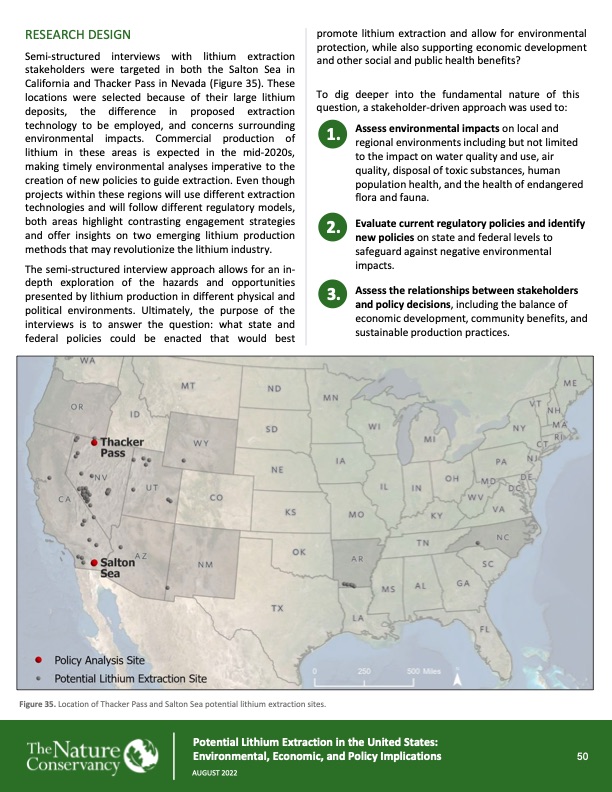
RESEARCH DESIGN promote lithium extraction and allow for environmental protection, while also supporting economic development and other social and public health benefits? To dig deeper into the fundamental nature of this question, a stakeholder-driven approach was used to: Assess environmental impacts on local and regional environments including but not limited to the impact on water quality and use, air quality, disposal of toxic substances, human population health, and the health of endangered flora and fauna. Evaluate current regulatory policies and identify new policies on state and federal levels to safeguard against negative environmental impacts. Assess the relationships between stakeholders and policy decisions, including the balance of economic development, community benefits, and sustainable production practices. Semi-structured interviews with lithium extraction stakeholders were targeted in both the Salton Sea in California and Thacker Pass in Nevada (Figure 35). These locations were selected because of their large lithium deposits, the difference in proposed extraction technology to be employed, and concerns surrounding environmental impacts. Commercial production of lithium in these areas is expected in the mid-2020s, making timely environmental analyses imperative to the creation of new policies to guide extraction. Even though projects within these regions will use different extraction technologies and will follow different regulatory models, both areas highlight contrasting engagement strategies and offer insights on two emerging lithium production methods that may revolutionize the lithium industry. The semi-structured interview approach allows for an in- depth exploration of the hazards and opportunities presented by lithium production in different physical and 3. political environments. Ultimately, the purpose of the interviews is to answer the question: what state and federal policies could be enacted that would best Figure 35. Location of Thacker Pass and Salton Sea potential lithium extraction sites. 1. 2. Potential Lithium Extraction in the United States: Environmental, Economic, and Policy Implications 50 AUGUST 2022PDF Image | Potential Lithium Extraction in the United States
PDF Search Title:
Potential Lithium Extraction in the United StatesOriginal File Name Searched:
Lithium_Report_FINAL.pdfDIY PDF Search: Google It | Yahoo | Bing
Product and Development Focus for Infinity Turbine
ORC Waste Heat Turbine and ORC System Build Plans: All turbine plans are $10,000 each. This allows you to build a system and then consider licensing for production after you have completed and tested a unit.Redox Flow Battery Technology: With the advent of the new USA tax credits for producing and selling batteries ($35/kW) we are focussing on a simple flow battery using shipping containers as the modular electrolyte storage units with tax credits up to $140,000 per system. Our main focus is on the salt battery. This battery can be used for both thermal and electrical storage applications. We call it the Cogeneration Battery or Cogen Battery. One project is converting salt (brine) based water conditioners to simultaneously produce power. In addition, there are many opportunities to extract Lithium from brine (salt lakes, groundwater, and producer water).Salt water or brine are huge sources for lithium. Most of the worlds lithium is acquired from a brine source. It's even in seawater in a low concentration. Brine is also a byproduct of huge powerplants, which can now use that as an electrolyte and a huge flow battery (which allows storage at the source).We welcome any business and equipment inquiries, as well as licensing our turbines for manufacturing.| CONTACT TEL: 608-238-6001 Email: greg@infinityturbine.com | RSS | AMP |