
PDF Publication Title:
Text from PDF Page: 049
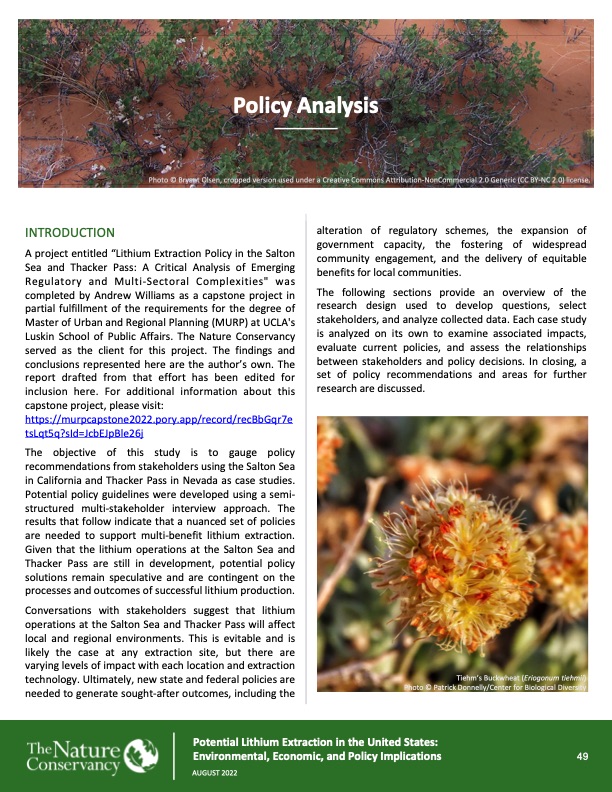
Policy Analysis Photo © Bryant Olsen, cropped version used under a Creative Commons Attribution-NonCommercial 2.0 Generic (CC BY-NC 2.0) license. INTRODUCTION A project entitled “Lithium Extraction Policy in the Salton Sea and Thacker Pass: A Critical Analysis of Emerging Regulatory and Multi-Sectoral Complexities" was completed by Andrew Williams as a capstone project in partial fulfillment of the requirements for the degree of Master of Urban and Regional Planning (MURP) at UCLA's Luskin School of Public Affairs. The Nature Conservancy served as the client for this project. The findings and conclusions represented here are the author’s own. The report drafted from that effort has been edited for inclusion here. For additional information about this capstone project, please visit: https://murpcapstone2022.pory.app/record/recBbGqr7e tsLqt5q?sId=JcbEJpBle26j The objective of this study is to gauge policy recommendations from stakeholders using the Salton Sea in California and Thacker Pass in Nevada as case studies. Potential policy guidelines were developed using a semi- structured multi-stakeholder interview approach. The results that follow indicate that a nuanced set of policies are needed to support multi-benefit lithium extraction. Given that the lithium operations at the Salton Sea and Thacker Pass are still in development, potential policy solutions remain speculative and are contingent on the processes and outcomes of successful lithium production. Conversations with stakeholders suggest that lithium operations at the Salton Sea and Thacker Pass will affect local and regional environments. This is evitable and is likely the case at any extraction site, but there are varying levels of impact with each location and extraction technology. Ultimately, new state and federal policies are needed to generate sought-after outcomes, including the alteration of regulatory schemes, the expansion of government capacity, the fostering of widespread community engagement, and the delivery of equitable benefits for local communities. The following sections provide an overview of the research design used to develop questions, select stakeholders, and analyze collected data. Each case study is analyzed on its own to examine associated impacts, evaluate current policies, and assess the relationships between stakeholders and policy decisions. In closing, a set of policy recommendations and areas for further research are discussed. Tiehm’s Buckwheat (Eriogonum tiehmii) Photo © Patrick Donnelly/Center for Biological Diversity Potential Lithium Extraction in the United States: Environmental, Economic, and Policy Implications 49 AUGUST 2022PDF Image | Potential Lithium Extraction in the United States
PDF Search Title:
Potential Lithium Extraction in the United StatesOriginal File Name Searched:
Lithium_Report_FINAL.pdfDIY PDF Search: Google It | Yahoo | Bing
Product and Development Focus for Infinity Turbine
ORC Waste Heat Turbine and ORC System Build Plans: All turbine plans are $10,000 each. This allows you to build a system and then consider licensing for production after you have completed and tested a unit.Redox Flow Battery Technology: With the advent of the new USA tax credits for producing and selling batteries ($35/kW) we are focussing on a simple flow battery using shipping containers as the modular electrolyte storage units with tax credits up to $140,000 per system. Our main focus is on the salt battery. This battery can be used for both thermal and electrical storage applications. We call it the Cogeneration Battery or Cogen Battery. One project is converting salt (brine) based water conditioners to simultaneously produce power. In addition, there are many opportunities to extract Lithium from brine (salt lakes, groundwater, and producer water).Salt water or brine are huge sources for lithium. Most of the worlds lithium is acquired from a brine source. It's even in seawater in a low concentration. Brine is also a byproduct of huge powerplants, which can now use that as an electrolyte and a huge flow battery (which allows storage at the source).We welcome any business and equipment inquiries, as well as licensing our turbines for manufacturing.| CONTACT TEL: 608-238-6001 Email: greg@infinityturbine.com | RSS | AMP |