
PDF Publication Title:
Text from PDF Page: 046
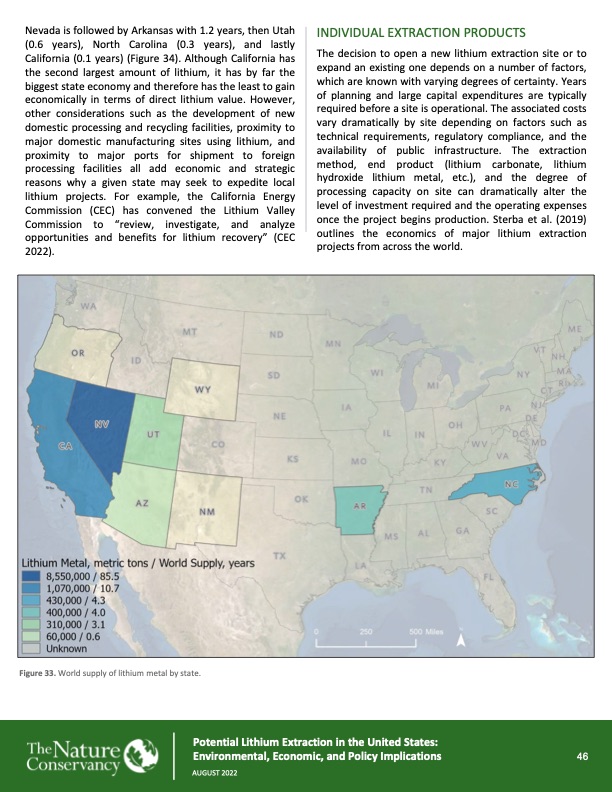
Nevada is followed by Arkansas with 1.2 years, then Utah (0.6 years), North Carolina (0.3 years), and lastly California (0.1 years) (Figure 34). Although California has the second largest amount of lithium, it has by far the biggest state economy and therefore has the least to gain economically in terms of direct lithium value. However, other considerations such as the development of new domestic processing and recycling facilities, proximity to major domestic manufacturing sites using lithium, and proximity to major ports for shipment to foreign processing facilities all add economic and strategic reasons why a given state may seek to expedite local lithium projects. For example, the California Energy Commission (CEC) has convened the Lithium Valley Commission to “review, investigate, and analyze opportunities and benefits for lithium recovery” (CEC 2022). INDIVIDUAL EXTRACTION PRODUCTS The decision to open a new lithium extraction site or to expand an existing one depends on a number of factors, which are known with varying degrees of certainty. Years of planning and large capital expenditures are typically required before a site is operational. The associated costs vary dramatically by site depending on factors such as technical requirements, regulatory compliance, and the availability of public infrastructure. The extraction method, end product (lithium carbonate, lithium hydroxide lithium metal, etc.), and the degree of processing capacity on site can dramatically alter the level of investment required and the operating expenses once the project begins production. Sterba et al. (2019) outlines the economics of major lithium extraction projects from across the world. Figure 33. World supply of lithium metal by state. Potential Lithium Extraction in the United States: Environmental, Economic, and Policy Implications 46 AUGUST 2022PDF Image | Potential Lithium Extraction in the United States
PDF Search Title:
Potential Lithium Extraction in the United StatesOriginal File Name Searched:
Lithium_Report_FINAL.pdfDIY PDF Search: Google It | Yahoo | Bing
Product and Development Focus for Infinity Turbine
ORC Waste Heat Turbine and ORC System Build Plans: All turbine plans are $10,000 each. This allows you to build a system and then consider licensing for production after you have completed and tested a unit.Redox Flow Battery Technology: With the advent of the new USA tax credits for producing and selling batteries ($35/kW) we are focussing on a simple flow battery using shipping containers as the modular electrolyte storage units with tax credits up to $140,000 per system. Our main focus is on the salt battery. This battery can be used for both thermal and electrical storage applications. We call it the Cogeneration Battery or Cogen Battery. One project is converting salt (brine) based water conditioners to simultaneously produce power. In addition, there are many opportunities to extract Lithium from brine (salt lakes, groundwater, and producer water).Salt water or brine are huge sources for lithium. Most of the worlds lithium is acquired from a brine source. It's even in seawater in a low concentration. Brine is also a byproduct of huge powerplants, which can now use that as an electrolyte and a huge flow battery (which allows storage at the source).We welcome any business and equipment inquiries, as well as licensing our turbines for manufacturing.| CONTACT TEL: 608-238-6001 Email: greg@infinityturbine.com | RSS | AMP |