
PDF Publication Title:
Text from PDF Page: 192
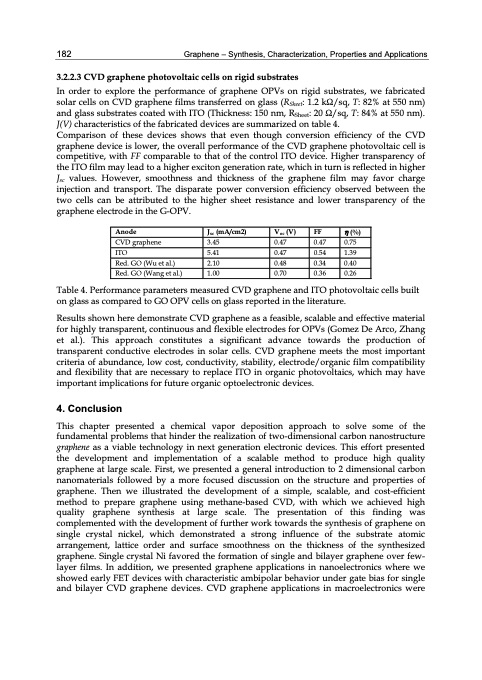
182 Graphene – Synthesis, Characterization, Properties and Applications 3.2.2.3 CVD graphene photovoltaic cells on rigid substrates In order to explore the performance of graphene OPVs on rigid substrates, we fabricated solar cells on CVD graphene films transferred on glass (RSheet: 1.2 kΩ/sq, T: 82% at 550 nm) and glass substrates coated with ITO (Thickness: 150 nm, RSheet: 20 Ω/sq, T: 84% at 550 nm). J(V) characteristics of the fabricated devices are summarized on table 4. Comparison of these devices shows that even though conversion efficiency of the CVD graphene device is lower, the overall performance of the CVD graphene photovoltaic cell is competitive, with FF comparable to that of the control ITO device. Higher transparency of the ITO film may lead to a higher exciton generation rate, which in turn is reflected in higher Jsc values. However, smoothness and thickness of the graphene film may favor charge injection and transport. The disparate power conversion efficiency observed between the two cells can be attributed to the higher sheet resistance and lower transparency of the graphene electrode in the G-OPV. Anode CVD graphene ITO Red. GO (Wu et al.) Red. GO (Wang et al.) Jsc (mA/cm2) Voc (V) 3.45 0.47 5.41 0.47 2.10 0.48 1.00 0.70 FF (%) 0.47 0.75 0.54 1.39 0.34 0.40 0.36 0.26 Table 4. Performance parameters measured CVD graphene and ITO photovoltaic cells built on glass as compared to GO OPV cells on glass reported in the literature. Results shown here demonstrate CVD graphene as a feasible, scalable and effective material for highly transparent, continuous and flexible electrodes for OPVs (Gomez De Arco, Zhang et al.). This approach constitutes a significant advance towards the production of transparent conductive electrodes in solar cells. CVD graphene meets the most important criteria of abundance, low cost, conductivity, stability, electrode/organic film compatibility and flexibility that are necessary to replace ITO in organic photovoltaics, which may have important implications for future organic optoelectronic devices. 4. Conclusion This chapter presented a chemical vapor deposition approach to solve some of the fundamental problems that hinder the realization of two-dimensional carbon nanostructure graphene as a viable technology in next generation electronic devices. This effort presented the development and implementation of a scalable method to produce high quality graphene at large scale. First, we presented a general introduction to 2 dimensional carbon nanomaterials followed by a more focused discussion on the structure and properties of graphene. Then we illustrated the development of a simple, scalable, and cost-efficient method to prepare graphene using methane-based CVD, with which we achieved high quality graphene synthesis at large scale. The presentation of this finding was complemented with the development of further work towards the synthesis of graphene on single crystal nickel, which demonstrated a strong influence of the substrate atomic arrangement, lattice order and surface smoothness on the thickness of the synthesized graphene. Single crystal Ni favored the formation of single and bilayer graphene over few- layer films. In addition, we presented graphene applications in nanoelectronics where we showed early FET devices with characteristic ambipolar behavior under gate bias for single and bilayer CVD graphene devices. CVD graphene applications in macroelectronics werePDF Image | GRAPHENE SYNTHESIS CHARACTERIZATION PROPERTIES
PDF Search Title:
GRAPHENE SYNTHESIS CHARACTERIZATION PROPERTIESOriginal File Name Searched:
Graphene-Synthesis.pdfDIY PDF Search: Google It | Yahoo | Bing
Salgenx Redox Flow Battery Technology: Power up your energy storage game with Salgenx Salt Water Battery. With its advanced technology, the flow battery provides reliable, scalable, and sustainable energy storage for utility-scale projects. Upgrade to a Salgenx flow battery today and take control of your energy future.
| CONTACT TEL: 608-238-6001 Email: greg@infinityturbine.com | RSS | AMP |