
PDF Publication Title:
Text from PDF Page: 187
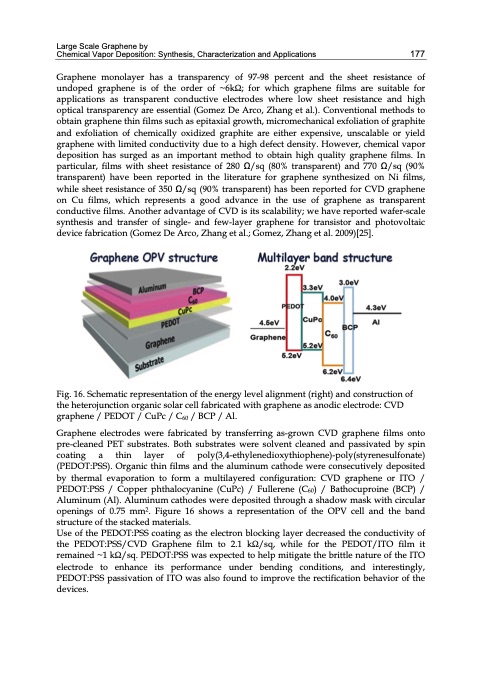
Large Scale Graphene by Chemical Vapor Deposition: Synthesis, Characterization and Applications 177 Graphene monolayer has a transparency of 97-98 percent and the sheet resistance of undoped graphene is of the order of ~6kΩ; for which graphene films are suitable for applications as transparent conductive electrodes where low sheet resistance and high optical transparency are essential (Gomez De Arco, Zhang et al.). Conventional methods to obtain graphene thin films such as epitaxial growth, micromechanical exfoliation of graphite and exfoliation of chemically oxidized graphite are either expensive, unscalable or yield graphene with limited conductivity due to a high defect density. However, chemical vapor deposition has surged as an important method to obtain high quality graphene films. In particular, films with sheet resistance of 280 Ω/sq (80% transparent) and 770 Ω/sq (90% transparent) have been reported in the literature for graphene synthesized on Ni films, while sheet resistance of 350 Ω/sq (90% transparent) has been reported for CVD graphene on Cu films, which represents a good advance in the use of graphene as transparent conductive films. Another advantage of CVD is its scalability; we have reported wafer-scale synthesis and transfer of single- and few-layer graphene for transistor and photovoltaic device fabrication (Gomez De Arco, Zhang et al.; Gomez, Zhang et al. 2009)[25]. Fig. 16. Schematic representation of the energy level alignment (right) and construction of the heterojunction organic solar cell fabricated with graphene as anodic electrode: CVD graphene / PEDOT / CuPc / C60 / BCP / Al. Graphene electrodes were fabricated by transferring as-grown CVD graphene films onto pre-cleaned PET substrates. Both substrates were solvent cleaned and passivated by spin coating a thin layer of poly(3,4-ethylenedioxythiophene)-poly(styrenesulfonate) (PEDOT:PSS). Organic thin films and the aluminum cathode were consecutively deposited by thermal evaporation to form a multilayered configuration: CVD graphene or ITO / PEDOT:PSS / Copper phthalocyanine (CuPc) / Fullerene (C60) / Bathocuproine (BCP) / Aluminum (Al). Aluminum cathodes were deposited through a shadow mask with circular openings of 0.75 mm2. Figure 16 shows a representation of the OPV cell and the band structure of the stacked materials. Use of the PEDOT:PSS coating as the electron blocking layer decreased the conductivity of the PEDOT:PSS/CVD Graphene film to 2.1 kΩ/sq, while for the PEDOT/ITO film it remained ~1 kΩ/sq. PEDOT:PSS was expected to help mitigate the brittle nature of the ITO electrode to enhance its performance under bending conditions, and interestingly, PEDOT:PSS passivation of ITO was also found to improve the rectification behavior of the devices.PDF Image | GRAPHENE SYNTHESIS CHARACTERIZATION PROPERTIES
PDF Search Title:
GRAPHENE SYNTHESIS CHARACTERIZATION PROPERTIESOriginal File Name Searched:
Graphene-Synthesis.pdfDIY PDF Search: Google It | Yahoo | Bing
Salgenx Redox Flow Battery Technology: Power up your energy storage game with Salgenx Salt Water Battery. With its advanced technology, the flow battery provides reliable, scalable, and sustainable energy storage for utility-scale projects. Upgrade to a Salgenx flow battery today and take control of your energy future.
| CONTACT TEL: 608-238-6001 Email: greg@infinityturbine.com | RSS | AMP |