PDF Publication Title:
Text from PDF Page: 172
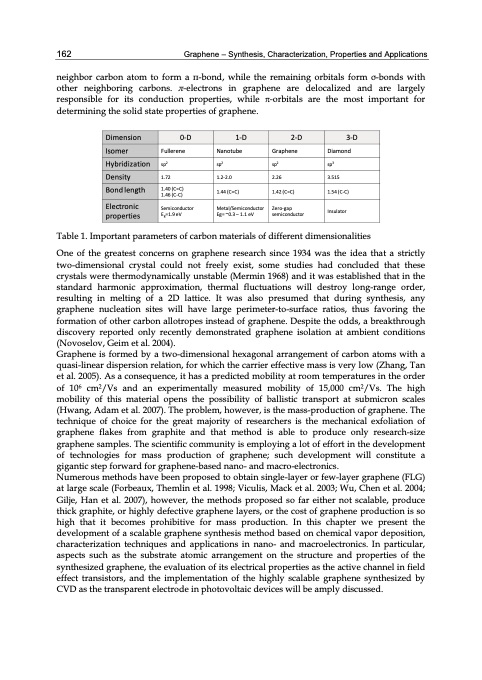
162 Graphene – Synthesis, Characterization, Properties and Applications neighbor carbon atom to form a π-bond, while the remaining orbitals form σ-bonds with other neighboring carbons. π-electrons in graphene are delocalized and are largely responsible for its conduction properties, while -orbitals are the most important for determining the solid state properties of graphene. Dimension 0-D 1-D 2-D 3-D Isomer Fullerene Nanotube Graphene Diamond Hybridization sp2 sp2 sp2 sp3 Density 1.72 1.2-2.0 2.26 3.515 Bond length 1.40 (C=C) 1.46 (C-C) 1.44 (C=C) 1.42 (C=C) 1.54 (C-C) Electronic properties Semiconductor Eg=1.9 eV Metal/Semiconductor Eg= ~0.3 – 1.1 eV Zero-gap semiconductor Insulator Table 1. Important parameters of carbon materials of different dimensionalities One of the greatest concerns on graphene research since 1934 was the idea that a strictly two-dimensional crystal could not freely exist, some studies had concluded that these crystals were thermodynamically unstable (Mermin 1968) and it was established that in the standard harmonic approximation, thermal fluctuations will destroy long-range order, resulting in melting of a 2D lattice. It was also presumed that during synthesis, any graphene nucleation sites will have large perimeter-to-surface ratios, thus favoring the formation of other carbon allotropes instead of graphene. Despite the odds, a breakthrough discovery reported only recently demonstrated graphene isolation at ambient conditions (Novoselov, Geim et al. 2004). Graphene is formed by a two-dimensional hexagonal arrangement of carbon atoms with a quasi-linear dispersion relation, for which the carrier effective mass is very low (Zhang, Tan et al. 2005). As a consequence, it has a predicted mobility at room temperatures in the order of 106 cm2/Vs and an experimentally measured mobility of 15,000 cm2/Vs. The high mobility of this material opens the possibility of ballistic transport at submicron scales (Hwang, Adam et al. 2007). The problem, however, is the mass-production of graphene. The technique of choice for the great majority of researchers is the mechanical exfoliation of graphene flakes from graphite and that method is able to produce only research-size graphene samples. The scientific community is employing a lot of effort in the development of technologies for mass production of graphene; such development will constitute a gigantic step forward for graphene-based nano- and macro-electronics. Numerous methods have been proposed to obtain single-layer or few-layer graphene (FLG) at large scale (Forbeaux, Themlin et al. 1998; Viculis, Mack et al. 2003; Wu, Chen et al. 2004; Gilje, Han et al. 2007), however, the methods proposed so far either not scalable, produce thick graphite, or highly defective graphene layers, or the cost of graphene production is so high that it becomes prohibitive for mass production. In this chapter we present the development of a scalable graphene synthesis method based on chemical vapor deposition, characterization techniques and applications in nano- and macroelectronics. In particular, aspects such as the substrate atomic arrangement on the structure and properties of the synthesized graphene, the evaluation of its electrical properties as the active channel in field effect transistors, and the implementation of the highly scalable graphene synthesized by CVD as the transparent electrode in photovoltaic devices will be amply discussed.PDF Image | GRAPHENE SYNTHESIS CHARACTERIZATION PROPERTIES
PDF Search Title:
GRAPHENE SYNTHESIS CHARACTERIZATION PROPERTIESOriginal File Name Searched:
Graphene-Synthesis.pdfDIY PDF Search: Google It | Yahoo | Bing
Salgenx Redox Flow Battery Technology: Power up your energy storage game with Salgenx Salt Water Battery. With its advanced technology, the flow battery provides reliable, scalable, and sustainable energy storage for utility-scale projects. Upgrade to a Salgenx flow battery today and take control of your energy future.
CONTACT TEL: 608-238-6001 Email: greg@infinityturbine.com (Standard Web Page)