
PDF Publication Title:
Text from PDF Page: 156
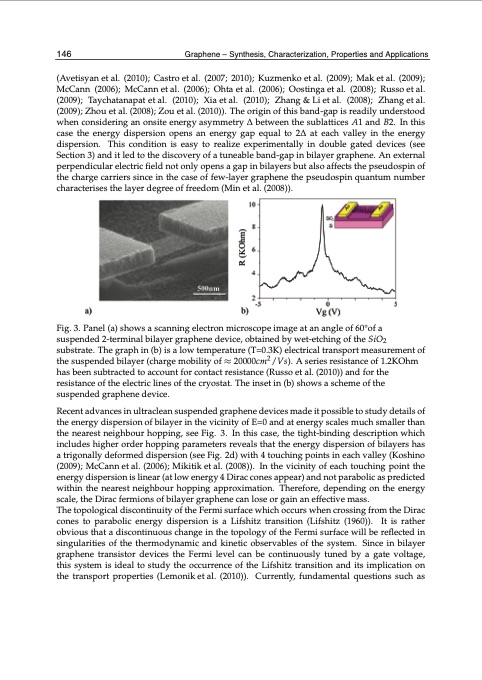
6146 Graphene – Synthesis, Characterization, Properties anWdill-bAe-psept-lbiyc-IaN-tTiEoCnHs (Avetisyan et al. (2010); Castro et al. (2007; 2010); Kuzmenko et al. (2009); Mak et al. (2009); McCann (2006); McCann et al. (2006); Ohta et al. (2006); Oostinga et al. (2008); Russo et al. (2009); Taychatanapatetal. (2010); Xiaetal. (2010); Zhang&Lietal. (2008); Zhangetal. (2009); Zhou et al. (2008); Zou et al. (2010)). The origin of this band-gap is readily understood when considering an onsite energy asymmetry Δ between the sublattices A1 and B2. In this case the energy dispersion opens an energy gap equal to 2Δ at each valley in the energy dispersion. This condition is easy to realize experimentally in double gated devices (see Section 3) and it led to the discovery of a tuneable band-gap in bilayer graphene. An external perpendicular electric field not only opens a gap in bilayers but also affects the pseudospin of the charge carriers since in the case of few-layer graphene the pseudospin quantum number characterises the layer degree of freedom (Min et al. (2008)). Fig. 3. Panel (a) shows a scanning electron microscope image at an angle of 60°of a suspended 2-terminal bilayer graphene device, obtained by wet-etching of the SiO2 substrate. The graph in (b) is a low temperature (T=0.3K) electrical transport measurement of the suspended bilayer (charge mobility of ≈ 20000cm2/Vs). A series resistance of 1.2KOhm has been subtracted to account for contact resistance (Russo et al. (2010)) and for the resistance of the electric lines of the cryostat. The inset in (b) shows a scheme of the suspended graphene device. Recent advances in ultraclean suspended graphene devices made it possible to study details of the energy dispersion of bilayer in the vicinity of E=0 and at energy scales much smaller than the nearest neighbour hopping, see Fig. 3. In this case, the tight-binding description which includes higher order hopping parameters reveals that the energy dispersion of bilayers has a trigonally deformed dispersion (see Fig. 2d) with 4 touching points in each valley (Koshino (2009); McCann et al. (2006); Mikitik et al. (2008)). In the vicinity of each touching point the energy dispersion is linear (at low energy 4 Dirac cones appear) and not parabolic as predicted within the nearest neighbour hopping approximation. Therefore, depending on the energy scale, the Dirac fermions of bilayer graphene can lose or gain an effective mass. The topological discontinuity of the Fermi surface which occurs when crossing from the Dirac cones to parabolic energy dispersion is a Lifshitz transition (Lifshitz (1960)). It is rather obvious that a discontinuous change in the topology of the Fermi surface will be reflected in singularities of the thermodynamic and kinetic observables of the system. Since in bilayer graphene transistor devices the Fermi level can be continuously tuned by a gate voltage, this system is ideal to study the occurrence of the Lifshitz transition and its implication on the transport properties (Lemonik et al. (2010)). Currently, fundamental questions such asPDF Image | GRAPHENE SYNTHESIS CHARACTERIZATION PROPERTIES
PDF Search Title:
GRAPHENE SYNTHESIS CHARACTERIZATION PROPERTIESOriginal File Name Searched:
Graphene-Synthesis.pdfDIY PDF Search: Google It | Yahoo | Bing
Salgenx Redox Flow Battery Technology: Power up your energy storage game with Salgenx Salt Water Battery. With its advanced technology, the flow battery provides reliable, scalable, and sustainable energy storage for utility-scale projects. Upgrade to a Salgenx flow battery today and take control of your energy future.
| CONTACT TEL: 608-238-6001 Email: greg@infinityturbine.com | RSS | AMP |