PDF Publication Title:
Text from PDF Page: 143
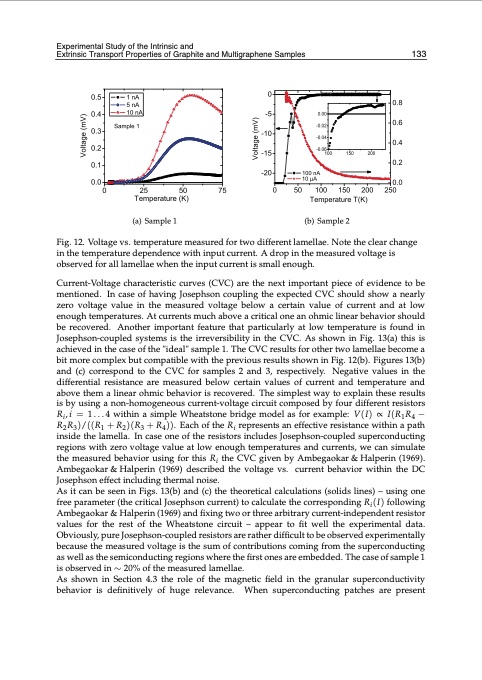
Experimental Study of the Intrinsic and Exxpetriminenstaicl StTudryaonf tshepInotrintsiPc arnodpExetrintsieic sTraonsfpoGrt rParopehrtietseofaGnradphiMte aundltMigurltiagrpaphenne SeamSpalesmples 13139 (a) Sample 1 (b) Sample 2 Fig. 12. Voltage vs. temperature measured for two different lamellae. Note the clear change in the temperature dependence with input current. A drop in the measured voltage is observed for all lamellae when the input current is small enough. Current-Voltage characteristic curves (CVC) are the next important piece of evidence to be mentioned. In case of having Josephson coupling the expected CVC should show a nearly zero voltage value in the measured voltage below a certain value of current and at low enough temperatures. At currents much above a critical one an ohmic linear behavior should be recovered. Another important feature that particularly at low temperature is found in Josephson-coupled systems is the irreversibility in the CVC. As shown in Fig. 13(a) this is achieved in the case of the "ideal" sample 1. The CVC results for other two lamellae become a bit more complex but compatible with the previous results shown in Fig. 12(b). Figures 13(b) and (c) correspond to the CVC for samples 2 and 3, respectively. Negative values in the differential resistance are measured below certain values of current and temperature and above them a linear ohmic behavior is recovered. The simplest way to explain these results is by using a non-homogeneous current-voltage circuit composed by four different resistors Ri, i = 1 . . . 4 within a simple Wheatstone bridge model as for example: V(I) ∝ I(R1R4 − R2R3)/((R1 + R2)(R3 + R4)). Each of the Ri represents an effective resistance within a path inside the lamella. In case one of the resistors includes Josephson-coupled superconducting regions with zero voltage value at low enough temperatures and currents, we can simulate the measured behavior using for this Ri the CVC given by Ambegaokar & Halperin (1969). Ambegaokar & Halperin (1969) described the voltage vs. current behavior within the DC Josephson effect including thermal noise. As it can be seen in Figs. 13(b) and (c) the theoretical calculations (solids lines) – using one free parameter (the critical Josephson current) to calculate the corresponding Ri(I) following Ambegaokar & Halperin (1969) and fixing two or three arbitrary current-independent resistor values for the rest of the Wheatstone circuit – appear to fit well the experimental data. Obviously, pure Josephson-coupled resistors are rather difficult to be observed experimentally because the measured voltage is the sum of contributions coming from the superconducting as well as the semiconducting regions where the first ones are embedded. The case of sample 1 is observed in ∼ 20% of the measured lamellae. As shown in Section 4.3 the role of the magnetic field in the granular superconductivity behavior is definitively of huge relevance. When superconducting patches are presentPDF Image | GRAPHENE SYNTHESIS CHARACTERIZATION PROPERTIES
PDF Search Title:
GRAPHENE SYNTHESIS CHARACTERIZATION PROPERTIESOriginal File Name Searched:
Graphene-Synthesis.pdfDIY PDF Search: Google It | Yahoo | Bing
Salgenx Redox Flow Battery Technology: Power up your energy storage game with Salgenx Salt Water Battery. With its advanced technology, the flow battery provides reliable, scalable, and sustainable energy storage for utility-scale projects. Upgrade to a Salgenx flow battery today and take control of your energy future.
CONTACT TEL: 608-238-6001 Email: greg@infinityturbine.com (Standard Web Page)