
PDF Publication Title:
Text from PDF Page: 076
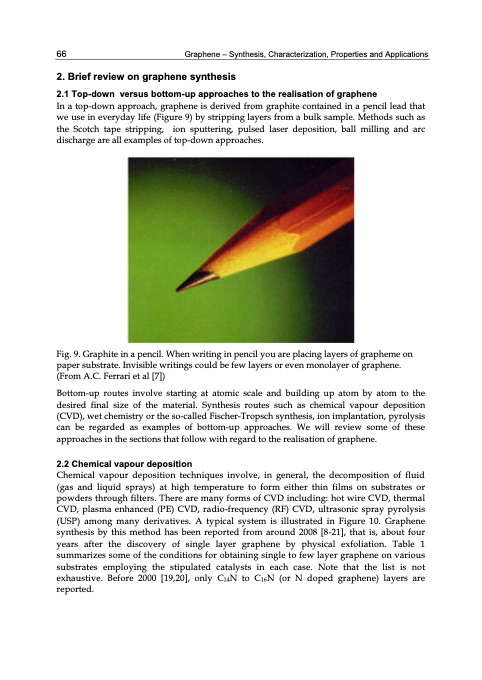
66 Graphene – Synthesis, Characterization, Properties and Applications 2. Brief review on graphene synthesis 2.1 Top-down versus bottom-up approaches to the realisation of graphene In a top-down approach, graphene is derived from graphite contained in a pencil lead that we use in everyday life (Figure 9) by stripping layers from a bulk sample. Methods such as the Scotch tape stripping, ion sputtering, pulsed laser deposition, ball milling and arc discharge are all examples of top-down approaches. Fig. 9. Graphite in a pencil. When writing in pencil you are placing layers of grapheme on paper substrate. Invisible writings could be few layers or even monolayer of graphene. (From A.C. Ferrari et al [7]) Bottom-up routes involve starting at atomic scale and building up atom by atom to the desired final size of the material. Synthesis routes such as chemical vapour deposition (CVD), wet chemistry or the so-called Fischer-Tropsch synthesis, ion implantation, pyrolysis can be regarded as examples of bottom-up approaches. We will review some of these approaches in the sections that follow with regard to the realisation of graphene. 2.2 Chemical vapour deposition Chemical vapour deposition techniques involve, in general, the decomposition of fluid (gas and liquid sprays) at high temperature to form either thin films on substrates or powders through filters. There are many forms of CVD including: hot wire CVD, thermal CVD, plasma enhanced (PE) CVD, radio-frequency (RF) CVD, ultrasonic spray pyrolysis (USP) among many derivatives. A typical system is illustrated in Figure 10. Graphene synthesis by this method has been reported from around 2008 [8-21], that is, about four years after the discovery of single layer graphene by physical exfoliation. Table 1 summarizes some of the conditions for obtaining single to few layer graphene on various substrates employing the stipulated catalysts in each case. Note that the list is not exhaustive. Before 2000 [19,20], only C14N to C16N (or N doped graphene) layers are reported.PDF Image | GRAPHENE SYNTHESIS CHARACTERIZATION PROPERTIES
PDF Search Title:
GRAPHENE SYNTHESIS CHARACTERIZATION PROPERTIESOriginal File Name Searched:
Graphene-Synthesis.pdfDIY PDF Search: Google It | Yahoo | Bing
Salgenx Redox Flow Battery Technology: Power up your energy storage game with Salgenx Salt Water Battery. With its advanced technology, the flow battery provides reliable, scalable, and sustainable energy storage for utility-scale projects. Upgrade to a Salgenx flow battery today and take control of your energy future.
| CONTACT TEL: 608-238-6001 Email: greg@infinityturbine.com | RSS | AMP |