
PDF Publication Title:
Text from PDF Page: 156
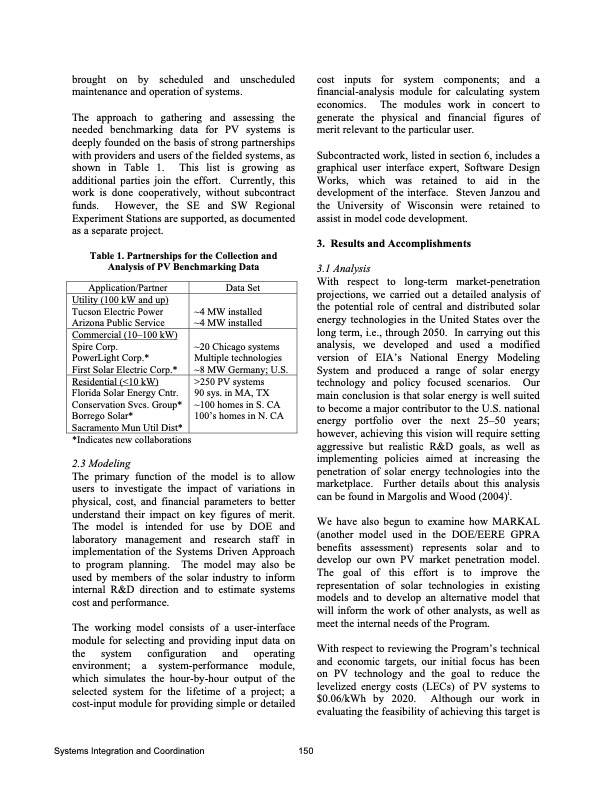
brought on by scheduled and unscheduled maintenance and operation of systems. The approach to gathering and assessing the needed benchmarking data for PV systems is deeply founded on the basis of strong partnerships with providers and users of the fielded systems, as shown in Table 1. This list is growing as additional parties join the effort. Currently, this work is done cooperatively, without subcontract funds. However, the SE and SW Regional Experiment Stations are supported, as documented as a separate project. Table 1. Partnerships for the Collection and Analysis of PV Benchmarking Data cost inputs for system components; and a financial-analysis module for calculating system economics. The modules work in concert to generate the physical and financial figures of merit relevant to the particular user. Subcontracted work, listed in section 6, includes a graphical user interface expert, Software Design Works, which was retained to aid in the development of the interface. Steven Janzou and the University of Wisconsin were retained to assist in model code development. 3. Results and Accomplishments 3.1 Analysis With respect to long-term market-penetration projections, we carried out a detailed analysis of the potential role of central and distributed solar energy technologies in the United States over the long term, i.e., through 2050. In carrying out this analysis, we developed and used a modified version of EIA’s National Energy Modeling System and produced a range of solar energy technology and policy focused scenarios. Our main conclusion is that solar energy is well suited to become a major contributor to the U.S. national energy portfolio over the next 25–50 years; however, achieving this vision will require setting aggressive but realistic R&D goals, as well as implementing policies aimed at increasing the penetration of solar energy technologies into the marketplace. Further details about this analysis can be found in Margolis and Wood (2004)i. We have also begun to examine how MARKAL (another model used in the DOE/EERE GPRA benefits assessment) represents solar and to develop our own PV market penetration model. The goal of this effort is to improve the representation of solar technologies in existing models and to develop an alternative model that will inform the work of other analysts, as well as meet the internal needs of the Program. With respect to reviewing the Program’s technical and economic targets, our initial focus has been on PV technology and the goal to reduce the levelized energy costs (LECs) of PV systems to $0.06/kWh by 2020. Although our work in evaluating the feasibility of achieving this target is Application/Partner Utility (100 kW and up) Tucson Electric Power Arizona Public Service *Indicates new collaborations 2.3 Modeling Data Set ~4 MW installed ~4 MW installed Commercial (10–100 kW) Spire Corp. PowerLight Corp.* First Solar Electric Corp.* ~20 Chicago systems Multiple technologies ~8 MW Germany; U.S. Residential (<10 kW) Florida Solar Energy Cntr. Conservation Svcs. Group* Borrego Solar* Sacramento Mun Util Dist* >250 PV systems 90 sys. in MA, TX ~100 homes in S. CA 100’s homes in N. CA The primary function of the model is to allow users to investigate the impact of variations in physical, cost, and financial parameters to better understand their impact on key figures of merit. The model is intended for use by DOE and laboratory management and research staff in implementation of the Systems Driven Approach to program planning. The model may also be used by members of the solar industry to inform internal R&D direction and to estimate systems cost and performance. The working model consists of a user-interface module for selecting and providing input data on the system configuration and operating environment; a system-performance module, which simulates the hour-by-hour output of the selected system for the lifetime of a project; a cost-input module for providing simple or detailedPDF Image | FY 2004 ANNUAL REPORT DOE Solar
PDF Search Title:
FY 2004 ANNUAL REPORT DOE SolarOriginal File Name Searched:
36804.pdfDIY PDF Search: Google It | Yahoo | Bing
NFT (Non Fungible Token): Buy our tech, design, development or system NFT and become part of our tech NFT network... More Info
IT XR Project Redstone NFT Available for Sale: NFT for high tech turbine design with one part 3D printed counter-rotating energy turbine. Be part of the future with this NFT. Can be bought and sold but only one design NFT exists. Royalties go to the developer (Infinity) to keep enhancing design and applications... More Info
Infinity Turbine IT XR Project Redstone Design: NFT for sale... NFT for high tech turbine design with one part 3D printed counter-rotating energy turbine. Includes all rights to this turbine design, including license for Fluid Handling Block I and II for the turbine assembly and housing. The NFT includes the blueprints (cad/cam), revenue streams, and all future development of the IT XR Project Redstone... More Info
Infinity Turbine ROT Radial Outflow Turbine 24 Design and Worldwide Rights: NFT for sale... NFT for the ROT 24 energy turbine. Be part of the future with this NFT. This design can be bought and sold but only one design NFT exists. You may manufacture the unit, or get the revenues from its sale from Infinity Turbine. Royalties go to the developer (Infinity) to keep enhancing design and applications... More Info
Infinity Supercritical CO2 10 Liter Extractor Design and Worldwide Rights: The Infinity Supercritical 10L CO2 extractor is for botanical oil extraction, which is rich in terpenes and can produce shelf ready full spectrum oil. With over 5 years of development, this industry leader mature extractor machine has been sold since 2015 and is part of many profitable businesses. The process can also be used for electrowinning, e-waste recycling, and lithium battery recycling, gold mining electronic wastes, precious metals. CO2 can also be used in a reverse fuel cell with nafion to make a gas-to-liquids fuel, such as methanol, ethanol and butanol or ethylene. Supercritical CO2 has also been used for treating nafion to make it more effective catalyst. This NFT is for the purchase of worldwide rights which includes the design. More Info
NFT (Non Fungible Token): Buy our tech, design, development or system NFT and become part of our tech NFT network... More Info
Infinity Turbine Products: Special for this month, any plans are $10,000 for complete Cad/Cam blueprints. License is for one build. Try before you buy a production license. May pay by Bitcoin or other Crypto. Products Page... More Info
| CONTACT TEL: 608-238-6001 Email: greg@infinityturbine.com | RSS | AMP |