Search Completed | Title | Paramagnetic Materials Algorithmic Cooling for NMR Quantum
Original File Name Searched: 0511153.pdf | Google It | Yahoo | Bing
Page | 005 4 Jos ́e Fernandez ,Tal Mor and Yossi Weinstein
taken out of equilibrium, the relaxation process back to equilibrium is always active. So not only do the warm reset qubits cool down, but also the cooled spins warm back up. This warming process is undesired, and therefore we need to find a way to minimize it. If we succeed in increasing the T1 ratio between the computational qubits and the reset qubits, the cooled qubits thermalization would play a smaller rule during the reset qubits thermalization.
The use of paramagnetic salts for reducing the thermalization times is a common practice in NMR spectroscopy. Can it also be used to improve the thermalization- times ratio? If we use protons as reset qubits and carbons as computation qubits, it may well be that a paramagnetic salt will increase the T1 ratio. A good reason to believe so is that, in a typical carbon-chain molecule, the protons are more exposed than the carbons to the environment solution.
We t o o k t r i c h l o r o e t h y l e n e ( T C E ) w i t h t w o 1 3 C n u c l e i ( s p i n 1 / 2 ) u s e d as computation qubits, and one proton (spin 1/2 as well) used as a reset qubit. The TCE was dissolved in deuterated chloroform. We added the salt chromium(III)acetylacetonate (AKA chromium 2,4-pentanedionate) to the solu- tion at a concentration of 233.2 mg/liter. Due to the physical structure of the TCE molecule, the proton has a significantly stronger contact with the magnetic ions than the carbons. The strong contact with the ions indeed decreases the thermal- ization time, T1, of the proton significantly compared to the carbons, achieving the goal of increasing the ratio of the T1’s. This is a very strong effect which can be observed by adding as little salt as we did. Naturally, the dephasing time, T2, of all spins, also decreases. T2 sets a boundary on the time available for computing. This is since any quantum information, which was obtained in the molecule, is lost due to dephasing. Therefore the ionic salt concentration should allow enough time to perform a computation.
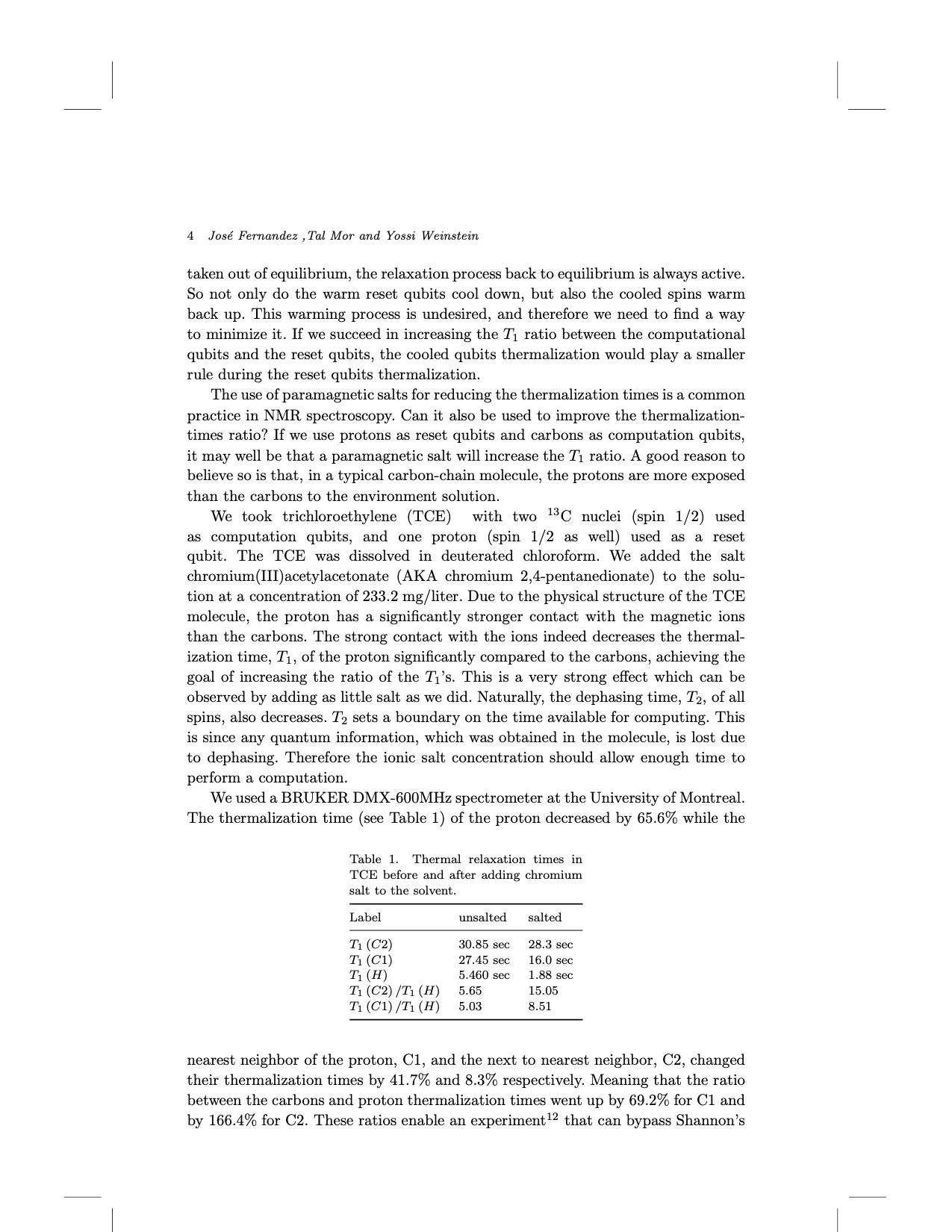
We used a BRUKER DMX-600MHz spectrometer at the University of Montreal. The thermalization time (see Table 1) of the proton decreased by 65.6% while the
Table 1. Thermal relaxation times in TCE before and after adding chromium salt to the solvent.
Label T1 (C2)
T1 (C1)
T1 (H)
T1 (C2) /T1 (H) T1 (C1) /T1 (H)
unsalted
30.85 sec 27.45 sec 5.460 sec 5.65
5.03
salted
28.3 sec 16.0 sec 1.88 sec 15.05 8.51
nearest neighbor of the proton, C1, and the next to nearest neighbor, C2, changed their thermalization times by 41.7% and 8.3% respectively. Meaning that the ratio between the carbons and proton thermalization times went up by 69.2% for C1 and by 166.4% for C2. These ratios enable an experiment12 that can bypass Shannon’s
|
