
PDF Publication Title:
Text from PDF Page: 185
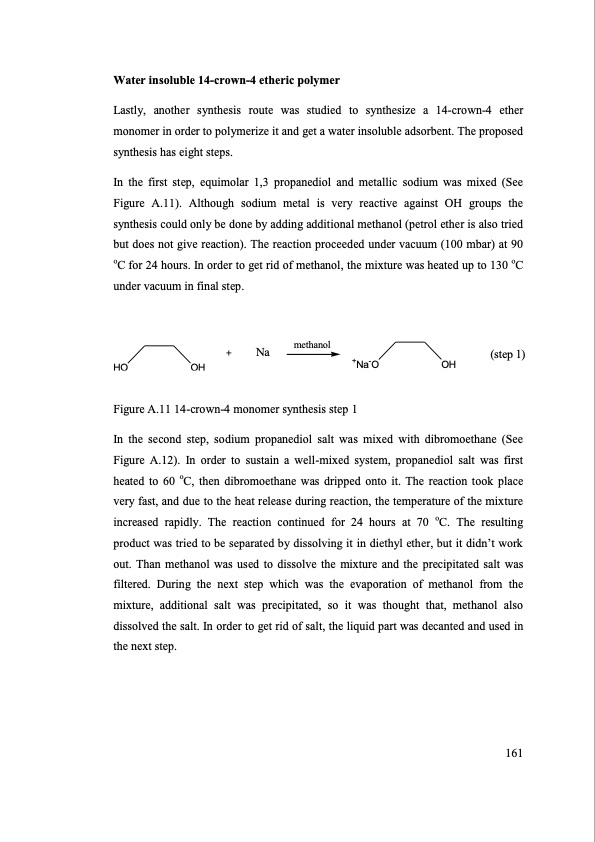
Water insoluble 14-crown-4 etheric polymer Lastly, another synthesis route was studied to synthesize a 14-crown-4 ether monomer in order to polymerize it and get a water insoluble adsorbent. The proposed synthesis has eight steps. In the first step, equimolar 1,3 propanediol and metallic sodium was mixed (See Figure A.11). Although sodium metal is very reactive against OH groups the synthesis could only be done by adding additional methanol (petrol ether is also tried but does not give reaction). The reaction proceeded under vacuum (100 mbar) at 90 oC for 24 hours. In order to get rid of methanol, the mixture was heated up to 130 oC under vacuum in final step. methanol +Na-O OH Figure A.11 14-crown-4 monomer synthesis step 1 HO OH Na (step 1) In the second step, sodium propanediol salt was mixed with dibromoethane (See Figure A.12). In order to sustain a well-mixed system, propanediol salt was first heated to 60 oC, then dibromoethane was dripped onto it. The reaction took place very fast, and due to the heat release during reaction, the temperature of the mixture increased rapidly. The reaction continued for 24 hours at 70 oC. The resulting product was tried to be separated by dissolving it in diethyl ether, but it didn’t work out. Than methanol was used to dissolve the mixture and the precipitated salt was filtered. During the next step which was the evaporation of methanol from the mixture, additional salt was precipitated, so it was thought that, methanol also dissolved the salt. In order to get rid of salt, the liquid part was decanted and used in the next step. 161PDF Image | SEPARATION OF LITHIUM FROM BRINES
PDF Search Title:
SEPARATION OF LITHIUM FROM BRINESOriginal File Name Searched:
separation-lithium-from-brine.pdfDIY PDF Search: Google It | Yahoo | Bing
Product and Development Focus for Infinity Turbine
ORC Waste Heat Turbine and ORC System Build Plans: All turbine plans are $10,000 each. This allows you to build a system and then consider licensing for production after you have completed and tested a unit.Redox Flow Battery Technology: With the advent of the new USA tax credits for producing and selling batteries ($35/kW) we are focussing on a simple flow battery using shipping containers as the modular electrolyte storage units with tax credits up to $140,000 per system. Our main focus is on the salt battery. This battery can be used for both thermal and electrical storage applications. We call it the Cogeneration Battery or Cogen Battery. One project is converting salt (brine) based water conditioners to simultaneously produce power. In addition, there are many opportunities to extract Lithium from brine (salt lakes, groundwater, and producer water).Salt water or brine are huge sources for lithium. Most of the worlds lithium is acquired from a brine source. It's even in seawater in a low concentration. Brine is also a byproduct of huge powerplants, which can now use that as an electrolyte and a huge flow battery (which allows storage at the source).We welcome any business and equipment inquiries, as well as licensing our turbines for manufacturing.| CONTACT TEL: 608-238-6001 Email: greg@infinityturbine.com | RSS | AMP |