
PDF Publication Title:
Text from PDF Page: 032
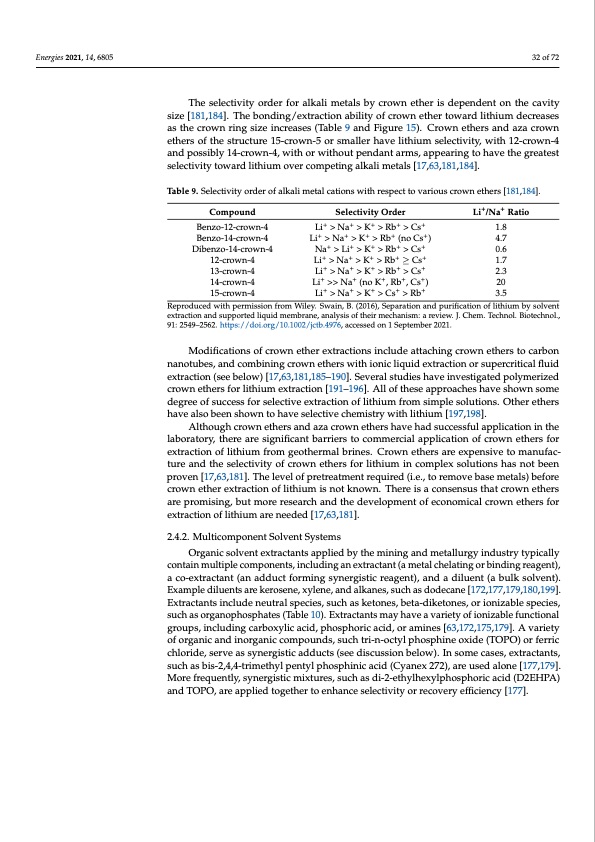
Energies 2021, 14, 6805 32 of 72 The selectivity order for alkali metals by crown ether is dependent on the cavity size [181,184]. The bonding/extraction ability of crown ether toward lithium decreases as the crown ring size increases (Table 9 and Figure 15). Crown ethers and aza crown ethers of the structure 15-crown-5 or smaller have lithium selectivity, with 12-crown-4 and possibly 14-crown-4, with or without pendant arms, appearing to have the greatest selectivity toward lithium over competing alkali metals [17,63,181,184]. Table 9. Selectivity order of alkali metal cations with respect to various crown ethers [181,184]. Compound Benzo-12-crown-4 Benzo-14-crown-4 Dibenzo-14-crown-4 12-crown-4 13-crown-4 14-crown-4 15-crown-4 Selectivity Order Li+ > Na+ > K+ > Rb+ > Cs+ Li+ > Na+ > K+ > Rb+ (no Cs+) Na+ > Li+ > K+ > Rb+ > Cs+ Li+ > Na+ > K+ > Rb+ ≥ Cs+ Li+ > Na+ > K+ > Rb+ > Cs+ Li+ >> Na+ (no K+, Rb+, Cs+) Li+ > Na+ > K+ > Cs+ > Rb+ Li+/Na+ Ratio 1.8 4.7 0.6 1.7 2.3 20 3.5 Reproduced with permission from Wiley. Swain, B. (2016), Separation and purification of lithium by solvent extraction and supported liquid membrane, analysis of their mechanism: a review. J. Chem. Technol. Biotechnol., 91: 2549–2562. https://doi.org/10.1002/jctb.4976, accessed on 1 September 2021. Modifications of crown ether extractions include attaching crown ethers to carbon nanotubes, and combining crown ethers with ionic liquid extraction or supercritical fluid extraction (see below) [17,63,181,185–190]. Several studies have investigated polymerized crown ethers for lithium extraction [191–196]. All of these approaches have shown some degree of success for selective extraction of lithium from simple solutions. Other ethers have also been shown to have selective chemistry with lithium [197,198]. Although crown ethers and aza crown ethers have had successful application in the laboratory, there are significant barriers to commercial application of crown ethers for extraction of lithium from geothermal brines. Crown ethers are expensive to manufac- ture and the selectivity of crown ethers for lithium in complex solutions has not been proven [17,63,181]. The level of pretreatment required (i.e., to remove base metals) before crown ether extraction of lithium is not known. There is a consensus that crown ethers are promising, but more research and the development of economical crown ethers for extraction of lithium are needed [17,63,181]. 2.4.2. Multicomponent Solvent Systems Organic solvent extractants applied by the mining and metallurgy industry typically contain multiple components, including an extractant (a metal chelating or binding reagent), a co-extractant (an adduct forming synergistic reagent), and a diluent (a bulk solvent). Example diluents are kerosene, xylene, and alkanes, such as dodecane [172,177,179,180,199]. Extractants include neutral species, such as ketones, beta-diketones, or ionizable species, such as organophosphates (Table 10). Extractants may have a variety of ionizable functional groups, including carboxylic acid, phosphoric acid, or amines [63,172,175,179]. A variety of organic and inorganic compounds, such tri-n-octyl phosphine oxide (TOPO) or ferric chloride, serve as synergistic adducts (see discussion below). In some cases, extractants, such as bis-2,4,4-trimethyl pentyl phosphinic acid (Cyanex 272), are used alone [177,179]. More frequently, synergistic mixtures, such as di-2-ethylhexylphosphoric acid (D2EHPA) and TOPO, are applied together to enhance selectivity or recovery efficiency [177].PDF Image | Recovery of Lithium from Geothermal Brines
PDF Search Title:
Recovery of Lithium from Geothermal BrinesOriginal File Name Searched:
energies-14-06805-v2.pdfDIY PDF Search: Google It | Yahoo | Bing
Product and Development Focus for Infinity Turbine
ORC Waste Heat Turbine and ORC System Build Plans: All turbine plans are $10,000 each. This allows you to build a system and then consider licensing for production after you have completed and tested a unit.Redox Flow Battery Technology: With the advent of the new USA tax credits for producing and selling batteries ($35/kW) we are focussing on a simple flow battery using shipping containers as the modular electrolyte storage units with tax credits up to $140,000 per system. Our main focus is on the salt battery. This battery can be used for both thermal and electrical storage applications. We call it the Cogeneration Battery or Cogen Battery. One project is converting salt (brine) based water conditioners to simultaneously produce power. In addition, there are many opportunities to extract Lithium from brine (salt lakes, groundwater, and producer water).Salt water or brine are huge sources for lithium. Most of the worlds lithium is acquired from a brine source. It's even in seawater in a low concentration. Brine is also a byproduct of huge powerplants, which can now use that as an electrolyte and a huge flow battery (which allows storage at the source).We welcome any business and equipment inquiries, as well as licensing our turbines for manufacturing.| CONTACT TEL: 608-238-6001 Email: greg@infinityturbine.com | RSS | AMP |