
PDF Publication Title:
Text from PDF Page: 066
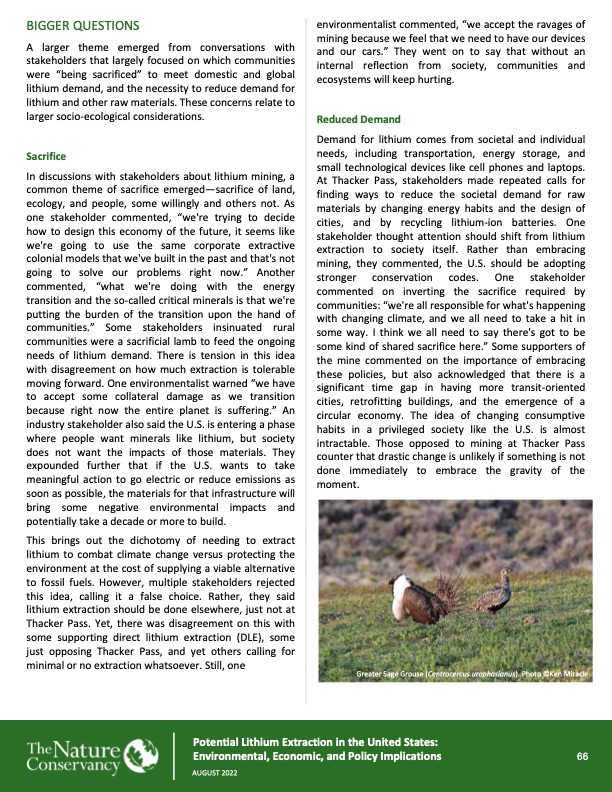
BIGGER QUESTIONS A larger theme emerged from conversations with stakeholders that largely focused on which communities were “being sacrificed” to meet domestic and global lithium demand, and the necessity to reduce demand for lithium and other raw materials. These concerns relate to larger socio-ecological considerations. Sacrifice In discussions with stakeholders about lithium mining, a common theme of sacrifice emerged—sacrifice of land, ecology, and people, some willingly and others not. As one stakeholder commented, “we're trying to decide how to design this economy of the future, it seems like we're going to use the same corporate extractive colonial models that we've built in the past and that's not going to solve our problems right now.” Another commented, “what we're doing with the energy transition and the so-called critical minerals is that we're putting the burden of the transition upon the hand of communities.” Some stakeholders insinuated rural communities were a sacrificial lamb to feed the ongoing needs of lithium demand. There is tension in this idea with disagreement on how much extraction is tolerable moving forward. One environmentalist warned “we have to accept some collateral damage as we transition because right now the entire planet is suffering.” An industry stakeholder also said the U.S. is entering a phase where people want minerals like lithium, but society does not want the impacts of those materials. They expounded further that if the U.S. wants to take meaningful action to go electric or reduce emissions as soon as possible, the materials for that infrastructure will bring some negative environmental impacts and potentially take a decade or more to build. This brings out the dichotomy of needing to extract lithium to combat climate change versus protecting the environment at the cost of supplying a viable alternative to fossil fuels. However, multiple stakeholders rejected this idea, calling it a false choice. Rather, they said lithium extraction should be done elsewhere, just not at Thacker Pass. Yet, there was disagreement on this with some supporting direct lithium extraction (DLE), some just opposing Thacker Pass, and yet others calling for minimal or no extraction whatsoever. Still, one environmentalist commented, “we accept the ravages of mining because we feel that we need to have our devices and our cars.” They went on to say that without an internal reflection from society, communities and ecosystems will keep hurting. Reduced Demand Demand for lithium comes from societal and individual needs, including transportation, energy storage, and small technological devices like cell phones and laptops. At Thacker Pass, stakeholders made repeated calls for finding ways to reduce the societal demand for raw materials by changing energy habits and the design of cities, and by recycling lithium-ion batteries. One stakeholder thought attention should shift from lithium extraction to society itself. Rather than embracing mining, they commented, the U.S. should be adopting stronger conservation codes. One stakeholder commented on inverting the sacrifice required by communities: “we're all responsible for what's happening with changing climate, and we all need to take a hit in some way. I think we all need to say there's got to be some kind of shared sacrifice here.” Some supporters of the mine commented on the importance of embracing these policies, but also acknowledged that there is a significant time gap in having more transit-oriented cities, retrofitting buildings, and the emergence of a circular economy. The idea of changing consumptive habits in a privileged society like the U.S. is almost intractable. Those opposed to mining at Thacker Pass counter that drastic change is unlikely if something is not done immediately to embrace the gravity of the moment. Greater Sage Grouse (Centrocercus urophasianus). Photo ©Ken Miracle Potential Lithium Extraction in the United States: Environmental, Economic, and Policy Implications 66 AUGUST 2022PDF Image | Potential Lithium Extraction in the United States
PDF Search Title:
Potential Lithium Extraction in the United StatesOriginal File Name Searched:
Lithium_Report_FINAL.pdfDIY PDF Search: Google It | Yahoo | Bing
Product and Development Focus for Infinity Turbine
ORC Waste Heat Turbine and ORC System Build Plans: All turbine plans are $10,000 each. This allows you to build a system and then consider licensing for production after you have completed and tested a unit.Redox Flow Battery Technology: With the advent of the new USA tax credits for producing and selling batteries ($35/kW) we are focussing on a simple flow battery using shipping containers as the modular electrolyte storage units with tax credits up to $140,000 per system. Our main focus is on the salt battery. This battery can be used for both thermal and electrical storage applications. We call it the Cogeneration Battery or Cogen Battery. One project is converting salt (brine) based water conditioners to simultaneously produce power. In addition, there are many opportunities to extract Lithium from brine (salt lakes, groundwater, and producer water).Salt water or brine are huge sources for lithium. Most of the worlds lithium is acquired from a brine source. It's even in seawater in a low concentration. Brine is also a byproduct of huge powerplants, which can now use that as an electrolyte and a huge flow battery (which allows storage at the source).We welcome any business and equipment inquiries, as well as licensing our turbines for manufacturing.| CONTACT TEL: 608-238-6001 Email: greg@infinityturbine.com | RSS | AMP |