
PDF Publication Title:
Text from PDF Page: 029
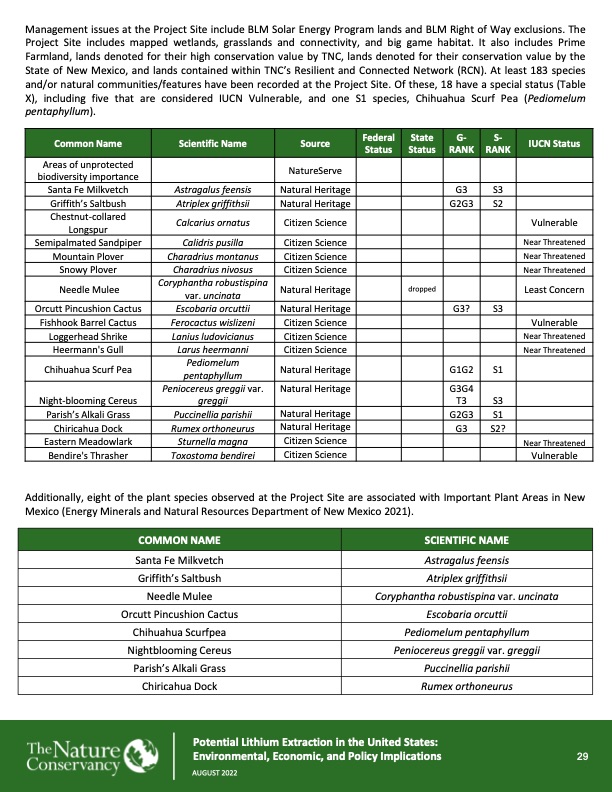
Management issues at the Project Site include BLM Solar Energy Program lands and BLM Right of Way exclusions. The Project Site includes mapped wetlands, grasslands and connectivity, and big game habitat. It also includes Prime Farmland, lands denoted for their high conservation value by TNC, lands denoted for their conservation value by the State of New Mexico, and lands contained within TNC’s Resilient and Connected Network (RCN). At least 183 species and/or natural communities/features have been recorded at the Project Site. Of these, 18 have a special status (Table X), including five that are considered IUCN Vulnerable, and one S1 species, Chihuahua Scurf Pea (Pediomelum pentaphyllum). Common Name Scientific Name Source Federal Status State Status G- RANK S- RANK IUCN Status Areas of unprotected biodiversity importance NatureServe Santa Fe Milkvetch Astragalus feensis Natural Heritage G3 S3 Griffith’s Saltbush Atriplex griffithsii Natural Heritage G2G3 S2 Chestnut-collared Longspur Calcarius ornatus Citizen Science Vulnerable Semipalmated Sandpiper Calidris pusilla Citizen Science Near Threatened Mountain Plover Charadrius montanus Citizen Science Near Threatened Snowy Plover Charadrius nivosus Citizen Science Near Threatened Needle Mulee Coryphantha robustispina var. uncinata Natural Heritage dropped Least Concern Orcutt Pincushion Cactus Escobaria orcuttii Natural Heritage G3? S3 Fishhook Barrel Cactus Ferocactus wislizeni Citizen Science Vulnerable Loggerhead Shrike Lanius ludovicianus Citizen Science Near Threatened Heermann's Gull Larus heermanni Citizen Science Near Threatened Chihuahua Scurf Pea Pediomelum pentaphyllum Natural Heritage G1G2 S1 © TNC Night-blooming Cereus Peniocereus greggii var. greggii Natural Heritage G3G4 T3 S3 Parish’s Alkali Grass Puccinellia parishii Natural Heritage G2G3 S1 Chiricahua Dock Rumex orthoneurus Natural Heritage G3 S2? Eastern Meadowlark Sturnella magna Citizen Science Near Threatened Bendire's Thrasher Toxostoma bendirei Citizen Science Vulnerable Additionally, eight of the plant species observed at the Project Site are associated with Important Plant Areas in New Mexico (Energy Minerals and Natural Resources Department of New Mexico 2021). COMMON NAME SCIENTIFIC NAME Santa Fe Milkvetch Astragalus feensis Griffith’s Saltbush Atriplex griffithsii Needle Mulee Coryphantha robustispina var. uncinata Orcutt Pincushion Cactus Escobaria orcuttii Chihuahua Scurfpea Pediomelum pentaphyllum Nightblooming Cereus Peniocereus greggii var. greggii Parish’s Alkali Grass Puccinellia parishii Chiricahua Dock Rumex orthoneurus Potential Lithium Extraction in the United States: Environmental, Economic, and Policy Implications 29 AUGUST 2022PDF Image | Potential Lithium Extraction in the United States
PDF Search Title:
Potential Lithium Extraction in the United StatesOriginal File Name Searched:
Lithium_Report_FINAL.pdfDIY PDF Search: Google It | Yahoo | Bing
Product and Development Focus for Infinity Turbine
ORC Waste Heat Turbine and ORC System Build Plans: All turbine plans are $10,000 each. This allows you to build a system and then consider licensing for production after you have completed and tested a unit.Redox Flow Battery Technology: With the advent of the new USA tax credits for producing and selling batteries ($35/kW) we are focussing on a simple flow battery using shipping containers as the modular electrolyte storage units with tax credits up to $140,000 per system. Our main focus is on the salt battery. This battery can be used for both thermal and electrical storage applications. We call it the Cogeneration Battery or Cogen Battery. One project is converting salt (brine) based water conditioners to simultaneously produce power. In addition, there are many opportunities to extract Lithium from brine (salt lakes, groundwater, and producer water).Salt water or brine are huge sources for lithium. Most of the worlds lithium is acquired from a brine source. It's even in seawater in a low concentration. Brine is also a byproduct of huge powerplants, which can now use that as an electrolyte and a huge flow battery (which allows storage at the source).We welcome any business and equipment inquiries, as well as licensing our turbines for manufacturing.| CONTACT TEL: 608-238-6001 Email: greg@infinityturbine.com | RSS | AMP |