
PDF Publication Title:
Text from PDF Page: 013
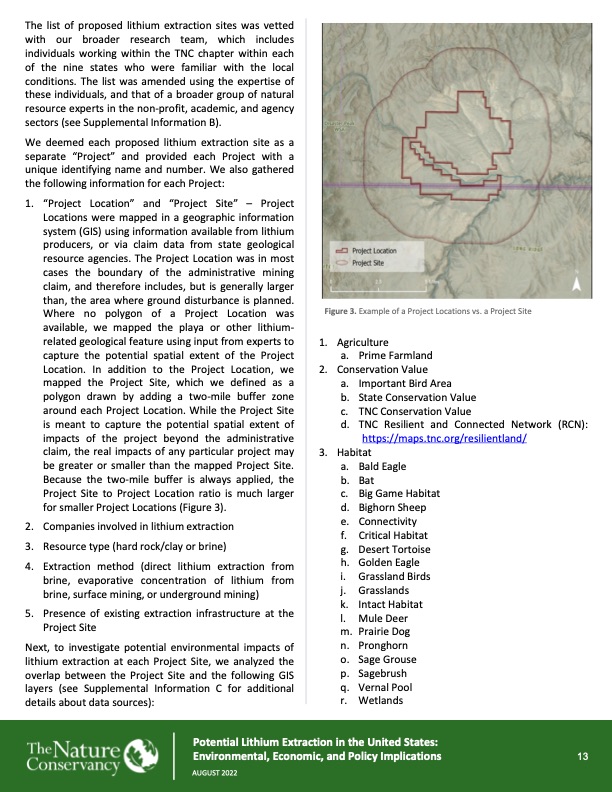
The list of proposed lithium extraction sites was vetted with our broader research team, which includes individuals working within the TNC chapter within each of the nine states who were familiar with the local conditions. The list was amended using the expertise of these individuals, and that of a broader group of natural resource experts in the non-profit, academic, and agency sectors (see Supplemental Information B). We deemed each proposed lithium extraction site as a separate “Project” and provided each Project with a unique identifying name and number. We also gathered the following information for each Project: 1. “Project Location” and “Project Site” – Project Locations were mapped in a geographic information system (GIS) using information available from lithium producers, or via claim data from state geological resource agencies. The Project Location was in most cases the boundary of the administrative mining claim, and therefore includes, but is generally larger than, the area where ground disturbance is planned. Where no polygon of a Project Location was available, we mapped the playa or other lithium- related geological feature using input from experts to capture the potential spatial extent of the Project Location. In addition to the Project Location, we mapped the Project Site, which we defined as a polygon drawn by adding a two-mile buffer zone around each Project Location. While the Project Site is meant to capture the potential spatial extent of impacts of the project beyond the administrative claim, the real impacts of any particular project may be greater or smaller than the mapped Project Site. Because the two-mile buffer is always applied, the Project Site to Project Location ratio is much larger for smaller Project Locations (Figure 3). 2. Companies involved in lithium extraction 3. Resource type (hard rock/clay or brine) 4. Extraction method (direct lithium extraction from brine, evaporative concentration of lithium from brine, surface mining, or underground mining) 5. Presence of existing extraction infrastructure at the Project Site Next, to investigate potential environmental impacts of lithium extraction at each Project Site, we analyzed the overlap between the Project Site and the following GIS layers (see Supplemental Information C for additional details about data sources): Figure 3. Example of a Project Locations vs. a Project Site 1. Agriculture 2. a. Prime Farmland Conservation Value a. Important Bird Area b. State Conservation Value c. TNC Conservation Value d. TNC Resilient and Connected Network (RCN): https://maps.tnc.org/resilientland/ 3. Habitat a. Bald Eagle b. Bat c. Big Game Habitat d. Bighorn Sheep e. Connectivity f. Critical Habitat g. Desert Tortoise h. Golden Eagle i. Grassland Birds j. Grasslands k. Intact Habitat l. Mule Deer m. PrairieDog n. Pronghorn o. Sage Grouse p. Sagebrush q. Vernal Pool r. Wetlands Potential Lithium Extraction in the United States: Environmental, Economic, and Policy Implications 13 AUGUST 2022PDF Image | Potential Lithium Extraction in the United States
PDF Search Title:
Potential Lithium Extraction in the United StatesOriginal File Name Searched:
Lithium_Report_FINAL.pdfDIY PDF Search: Google It | Yahoo | Bing
Product and Development Focus for Infinity Turbine
ORC Waste Heat Turbine and ORC System Build Plans: All turbine plans are $10,000 each. This allows you to build a system and then consider licensing for production after you have completed and tested a unit.Redox Flow Battery Technology: With the advent of the new USA tax credits for producing and selling batteries ($35/kW) we are focussing on a simple flow battery using shipping containers as the modular electrolyte storage units with tax credits up to $140,000 per system. Our main focus is on the salt battery. This battery can be used for both thermal and electrical storage applications. We call it the Cogeneration Battery or Cogen Battery. One project is converting salt (brine) based water conditioners to simultaneously produce power. In addition, there are many opportunities to extract Lithium from brine (salt lakes, groundwater, and producer water).Salt water or brine are huge sources for lithium. Most of the worlds lithium is acquired from a brine source. It's even in seawater in a low concentration. Brine is also a byproduct of huge powerplants, which can now use that as an electrolyte and a huge flow battery (which allows storage at the source).We welcome any business and equipment inquiries, as well as licensing our turbines for manufacturing.| CONTACT TEL: 608-238-6001 Email: greg@infinityturbine.com | RSS | AMP |