
PDF Publication Title:
Text from PDF Page: 027
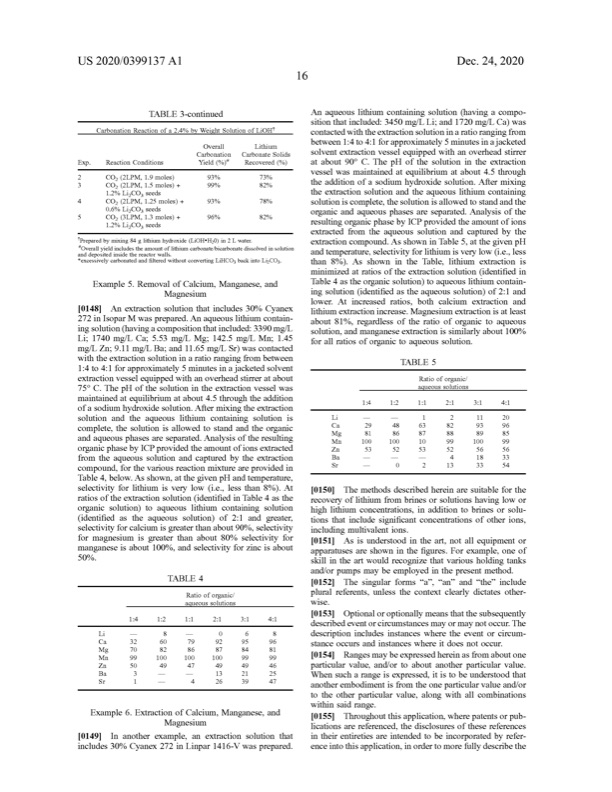
US 2020/0399137A1 Dec.24,2020 TABLE 3-continued CarbonationReactionofa2.4%byWeightSolutionofLiOH* Exp. ReactionConditions 2 CO2(2LPM,1.9moles) 3 CO2(2LPM,1.5moles)+ 1.2% Li2CO3seds 4 CO2(2LPM,1.25moles)+ 0.6% Li2CO3seds 5 CO2(3LPM,1.3moles)+ 1.2% Li2CO3seds Anaqueouslithiumcontainingsolution(havingacompo sitionthatincluded:3450mg/LLi;and1720mg/LCa)was contactedwiththeextractionsolutioninaratiorangingfrom betwen1:4to4:1foraproximately5minutesinajacketed *Preparedbymixing84glithiumhydroxide(LiOH·H20)in2Lwater. #Overalyieldincludestheamountoflithiumcarbonate/bicarbonatedisolvedinsolution anddepositedinsidethereactorwals. *excesivelycarbonatedandfilteredwithoutconvertingLiHCO3backintoLi2CO3. Example5.RemovalofCalcium,Manganese,and Magnesium [0148] Anextractionsolutionthatincludes30% Cyanex 272inIsoparMwasprepared.Anaqueouslithiumcontain ingsolution(havingacompositionthatincluded:390mg/L Li;1740mg/LCa;5.53mg/LMg;142.5mg/LMn;1.45 mg/LZn;9.1mg/LBa;and1.65mg/LSr)wascontacted withtheextractionsolutioninaratiorangingfrombetween 1:4to4:1foraproximately5minutesinajacketedsolvent extractionveselequipedwithanoverheadstireratabout 75°C.ThepHofthesolutionintheextractionveselwas maintainedatequilibriumatabout4.5throughtheadition ofasodiumhydroxidesolution.Aftermixingtheextraction solutionandtheaqueouslithiumcontainingsolutionis complete,thesolutionisalowedtostandandtheorganic andaqueousphasesareseparated.Analysisoftheresulting organicphasebyICPprovidedtheamountofionsextracted fromtheaqueoussolutionandcapturedbytheextraction compound,forthevariousreactionmixtureareprovidedin Table4,below.Asshown,atthegivenpHandtemperature, selectivityforlithiumisverylow(i.e.,lesthan8%).At ratiosoftheextractionsolution(identifiedinTable4asthe organicsolution)toaqueouslithiumcontainingsolution (identifiedastheaqueoussolution)of2:1andgreater, selectivityforcalciumisgreaterthanabout90%,selectivity formagnesiumisgreaterthanabout80% selectivityfor manganeseisabout10%,andselectivityforzincisabout 50%. TABLE 4 Ratiooforganic aqueoussolutions 1:4 1:2 1:1 2:1 3:1 4:1 1 2 11 20 Li 8 0 Ca 32 60 79 92 Mg 70 82 86 87 Mn 99 100 100 100 Zn 50 49 47 49 49 46 [0150] Themethodsdescribedhereinaresuitableforthe recoveryoflithiumfrombrinesorsolutionshavinglowor highlithiumconcentrations,inaditiontobrinesorsolu tionsthatincludesignificantconcentrationsofotherions, includingmultivalentions. [0151] Asisunderstodintheart,notalequipmentor aparatusesareshowninthefigures.Forexample,oneof skilintheartwouldrecognizethatvariousholdingtanks and/orpumpsmaybeemployedinthepresentmethod. [0152] Thesingularforms“a”,“an”and“the”include pluralreferents,unlesthecontextclearlydictatesother wise. [0153] Optionaloroptionalymeansthatthesubsequently describedeventorcircumstancesmayormaynotoccur.The descriptionincludesinstanceswheretheeventorcircum stance occurs and instances where itdoes not occur. [0154] Rangesmaybeexpresedhereinasfromaboutone particularvalue,and/ortoaboutanotherparticularvalue. Whensucharangeisexpresed,itistobeunderstodthat anotherembodimentisfromtheoneparticularvalueand/or totheotherparticularvalue,alongwithalcombinations withinsaidrange. [015] Throughoutthisaplication,wherepatentsorpub Ba 3 Sr 1 13 21 25 4 26 39 47 Example6.ExtractionofCalcium,Manganese,and Magnesium 6 8 95 96 84 81 99 99 16 Overall Lithium Carbonation CarbonateSolids solventextractionveselequippedwithanoverheadstirer Yield(%)* Recovered(%) atabout90°C.ThepHofthesolutionintheextraction 93% 73% 99% 82% 93% 78% 96% 82% veselwasmaintainedatequilibriumatabout4.5through theaditionofasodiumhydroxidesolution.Aftermixing theextractionsolutionandtheaqueouslithiumcontaining solutioniscomplete,thesolutionisalowedtostandandthe organicandaqueousphasesareseparated.Analysisofthe resultingorganicphasebyICPprovidedtheamountofions extractedfromtheaqueoussolutionandcapturedbythe extractioncompound.AsshowninTable5,atthegivenpH andtemperature,selectivityforlithiumisverylow(i.e.,les than 8% ).As shown in the Table, lithium extraction is minimizedatratiosoftheextractionsolution(identifiedin Table4astheorganicsolution)toaqueouslithiumcontain ingsolution(identifiedastheaqueoussolution)of2:1and lower. At increased ratios, both calcium extraction and lithiumextractionincrease.Magnesiumextractionisatleast about81%,regardlesoftheratiooforganictoaqueous solution,andmanganeseextractionissimilarlyabout10% foralratiosoforganictoaqueoussolution. TABLE 5 Ratiooforganic aqueoussolutions 1:4 1:2 1:1 2:1 3:1 4:1 4 18 33 0 2 13 33 54 licationsarereferenced,thedisclosuresofthesereferences [0149]Inanotherexample,anextractionsolutionthat intheirentiretiesareintendedtobeincorporatedbyrefer includes30%Cyanex272inLinpar1416-Vwasprepared. enceintothisaplication,inordertomorefulydescribethe Li Ca 29 48 63 82 93 96 Mg 81 86 87 88 89 85 Mn 100 100 10 99 100 99 Zn 53 52 53 52 56 56 Ba SrPDF Image | Patent LITHIUM CHLORIDE CONTAINING BRINE
PDF Search Title:
Patent LITHIUM CHLORIDE CONTAINING BRINEOriginal File Name Searched:
US20200399137A1.pdfDIY PDF Search: Google It | Yahoo | Bing
Product and Development Focus for Infinity Turbine
ORC Waste Heat Turbine and ORC System Build Plans: All turbine plans are $10,000 each. This allows you to build a system and then consider licensing for production after you have completed and tested a unit.Redox Flow Battery Technology: With the advent of the new USA tax credits for producing and selling batteries ($35/kW) we are focussing on a simple flow battery using shipping containers as the modular electrolyte storage units with tax credits up to $140,000 per system. Our main focus is on the salt battery. This battery can be used for both thermal and electrical storage applications. We call it the Cogeneration Battery or Cogen Battery. One project is converting salt (brine) based water conditioners to simultaneously produce power. In addition, there are many opportunities to extract Lithium from brine (salt lakes, groundwater, and producer water).Salt water or brine are huge sources for lithium. Most of the worlds lithium is acquired from a brine source. It's even in seawater in a low concentration. Brine is also a byproduct of huge powerplants, which can now use that as an electrolyte and a huge flow battery (which allows storage at the source).We welcome any business and equipment inquiries, as well as licensing our turbines for manufacturing.| CONTACT TEL: 608-238-6001 Email: greg@infinityturbine.com | RSS | AMP |