
PDF Publication Title:
Text from PDF Page: 142
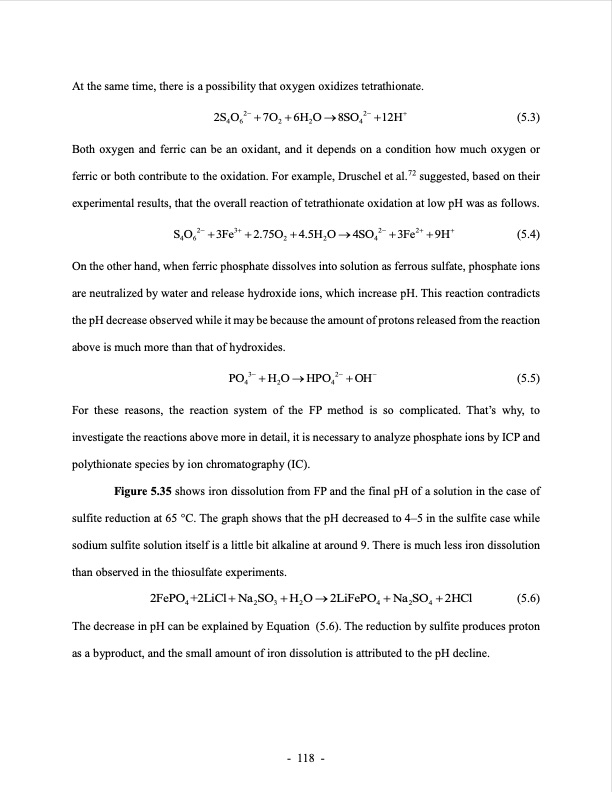
At the same time, there is a possibility that oxygen oxidizes tetrathionate. 2SO2−+7O +6HO→8SO2−+12H+ 46224 Both oxygen and ferric can be an oxidant, and it depends on a condition how much oxygen or ferric or both contribute to the oxidation. For example, Druschel et al.72 suggested, based on their experimental results, that the overall reaction of tetrathionate oxidation at low pH was as follows. (5.4) On the other hand, when ferric phosphate dissolves into solution as ferrous sulfate, phosphate ions are neutralized by water and release hydroxide ions, which increase pH. This reaction contradicts the pH decrease observed while it may be because the amount of protons released from the reaction above is much more than that of hydroxides. (5.5) For these reasons, the reaction system of the FP method is so complicated. That’s why, to investigate the reactions above more in detail, it is necessary to analyze phosphate ions by ICP and polythionate species by ion chromatography (IC). Figure 5.35 shows iron dissolution from FP and the final pH of a solution in the case of sulfite reduction at 65 °C. The graph shows that the pH decreased to 4–5 in the sulfite case while sodium sulfite solution itself is a little bit alkaline at around 9. There is much less iron dissolution than observed in the thiosulfate experiments. 2FePO4 +2LiCl + Na2SO3 + H2O → 2LiFePO4 + Na2SO4 + 2HCl (5.6) The decrease in pH can be explained by Equation (5.6). The reduction by sulfite produces proton as a byproduct, and the small amount of iron dissolution is attributed to the pH decline. (5.3) S O 2− +3Fe3+ +2.75O +4.5H O→4SO 2− +3Fe2+ +9H+ 46224 PO 3− +H O→HPO 2− +OH− 424 - 118 -PDF Image | LITHIUM EXTRACTION FROM BRINE using ion resin
PDF Search Title:
LITHIUM EXTRACTION FROM BRINE using ion resinOriginal File Name Searched:
3.pdfDIY PDF Search: Google It | Yahoo | Bing
Product and Development Focus for Infinity Turbine
ORC Waste Heat Turbine and ORC System Build Plans: All turbine plans are $10,000 each. This allows you to build a system and then consider licensing for production after you have completed and tested a unit.Redox Flow Battery Technology: With the advent of the new USA tax credits for producing and selling batteries ($35/kW) we are focussing on a simple flow battery using shipping containers as the modular electrolyte storage units with tax credits up to $140,000 per system. Our main focus is on the salt battery. This battery can be used for both thermal and electrical storage applications. We call it the Cogeneration Battery or Cogen Battery. One project is converting salt (brine) based water conditioners to simultaneously produce power. In addition, there are many opportunities to extract Lithium from brine (salt lakes, groundwater, and producer water).Salt water or brine are huge sources for lithium. Most of the worlds lithium is acquired from a brine source. It's even in seawater in a low concentration. Brine is also a byproduct of huge powerplants, which can now use that as an electrolyte and a huge flow battery (which allows storage at the source).We welcome any business and equipment inquiries, as well as licensing our turbines for manufacturing.| CONTACT TEL: 608-238-6001 Email: greg@infinityturbine.com | RSS | AMP |