
PDF Publication Title:
Text from PDF Page: 013
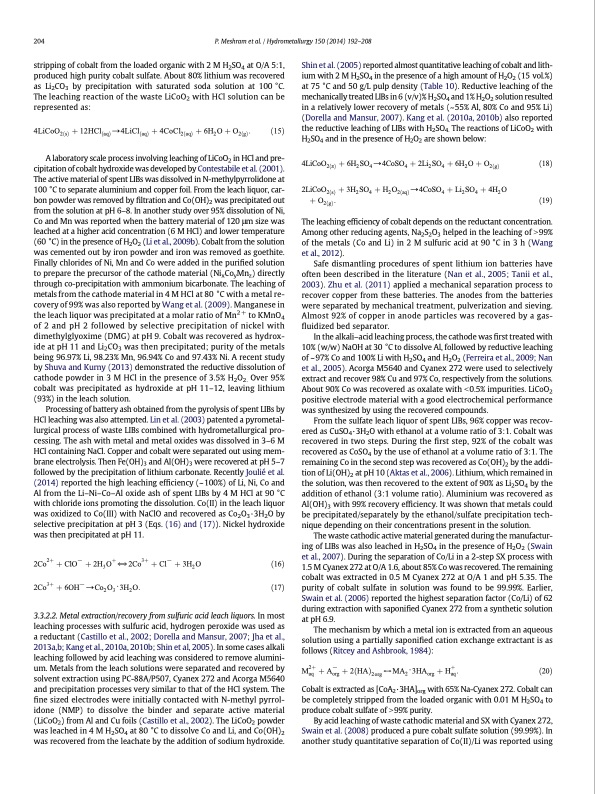
204 P. Meshram et al. / Hydrometallurgy 150 (2014) 192–208 stripping of cobalt from the loaded organic with 2 M H2SO4 at O/A 5:1, produced high purity cobalt sulfate. About 80% lithium was recovered as Li2CO3 by precipitation with saturated soda solution at 100 °C. The leaching reaction of the waste LiCoO2 with HCl solution can be represented as: 4LiCoO2ðsÞ þ 12HClðaqÞ→4LiClðaqÞ þ 4CoCl2ðaqÞ þ 6H2O þ O2ðgÞ: ð15Þ A laboratory scale process involving leaching of LiCoO2 in HCl and pre- cipitation of cobalt hydroxide was developed by Contestabile et al. (2001). The active material of spent LIBs was dissolved in N-methylpyrrolidone at 100 °C to separate aluminium and copper foil. From the leach liquor, car- bon powder was removed by filtration and Co(OH)2 was precipitated out from the solution at pH 6–8. In another study over 95% dissolution of Ni, Co and Mn was reported when the battery material of 120 μm size was leached at a higher acid concentration (6 M HCl) and lower temperature (60 °C) in the presence of H2O2 (Li et al., 2009b). Cobalt from the solution was cemented out by iron powder and iron was removed as goethite. Finally chlorides of Ni, Mn and Co were added in the purified solution to prepare the precursor of the cathode material (NixCoyMnz) directly through co-precipitation with ammonium bicarbonate. The leaching of metals from the cathode material in 4 M HCl at 80 °C with a metal re- covery of 99% was also reported by Wang et al. (2009). Manganese in the leach liquor was precipitated at a molar ratio of Mn2 + to KMnO4 of 2 and pH 2 followed by selective precipitation of nickel with dimethylglyoxime (DMG) at pH 9. Cobalt was recovered as hydrox- ide at pH 11 and Li2CO3 was then precipitated; purity of the metals being 96.97% Li, 98.23% Mn, 96.94% Co and 97.43% Ni. A recent study by Shuva and Kurny (2013) demonstrated the reductive dissolution of cathode powder in 3 M HCl in the presence of 3.5% H2O2. Over 95% cobalt was precipitated as hydroxide at pH 11–12, leaving lithium (93%) in the leach solution. Processing of battery ash obtained from the pyrolysis of spent LIBs by HCl leaching was also attempted. Lin et al. (2003) patented a pyrometal- lurgical process of waste LIBs combined with hydrometallurgical pro- cessing. The ash with metal and metal oxides was dissolved in 3–6 M HCl containing NaCl. Copper and cobalt were separated out using mem- brane electrolysis. Then Fe(OH)3 and Al(OH)3 were recovered at pH 5–7 followed by the precipitation of lithium carbonate. Recently Joulié et al. (2014) reported the high leaching efficiency (~100%) of Li, Ni, Co and Al from the Li–Ni–Co–Al oxide ash of spent LIBs by 4 M HCl at 90 °C with chloride ions promoting the dissolution. Co(II) in the leach liquor was oxidized to Co(III) with NaClO and recovered as Co2O3·3H2O by selective precipitation at pH 3 (Eqs. (16) and (17)). Nickel hydroxide was then precipitated at pH 11. Shin et al. (2005) reported almost quantitative leaching of cobalt and lith- ium with 2 M H2SO4 in the presence of a high amount of H2O2 (15 vol.%) at 75 °C and 50 g/L pulp density (Table 10). Reductive leaching of the mechanically treated LIBs in 6 (v/v)% H2SO4 and 1% H2O2 solution resulted in a relatively lower recovery of metals (~55% Al, 80% Co and 95% Li) (Dorella and Mansur, 2007). Kang et al. (2010a, 2010b) also reported the reductive leaching of LIBs with H2SO4. The reactions of LiCoO2 with H2SO4 and in the presence of H2O2 are shown below: 4LiCoO2ðsÞ þ 6H2SO4→4CoSO4 þ 2Li2SO4 þ 6H2O þ O2ðgÞ ð18Þ 2LiCoO2ðsÞ þ 3H2 SO4 þ H2 O2ðaqÞ →4CoSO4 þ Li2 SO4 þ 4H2 O 2Co2þ þ ClO− þ 2H Oþ⇔2Co3þ þ Cl− þ 3H O 32 2Co3þ þ 6OH− →Co2 O3 ⋅3H2 O: ð16Þ ð17Þ The leaching efficiency of cobalt depends on the reductant concentration. Among other reducing agents, Na2S2O3 helped in the leaching of N99% ofthemetals(CoandLi)in2Msulfuricacidat90°Cin3h(Wang et al., 2012). Safe dismantling procedures of spent lithium ion batteries have often been described in the literature (Nan et al., 2005; Tanii et al., 2003). Zhu et al. (2011) applied a mechanical separation process to recover copper from these batteries. The anodes from the batteries were separated by mechanical treatment, pulverization and sieving. Almost 92% of copper in anode particles was recovered by a gas- fluidized bed separator. In the alkali–acid leaching process, the cathode was first treated with 10% (w/w) NaOH at 30 °C to dissolve Al, followed by reductive leaching of ~97% Co and 100% Li with H2SO4 and H2O2 (Ferreira et al., 2009; Nan et al., 2005). Acorga M5640 and Cyanex 272 were used to selectively extract and recover 98% Cu and 97% Co, respectively from the solutions. About 90% Co was recovered as oxalate with b0.5% impurities. LiCoO2 positive electrode material with a good electrochemical performance was synthesized by using the recovered compounds. From the sulfate leach liquor of spent LIBs, 96% copper was recov- ered as CuSO4·3H2O with ethanol at a volume ratio of 3:1. Cobalt was recovered in two steps. During the first step, 92% of the cobalt was recovered as CoSO4 by the use of ethanol at a volume ratio of 3:1. The remaining Co in the second step was recovered as Co(OH)2 by the addi- tion of Li(OH)2 at pH 10 (Aktas et al., 2006). Lithium, which remained in the solution, was then recovered to the extent of 90% as Li2SO4 by the addition of ethanol (3:1 volume ratio). Aluminium was recovered as Al(OH)3 with 99% recovery efficiency. It was shown that metals could be precipitated/separately by the ethanol/sulfate precipitation tech- nique depending on their concentrations present in the solution. The waste cathodic active material generated during the manufactur- ing of LIBs was also leached in H2SO4 in the presence of H2O2 (Swain et al., 2007). During the separation of Co/Li in a 2-step SX process with 1.5 M Cyanex 272 at O/A 1.6, about 85% Co was recovered. The remaining cobalt was extracted in 0.5 M Cyanex 272 at O/A 1 and pH 5.35. The purity of cobalt sulfate in solution was found to be 99.99%. Earlier, Swain et al. (2006) reported the highest separation factor (Co/Li) of 62 during extraction with saponified Cyanex 272 from a synthetic solution at pH 6.9. The mechanism by which a metal ion is extracted from an aqueous solution using a partially saponified cation exchange extractant is as follows (Ritcey and Ashbrook, 1984): M2þ þA− þ2ðHAÞ ↔MA ⋅3HA þHþ: ð20Þ aq org 2org 2 org aq Cobalt is extracted as [CoA2·3HA]org with 65% Na-Cyanex 272. Cobalt can be completely stripped from the loaded organic with 0.01 M H2SO4 to produce cobalt sulfate of N 99% purity. By acid leaching of waste cathodic material and SX with Cyanex 272, Swain et al. (2008) produced a pure cobalt sulfate solution (99.99%). In another study quantitative separation of Co(II)/Li was reported using 3.3.2.2. Metal extraction/recovery from sulfuric acid leach liquors. In most leaching processes with sulfuric acid, hydrogen peroxide was used as a reductant (Castillo et al., 2002; Dorella and Mansur, 2007; Jha et al., 2013a,b; Kang et al., 2010a, 2010b; Shin et al, 2005). In some cases alkali leaching followed by acid leaching was considered to remove alumini- um. Metals from the leach solutions were separated and recovered by solvent extraction using PC-88A/P507, Cyanex 272 and Acorga M5640 and precipitation processes very similar to that of the HCl system. The fine sized electrodes were initially contacted with N-methyl pyrrol- idone (NMP) to dissolve the binder and separate active material (LiCoO2) from Al and Cu foils (Castillo et al., 2002). The LiCoO2 powder was leached in 4 M H2SO4 at 80 °C to dissolve Co and Li, and Co(OH)2 was recovered from the leachate by the addition of sodium hydroxide. þ O2ðgÞ: ð19ÞPDF Image | Extraction of lithium from primary and secondary sources
PDF Search Title:
Extraction of lithium from primary and secondary sourcesOriginal File Name Searched:
1ca41gb-Pratima-BDP-Li Review-Hydrom-2014.pdfDIY PDF Search: Google It | Yahoo | Bing
Product and Development Focus for Infinity Turbine
ORC Waste Heat Turbine and ORC System Build Plans: All turbine plans are $10,000 each. This allows you to build a system and then consider licensing for production after you have completed and tested a unit.Redox Flow Battery Technology: With the advent of the new USA tax credits for producing and selling batteries ($35/kW) we are focussing on a simple flow battery using shipping containers as the modular electrolyte storage units with tax credits up to $140,000 per system. Our main focus is on the salt battery. This battery can be used for both thermal and electrical storage applications. We call it the Cogeneration Battery or Cogen Battery. One project is converting salt (brine) based water conditioners to simultaneously produce power. In addition, there are many opportunities to extract Lithium from brine (salt lakes, groundwater, and producer water).Salt water or brine are huge sources for lithium. Most of the worlds lithium is acquired from a brine source. It's even in seawater in a low concentration. Brine is also a byproduct of huge powerplants, which can now use that as an electrolyte and a huge flow battery (which allows storage at the source).We welcome any business and equipment inquiries, as well as licensing our turbines for manufacturing.| CONTACT TEL: 608-238-6001 Email: greg@infinityturbine.com | RSS | AMP |