
PDF Publication Title:
Text from PDF Page: 134
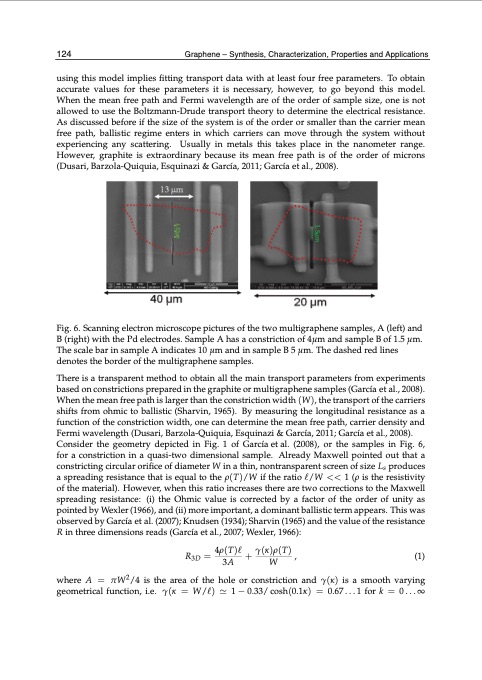
1024 Graphene – Synthesis, Characterization, Properties anWdill-bAe-psept-lbiyc-IaN-tTiEoCnHs using this model implies fitting transport data with at least four free parameters. To obtain accurate values for these parameters it is necessary, however, to go beyond this model. When the mean free path and Fermi wavelength are of the order of sample size, one is not allowed to use the Boltzmann-Drude transport theory to determine the electrical resistance. As discussed before if the size of the system is of the order or smaller than the carrier mean free path, ballistic regime enters in which carriers can move through the system without experiencing any scattering. Usually in metals this takes place in the nanometer range. However, graphite is extraordinary because its mean free path is of the order of microns (Dusari, Barzola-Quiquia, Esquinazi & García, 2011; García et al., 2008). Fig. 6. Scanning electron microscope pictures of the two multigraphene samples, A (left) and B (right) with the Pd electrodes. Sample A has a constriction of 4μm and sample B of 1.5 μm. The scale bar in sample A indicates 10 μm and in sample B 5 μm. The dashed red lines denotes the border of the multigraphene samples. There is a transparent method to obtain all the main transport parameters from experiments based on constrictions prepared in the graphite or multigraphene samples (García et al., 2008). When the mean free path is larger than the constriction width (W), the transport of the carriers shifts from ohmic to ballistic (Sharvin, 1965). By measuring the longitudinal resistance as a function of the constriction width, one can determine the mean free path, carrier density and Fermi wavelength (Dusari, Barzola-Quiquia, Esquinazi & García, 2011; García et al., 2008). Consider the geometry depicted in Fig. 1 of García et al. (2008), or the samples in Fig. 6, for a constriction in a quasi-two dimensional sample. Already Maxwell pointed out that a constricting circular orifice of diameter W in a thin, nontransparent screen of size Ls produces a spreading resistance that is equal to the ρ(T)/W if the ratio l/W << 1 (ρ is the resistivity of the material). However, when this ratio increases there are two corrections to the Maxwell spreading resistance: (i) the Ohmic value is corrected by a factor of the order of unity as pointed by Wexler (1966), and (ii) more important, a dominant ballistic term appears. This was observed by García et al. (2007); Knudsen (1934); Sharvin (1965) and the value of the resistance R in three dimensions reads (García et al., 2007; Wexler, 1966): R3D = 4ρ(T)l + γ(κ)ρ(T) , (1) 3A W where A = πW2/4 is the area of the hole or constriction and γ(κ) is a smooth varying geometrical function, i.e. γ(κ = W/l) ≃ 1−0.33/cosh(0.1κ) = 0.67...1 for k = 0...∞ 1.5μmPDF Image | GRAPHENE SYNTHESIS CHARACTERIZATION PROPERTIES
PDF Search Title:
GRAPHENE SYNTHESIS CHARACTERIZATION PROPERTIESOriginal File Name Searched:
Graphene-Synthesis.pdfDIY PDF Search: Google It | Yahoo | Bing
Salgenx Redox Flow Battery Technology: Power up your energy storage game with Salgenx Salt Water Battery. With its advanced technology, the flow battery provides reliable, scalable, and sustainable energy storage for utility-scale projects. Upgrade to a Salgenx flow battery today and take control of your energy future.
| CONTACT TEL: 608-238-6001 Email: greg@infinityturbine.com | RSS | AMP |