Search GE Vernonva Gas Turbine Power for Data Center Publications search was updated real-time via Filemaker on:
Search Completed | Title | GE Vernova Aeroderivative Gas Turbines Technology and Microgrid
Original File Name Searched: GEA35139A-Aero-Technology-for-Data-Centers-Whitepaper.pdf | Google It | Yahoo | Bing
Page | 003 GE VERNOVA’S AERODERIVATIVE TECHNOLOGY AND MICROGRID CONTROLS
INTRODUCTION
How do you help to decarbonize an operation that requires
reliable-resilient power 24/7/365, in a dynamically changing
environment, while maintaining global environmental
responsibility, sustainability, and profitability?
Some data centers consume more energy than a large town
or small city. But those towns and cities have time to relax and
shut down. While data centers are critical infrastructure, they
also run our world’s critical infrastructure – so keeping them
online can be a matter of life and death. Combine this with the
continued need for more sustainable operations, renewable
energy goals and objectives, and a dramatic increase for data
storage services, and you have an interesting challenge.
The data centers industry has gone through a massive
growth pattern in the past decade due to cloud
computing transformation, hyperscale, 5G networks and
othertechnological and socioeconomic changes. This
technological evolution introduced challenges to data center
owners in terms of sustainability, cost effectiveness and
reliable operation. Per Seagate.com, there’s an expected
multi-fold growth, measured in zetabytes (1 zetabyte = 1
billion terabytes) for the data centers segment. Despite
the fact that the energy consumed per transmitted data
(kWh/GB) is getting more efficient, it’s fair to assume that
data centers at the start of 2020, consumed as little as 0.015
kWh/GB in the transmission of data through the internet to a
user (datacenterknowledge.com). As much as this efficiency
is supporting the growth, nevertheless, the expansion of the
digital infrastructures will still be challenged by the energy
(GWh) needed to support this growing segment. Hence,
utilities are facing challenges to meet data centers’ needs as
the growth of data continues to expand.
We have to help reduce data centers’ carbon footprint and
also aim to increase operational efficiencies while relying on
renewable energy. These renewable energies create other
hurdles for data center operators in terms of intermittency and
variability of power generation to support the operation 24/7.
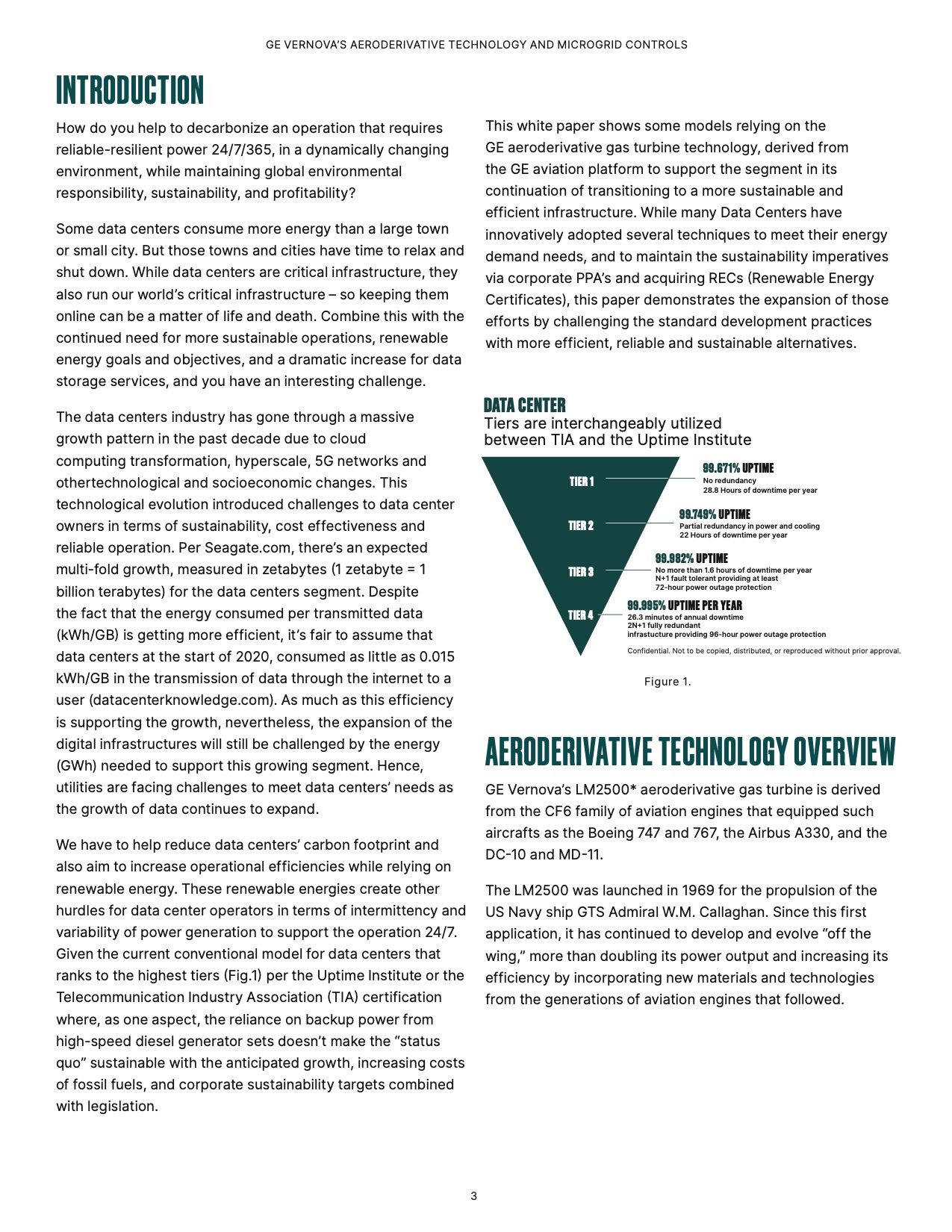
Given the current conventional model for data centers that
ranks to the highest tiers (Fig.1) per the Uptime Institute or the
Telecommunication Industry Association (TIA) certification
where, as one aspect, the reliance on backup power from
high-speed diesel generator sets doesn’t make the “status
quo” sustainable with the anticipated growth, increasing costs
of fossil fuels, and corporate sustainability targets combined
with legislation.
This white paper shows some models relying on the
GE aeroderivative gas turbine technology, derived from
the GE aviation platform to support the segment in its
continuation of transitioning to a more sustainable and
efficient infrastructure. While many Data Centers have
innovatively adopted several techniques to meet their energy
demand needs, and to maintain the sustainability imperatives
via corporate PPA’s and acquiring RECs (Renewable Energy
Certificates), this paper demonstrates the expansion of those
efforts by challenging the standard development practices
with more efficient, reliable and sustainable alternatives.
DATA CENTER
Tiers are interchangeably utilized
between TIA and the Uptime Institute
TIER 1
TIER 2
TIER 3
TIER 4
99.671% UPTIME
No redundancy
28.8 Hours of downtime per year
99.749% UPTIME
Partial redundancy in power and cooling
22 Hours of downtime per year
99.982% UPTIME
No more than 1.6 hours of downtime per year
N+1 fault tolerant providing at least
72-hour power outage protection
99.995% UPTIME PER YEAR
26.3 minutes of annual downtime
2N+1 fully redundant
infrastucture providing 96-hour power outage protection
Confidential. Not to be copied, distributed, or reproduced without prior approval.
Figure 1.
AERODERIVATIVE TECHNOLOGY OVERVIEW
GE Vernova’s LM2500* aeroderivative gas turbine is derived
from the CF6 family of aviation engines that equipped such
aircrafts as the Boeing 747 and 767, the Airbus A330, and the
DC-10 and MD-11.
The LM2500 was launched in 1969 for the propulsion of the
US Navy ship GTS Admiral W.M. Callaghan. Since this first
application, it has continued to develop and evolve “off the
wing,” more than doubling its power output and increasing its
efficiency by incorporating new materials and technologies
from the generations of aviation engines that followed.
3 |
