Search GE Vernonva Gas Turbine Power for Data Center Publications search was updated real-time via Filemaker on:
Page | 009 GEA34130 AERODERIVATIVE GAS TURBINES
SMALLER FOOTPRINT
Aeroderivative generator sets have much higher power density—with about 22 times more power output per unit— than high-speed
diesel reciprocating engines. Aeroderivatives offer advantages in the cost of land, power density, maintenance area, and storage
facilities. A GE aeroderivative power plant has a footprint that is three to four times smaller than a typical reciprocating engine plant
option for equivalent power. In an island grid, real-estate can represent a significant part of power generation costs.
Not only are aeroderivative units smaller, but they are also much lighter per MW than their high-speed diesel reciprocating engine
counterparts. The lighter weight leads to higher mobility, and it is a great complement to fuel flexibility. In Ecuador, for instance, six
TM2500 mobile generator sets were installed to run on diesel for immediate relief of a drought-related electricity crisis. A few years
later, they were easily relocated 200 miles away to burn natural gas from a nearby field. Picking up and moving a high-speed diesel
reciprocating engine farm in the same way—or building a whole new power plant—would have been considerably more cumbersome,
time-consuming, and expensive.
FASTER POWER SPEED OF INSTALLATION/DEPLOYMENT
How soon can these turbines provide power to the grid? The TM2500 is a version of the LM2500 gas turbine built on a movable
trailer, hence the name “TM” for Trailer Mounted. These units can rapidly be deployed anywhere in the world to provide power
quickly in a fast, clean, reliable, and economical fashion.
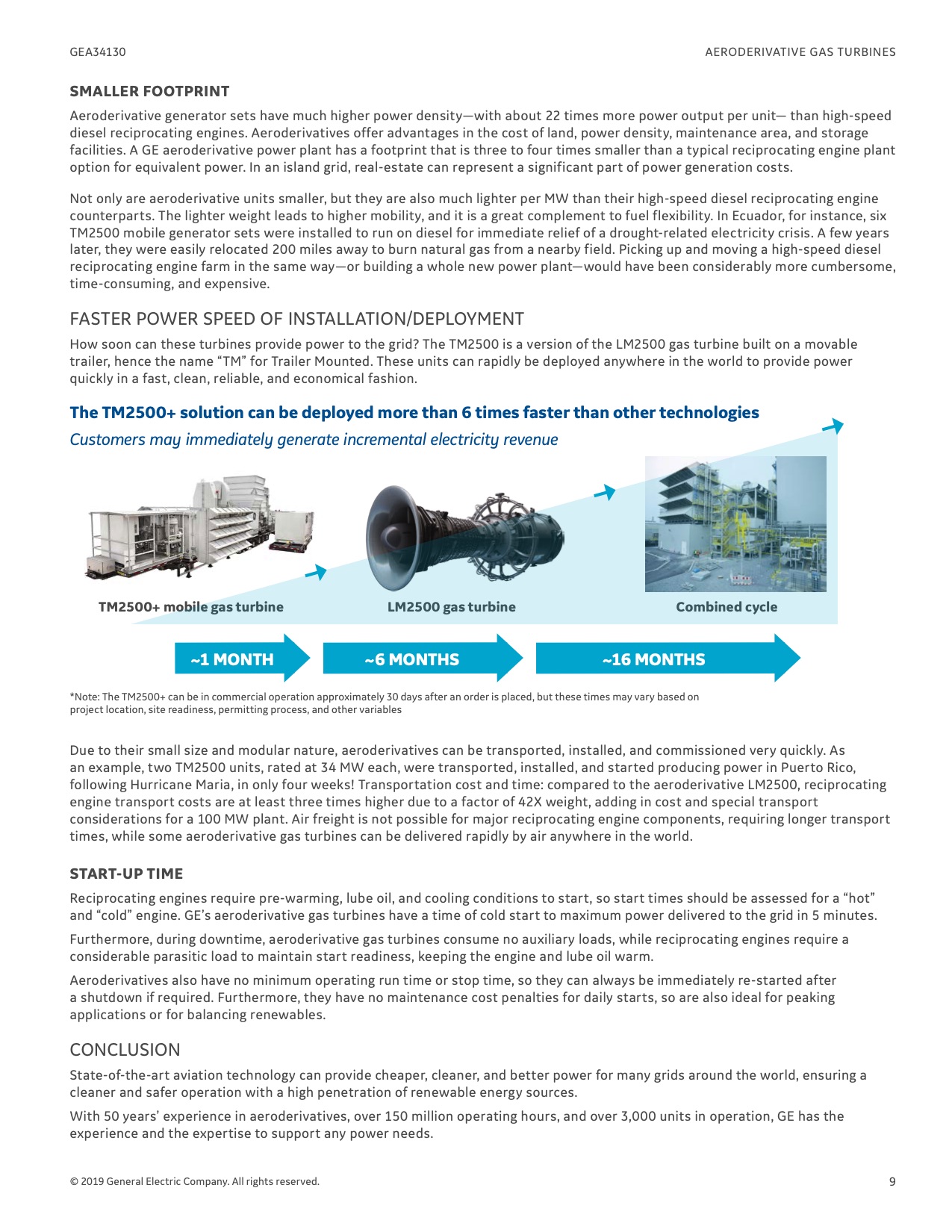
The TM2500+ solution can be deployed more than 6 times faster than other technologies
Customers may immediately generate incremental electricity revenue
TM2500+ mobile gas turbine LM2500 gas turbine Combined cycle
~1 MONTH ~6 MONTHS ~16 MONTHS
*Note: The TM2500+ can be in commercial operation approximately 30 days after an order is placed, but these times may vary based on
project location, site readiness, permitting process, and other variables
Due to their small size and modular nature, aeroderivatives can be transported, installed, and commissioned very quickly. As
an example, two TM2500 units, rated at 34 MW each, were transported, installed, and started producing power in Puerto Rico,
following Hurricane Maria, in only four weeks! Transportation cost and time: compared to the aeroderivative LM2500, reciprocating
engine transport costs are at least three times higher due to a factor of 42X weight, adding in cost and special transport
considerations for a 100 MW plant. Air freight is not possible for major reciprocating engine components, requiring longer transport
times, while some aeroderivative gas turbines can be delivered rapidly by air anywhere in the world.
START-UP TIME
Reciprocating engines require pre-warming, lube oil, and cooling conditions to start, so start times should be assessed for a “hot”
and “cold” engine. GE’s aeroderivative gas turbines have a time of cold start to maximum power delivered to the grid in 5 minutes.
Furthermore, during downtime, aeroderivative gas turbines consume no auxiliary loads, while reciprocating engines require a
considerable parasitic load to maintain start readiness, keeping the engine and lube oil warm.
Aeroderivatives also have no minimum operating run time or stop time, so they can always be immediately re-started after
a shutdown if required. Furthermore, they have no maintenance cost penalties for daily starts, so are also ideal for peaking
applications or for balancing renewables.
CONCLUSION
State-of-the-art aviation technology can provide cheaper, cleaner, and better power for many grids around the world, ensuring a
cleaner and safer operation with a high penetration of renewable energy sources.
With 50 years’ experience in aeroderivatives, over 150 million operating hours, and over 3,000 units in operation, GE has the
experience and the expertise to support any power needs.
© 2019 General Electric Company. All rights reserved.
9 |
