Search GE Vernonva Gas Turbine Power for Data Center Publications search was updated real-time via Filemaker on:
Page | 016 Economic Value
Operating a gas turbine power plant requires large volumes of fuel to keep operating. For this reason, fuel is typically the single largest cost of
operating a power plant, ranging from 50% to 80% of a power plant’s annual operating budget. Therefore, even small changes in fuel price can have a
large impact on the overall cost of operating a power plant.
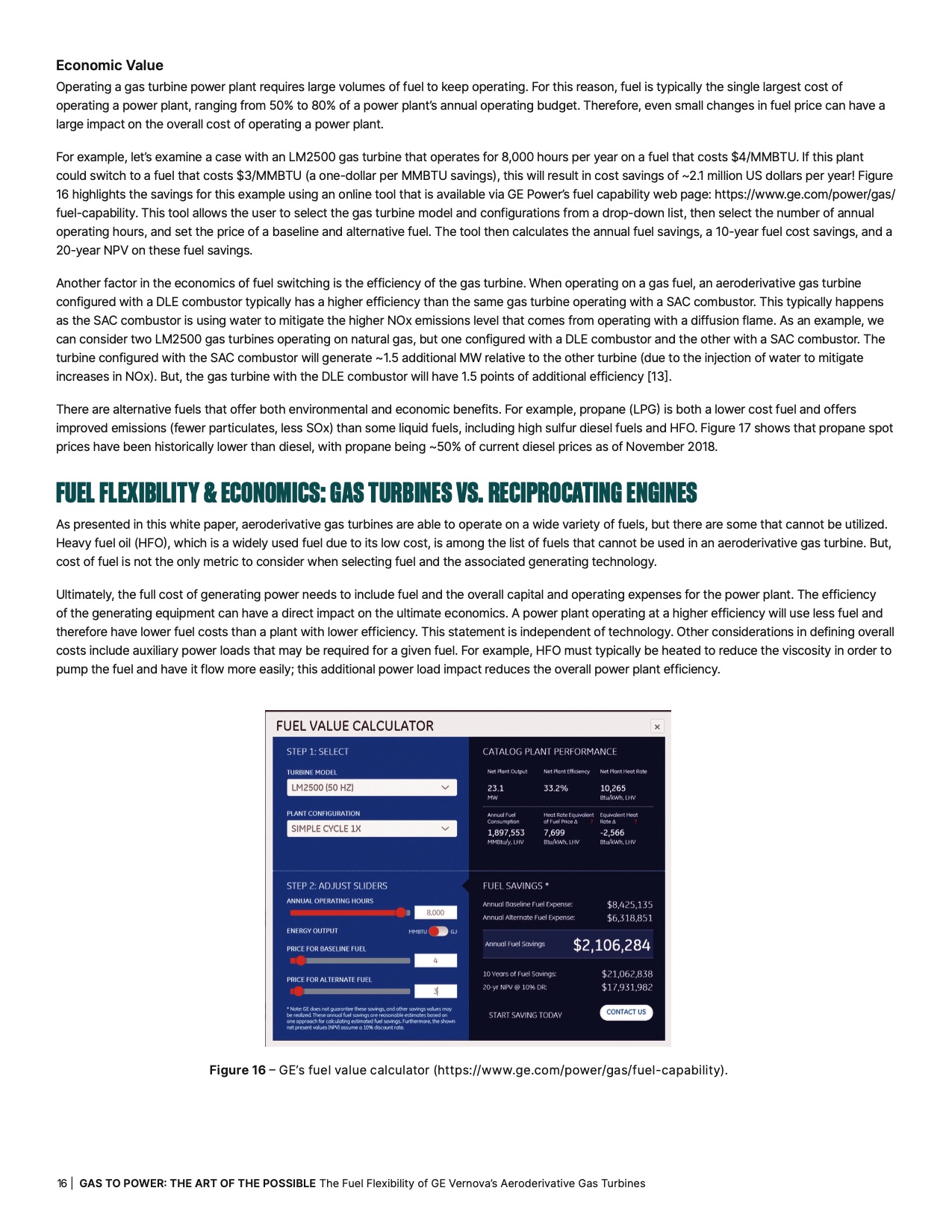
For example, let’s examine a case with an LM2500 gas turbine that operates for 8,000 hours per year on a fuel that costs $4/MMBTU. If this plant
could switch to a fuel that costs $3/MMBTU (a one-dollar per MMBTU savings), this will result in cost savings of ~2.1 million US dollars per year! Figure
16 highlights the savings for this example using an online tool that is available via GE Power’s fuel capability web page: https://www.ge.com/power/gas/
fuel-capability. This tool allows the user to select the gas turbine model and configurations from a drop-down list, then select the number of annual
operating hours, and set the price of a baseline and alternative fuel. The tool then calculates the annual fuel savings, a 10-year fuel cost savings, and a
20-year NPV on these fuel savings.
Another factor in the economics of fuel switching is the efficiency of the gas turbine. When operating on a gas fuel, an aeroderivative gas turbine
configured with a DLE combustor typically has a higher efficiency than the same gas turbine operating with a SAC combustor. This typically happens
as the SAC combustor is using water to mitigate the higher NOx emissions level that comes from operating with a diffusion flame. As an example, we
can consider two LM2500 gas turbines operating on natural gas, but one configured with a DLE combustor and the other with a SAC combustor. The
turbine configured with the SAC combustor will generate ~1.5 additional MW relative to the other turbine (due to the injection of water to mitigate
increases in NOx). But, the gas turbine with the DLE combustor will have 1.5 points of additional efficiency [13].
There are alternative fuels that offer both environmental and economic benefits. For example, propane (LPG) is both a lower cost fuel and offers
improved emissions (fewer particulates, less SOx) than some liquid fuels, including high sulfur diesel fuels and HFO. Figure 17 shows that propane spot
prices have been historically lower than diesel, with propane being ~50% of current diesel prices as of November 2018.
FUEL FLEXIBILITY & ECONOMICS: GAS TURBINES VS. RECIPROCATING ENGINES
As presented in this white paper, aeroderivative gas turbines are able to operate on a wide variety of fuels, but there are some that cannot be utilized.
Heavy fuel oil (HFO), which is a widely used fuel due to its low cost, is among the list of fuels that cannot be used in an aeroderivative gas turbine. But,
cost of fuel is not the only metric to consider when selecting fuel and the associated generating technology.
Ultimately, the full cost of generating power needs to include fuel and the overall capital and operating expenses for the power plant. The efficiency
of the generating equipment can have a direct impact on the ultimate economics. A power plant operating at a higher efficiency will use less fuel and
therefore have lower fuel costs than a plant with lower efficiency. This statement is independent of technology. Other considerations in defining overall
costs include auxiliary power loads that may be required for a given fuel. For example, HFO must typically be heated to reduce the viscosity in order to
pump the fuel and have it flow more easily; this additional power load impact reduces the overall power plant efficiency.
Figure 16 – GE’s fuel value calculator (https://www.ge.com/power/gas/fuel-capability).
16 | GAS TO POWER: THE ART OF THE POSSIBLE The Fuel Flexibility of GE Vernova’s Aeroderivative Gas Turbines |
