Search Gas Turbine Power for Data Center Publications search was updated real-time via Filemaker on:
Search Completed | Title | The Role of Distributed Generation and Combined Heat and Power CHP Systems in Data Centers
Original File Name Searched: distributed_generation_chp_systems_in_data_centers.pdf | Google It | Yahoo | Bing
Page | 007 Average Load: 25
Average ~25
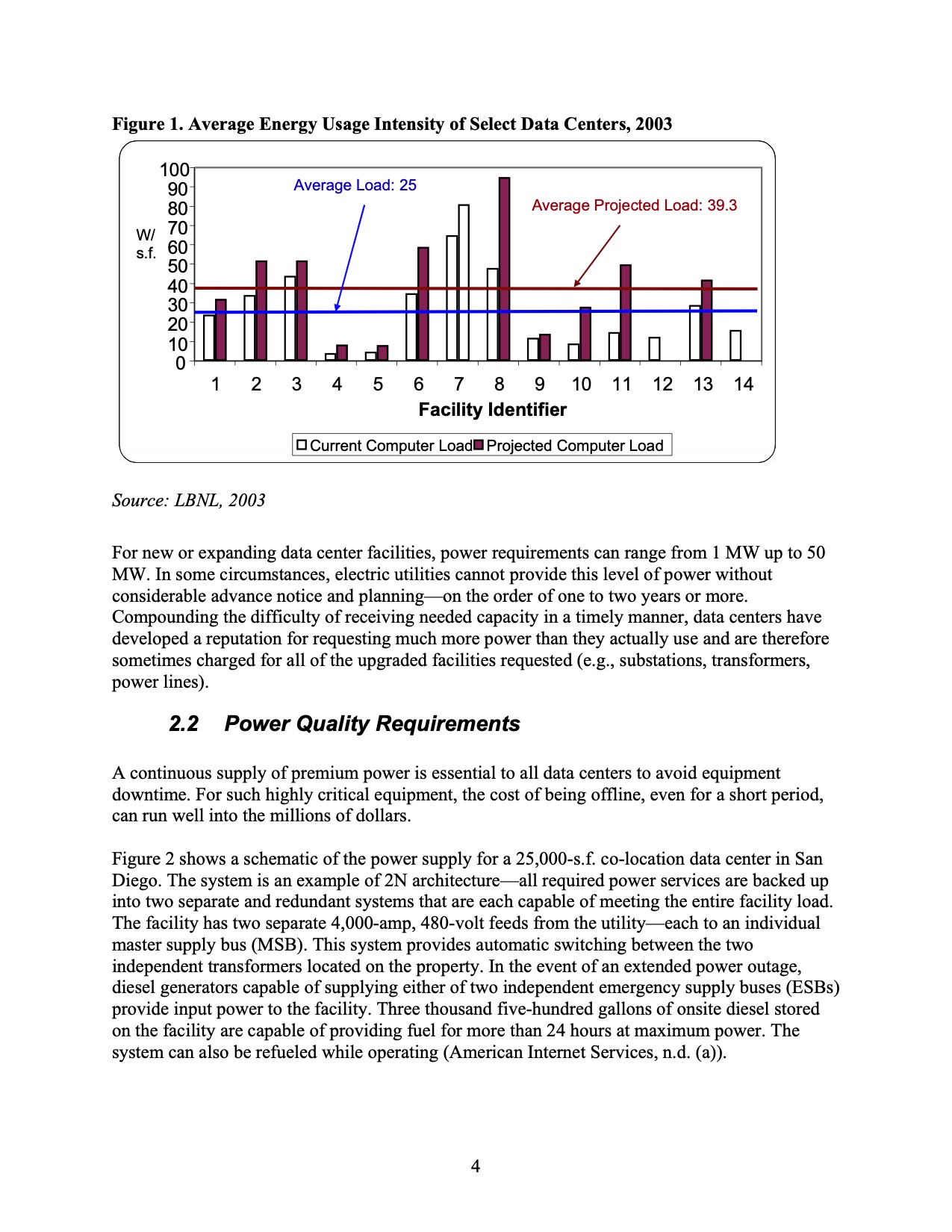
Figure 1. Average Energy Usage Intensity of Select Data Centers, 2003
100
100
90
90
80
80
70
70
W/
W/Sq.Ft.
s.f.
60
60
50
50
40
40
30
30
20
20
10
10
0
0
Average Projected Load: 39.3
Average 39.3
1 2 3 4 5 6 7 8 9 10 11 12 13 14
1 2 3 4 5 6 7 8 9 10 11 12 13 14
Facility Identifier
Facility Identifier
Current Computer Load Projected Computer Load
Current Computer Load Projected Computer Load
Source: LBNL, 2003
For new or expanding data center facilities, power requirements can range from 1 MW up to 50
MW. In some circumstances, electric utilities cannot provide this level of power without
considerable advance notice and planning—on the order of one to two years or more.
Compounding the difficulty of receiving needed capacity in a timely manner, data centers have
developed a reputation for requesting much more power than they actually use and are therefore
sometimes charged for all of the upgraded facilities requested (e.g., substations, transformers,
power lines).
2.2 Power Quality Requirements
A continuous supply of premium power is essential to all data centers to avoid equipment
downtime. For such highly critical equipment, the cost of being offline, even for a short period,
can run well into the millions of dollars.
Figure 2 shows a schematic of the power supply for a 25,000-s.f. co-location data center in San
Diego. The system is an example of 2N architecture—all required power services are backed up
into two separate and redundant systems that are each capable of meeting the entire facility load.
The facility has two separate 4,000-amp, 480-volt feeds from the utility—each to an individual
master supply bus (MSB). This system provides automatic switching between the two
independent transformers located on the property. In the event of an extended power outage,
diesel generators capable of supplying either of two independent emergency supply buses (ESBs)
provide input power to the facility. Three thousand five-hundred gallons of onsite diesel stored
on the facility are capable of providing fuel for more than 24 hours at maximum power. The
system can also be refueled while operating (American Internet Services, n.d. (a)).
4 |
