Search Gas Turbine Power for Data Center Publications search was updated real-time via Filemaker on:
Page | 001 3.2.2.3
Surface Stabilized
Combustion
3.2.2.3-1 Introduction
Surface-stabilized combustion is a simple approach that can maximize the
emissions benefi t of lean fuel/air premixing by increasing fl ame stability, and doing
so in a compact and fl exible manner. ALZETA Corporation is developing a surface-
stabilized combustion system for industrial turbine applications capable of sub-3 ppm
emissions of oxides of nitrogen (NOX) with simultaneous low emissions of carbon
monoxide (CO) and unburned hydrocarbons (HC). The application of surface-stabilized
combustion to gas turbines is being developed under the name nanoSTAR™. The
development has been reported in a series of technical papers given at various ASME
conferences1
.
Low emissions of oxides of nitrogen (NOX), as well as carbon monoxide
(CO) and unburned hydrocarbons can be achieved with thorough fuel/air mixing
and control of the adiabatic fl ame temperature of that mixture below about 1920 K
(3000 °F). One of the great diffi culties with such lean premixed systems has been
maintaining fl ame stability in the narrow fl ame temperature range between high NOX
production and lean fl ame extinction. Aerodynamically stabilized injectors have very
narrow ranges of operation, necessitating multiple injector staging (up to four stages
in some systems) or piloting2. When control of NO
emissions is achieved without the
x
use of steam or water injection, it is referred to as a dry method, such Dry Low NOx, or
DLN systems, have been successfully deployed to achieve sub-25 ppm NOx
emissions
in several gas turbine applications, and in some cases much lower.
Surface-stabilized combustion is a simple approach that extends the operating
range of lean premixed systems to achieve sub-3 ppm NOx emissions. The technology
has advanced through proof-of-concept testing in pressurized rigs and demonstration
in a one megawatt test engine. Prototype injectors for small industrial turbines have
been designed, built, and rig tested. Multiple injectors have been tested in an annular
combustor with varied combustion air inlet temperatures under atmospheric and
elevated pressures while work is progressing toward an engine demonstration.
3.2.2.3-2 Technology
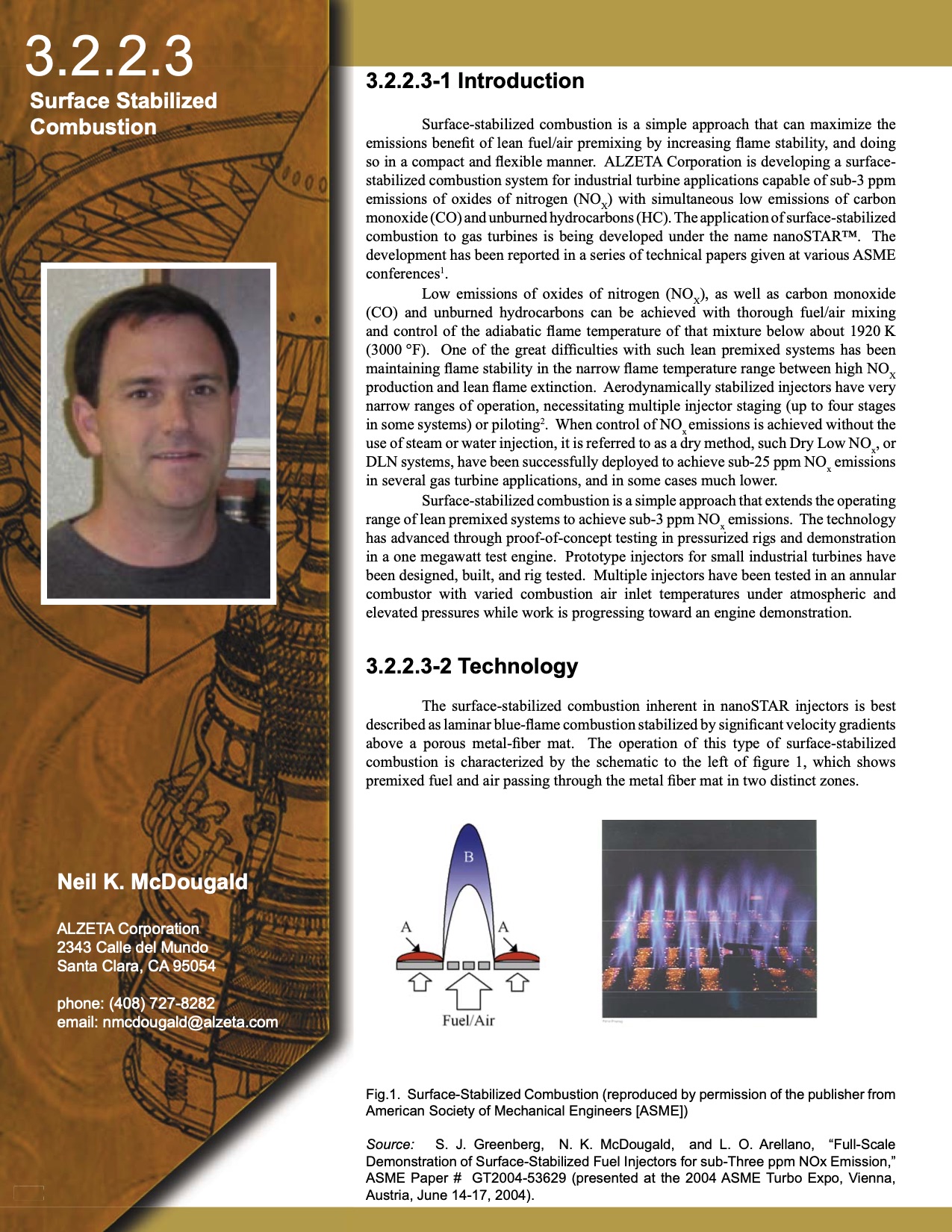
The surface-stabilized combustion inherent in nanoSTAR injectors is best
described as laminar blue-fl ame combustion stabilized by signifi cant velocity gradients
above a porous metal-fi ber mat. The operation of this type of surface-stabilized
combustion is characterized by the schematic to the left of fi gure 1, which shows
premixed fuel and air passing through the metal fi ber mat in two distinct zones.
B
Neil K. McDougald
ALZETA Corporation
2343 Calle del Mundo
Santa Clara, CA 95054
phone: (408) 727-8282
email: nmcdougald@alzeta.com Fuel/Air
A A
289 289
Fig.1. Surface-Stabilized Combustion (reproduced by permission of the publisher from
American Society of Mechanical Engineers [ASME])
Source: S. J. Greenberg, N. K. McDougald, and L. O. Arellano, “Full-Scale
Demonstration of Surface-Stabilized Fuel Injectors for sub-Three ppm NOx Emission,”
ASME Paper # GT2004-53629 (presented at the 2004 ASME Turbo Expo, Vienna,
Austria, June 14-17, 2004). |
