Search Gas Turbine Power for Data Center Publications search was updated real-time via Filemaker on:
Page | 022 6.9. OPTIONAL HEAT RECOVERY
Just like any other fuel-driven machine, a gas-fired reciprocating engine inevitably
converts a considerable portion of fuel energy into heat, which is then discharged to the
environment. In order to improve efficiency of fuel utilization, this heat may be recovered
and put into use.
A modern medium-speed gas engine discharges heat in following ways:
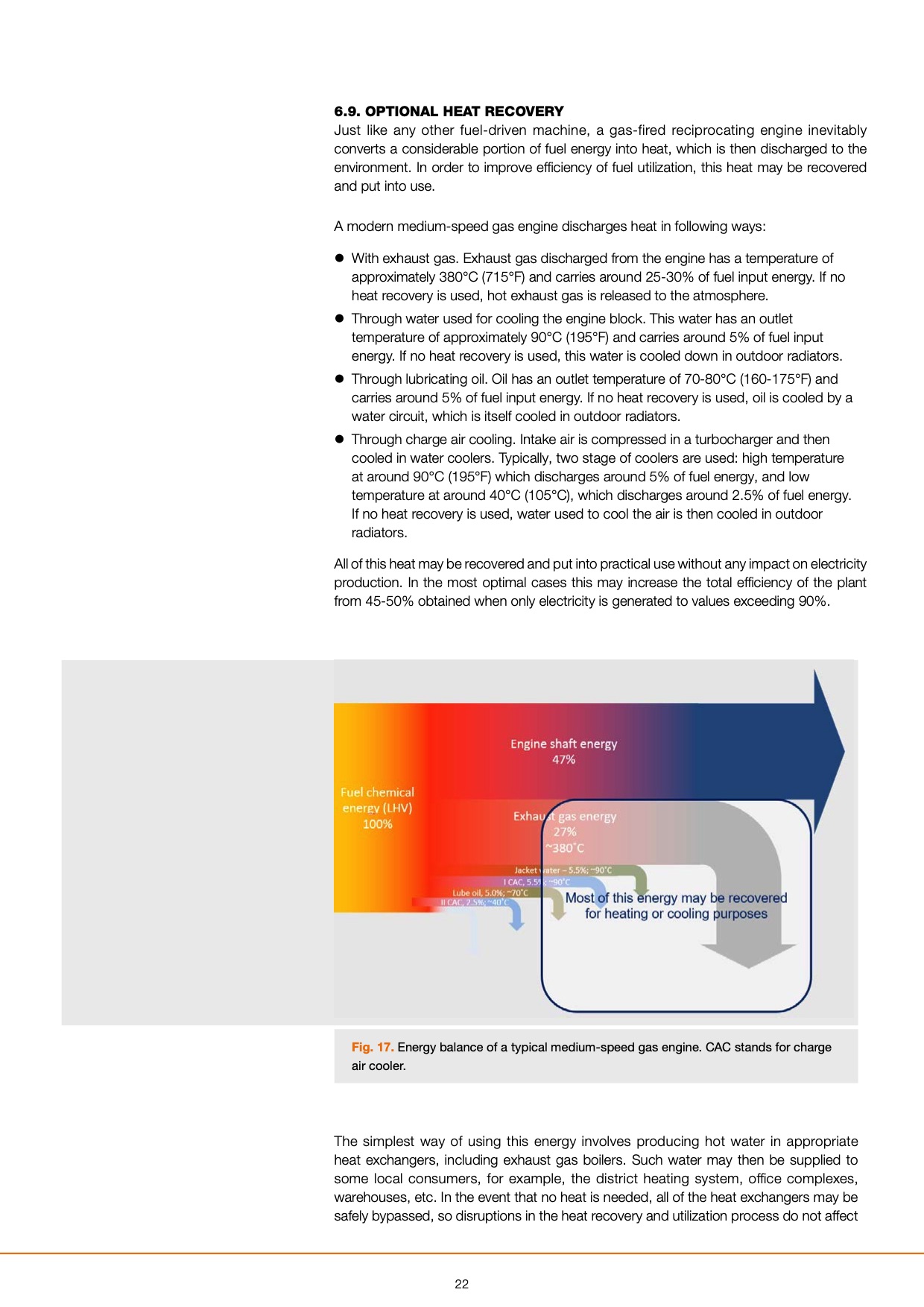
z With exhaust gas. Exhaust gas discharged from the engine has a temperature of
z
approximately 380°C (715°F) and carries around 25-30% of fuel input energy. If no
heat recovery is used, hot exhaust gas is released to the atmosphere.
z Through water used for cooling the engine block. This water has an outlet
z
temperature of approximately 90°C (195°F) and carries around 5% of fuel input
energy. If no heat recovery is used, this water is cooled down in outdoor radiators.
z Through lubricating oil. Oil has an outlet temperature of 70-80°C (160-175°F) and
z
carries around 5% of fuel input energy. If no heat recovery is used, oil is cooled by a
water circuit, which is itself cooled in outdoor radiators.
z Through charge air cooling. Intake air is compressed in a turbocharger and then
z
cooled in water coolers. Typically, two stage of coolers are used: high temperature
at around 90°C (195°F) which discharges around 5% of fuel energy, and low
temperature at around 40°C (105°C), which discharges around 2.5% of fuel energy.
If no heat recovery is used, water used to cool the air is then cooled in outdoor
radiators.
All of this heat may be recovered and put into practical use without any impact on electricity
production. In the most optimal cases this may increase the total efficiency of the plant
from 45-50% obtained when only electricity is generated to values exceeding 90%.
Fig. 17. Energy balance of a typical medium-speed gas engine. CAC stands for charge
air cooler.
The simplest way of using this energy involves producing hot water in appropriate
heat exchangers, including exhaust gas boilers. Such water may then be supplied to
some local consumers, for example, the district heating system, office complexes,
warehouses, etc. In the event that no heat is needed, all of the heat exchangers may be
safely bypassed, so disruptions in the heat recovery and utilization process do not affect
22 |
