Search Gas Turbine Power for Data Center Publications search was updated real-time via Filemaker on:
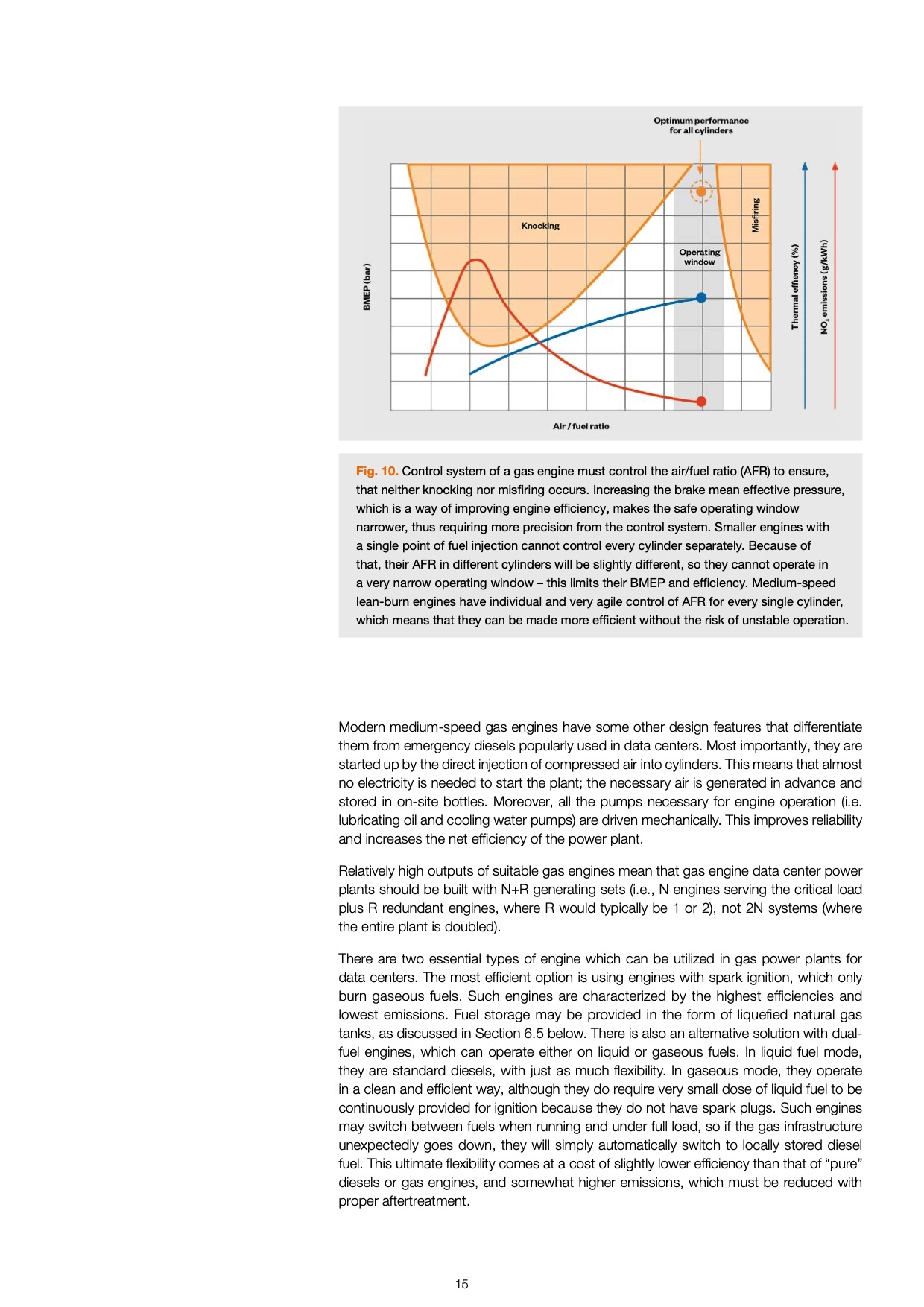
Page | 015 Fig. 10. Control system of a gas engine must control the air/fuel ratio (AFR) to ensure,
that neither knocking nor misfiring occurs. Increasing the brake mean effective pressure,
which is a way of improving engine efficiency, makes the safe operating window
narrower, thus requiring more precision from the control system. Smaller engines with
a single point of fuel injection cannot control every cylinder separately. Because of
that, their AFR in different cylinders will be slightly different, so they cannot operate in
a very narrow operating window – this limits their BMEP and efficiency. Medium-speed
lean-burn engines have individual and very agile control of AFR for every single cylinder,
which means that they can be made more efficient without the risk of unstable operation.
Modern medium-speed gas engines have some other design features that differentiate
them from emergency diesels popularly used in data centers. Most importantly, they are
started up by the direct injection of compressed air into cylinders. This means that almost
no electricity is needed to start the plant; the necessary air is generated in advance and
stored in on-site bottles. Moreover, all the pumps necessary for engine operation (i.e.
lubricating oil and cooling water pumps) are driven mechanically. This improves reliability
and increases the net efficiency of the power plant.
Relatively high outputs of suitable gas engines mean that gas engine data center power
plants should be built with N+R generating sets (i.e., N engines serving the critical load
plus R redundant engines, where R would typically be 1 or 2), not 2N systems (where
the entire plant is doubled).
There are two essential types of engine which can be utilized in gas power plants for
data centers. The most efficient option is using engines with spark ignition, which only
burn gaseous fuels. Such engines are characterized by the highest efficiencies and
lowest emissions. Fuel storage may be provided in the form of liquefied natural gas
tanks, as discussed in Section 6.5 below. There is also an alternative solution with dual-
fuel engines, which can operate either on liquid or gaseous fuels. In liquid fuel mode,
they are standard diesels, with just as much flexibility. In gaseous mode, they operate
in a clean and efficient way, although they do require very small dose of liquid fuel to be
continuously provided for ignition because they do not have spark plugs. Such engines
may switch between fuels when running and under full load, so if the gas infrastructure
unexpectedly goes down, they will simply automatically switch to locally stored diesel
fuel. This ultimate flexibility comes at a cost of slightly lower efficiency than that of “pure”
diesels or gas engines, and somewhat higher emissions, which must be reduced with
proper aftertreatment.
15 |
