Search Gas Turbine Power for Data Center Publications search was updated real-time via Filemaker on:
Page | 001 3.2.1.3
Rich Burn, Quick-
Mix, Lean Burn (RQL)
Combustor
Scott Samuelsen
Professor of Mechanical, Aerospace,
and Environmental Engineering
Director
Advanced Power and Energy Program
University of California
Irvine
92697-3550
phone: 949-824-5468
email: gss@uci.edu
227 227
3.2.1.3-1 Introduction
The Rich-Burn, Quick-Mix, Lean-Burn (RQL) combustor concept was
introduced in 1980 as strategy to reduce oxides of nitrogen (NOx) emission from
gas turbine engines.1 Later, in the 1990’s, the concept was targeted by the National
Aeronautics and Space Administration (NASA) for the reduction of nitrogen
oxides in next generation aero-propulsion engines. Today, the RQL is the anchor
combustor technology in aeroengines deployed commercially by Pratt & Whitney
under the name TALON (Technology for Advanced Low NOx). Due to safety
considerations and overall performance (e.g., stability) throughout the duty cycle,
the RQL is preferred over lean premixed options in aeroengine applications.
In stationary applications, lean premixed combustor technology is
the standard. Safety considerations are not as severe, the duty cycle is more
constrained, and the reduction in NOx
emission is more substantial in contrast to
RQL technology. However, RQL combustor technology is of growing interest
for stationary applications due to the attributes of (1) more effectively processing
fuels of complex composition, and (2) processing fuels of varying composition.
The latter is becoming of importance with the increasing international competition
for fuels in general, the burgeoning interest in biomass fuels, the expanding use
of “opportunity fuels” (land-fi ll gases, digester gases, well-head gases), and the
growing use of liquefi ed natural gas to either complement domestic sources or
serve as the sole source of natural gas to a large region of a country or the country
as a whole. The California Energy Commission is engaged in RQL technology
research, in cooperation with the U.S. Department of Energy, to explore the utility
of RQL strategies as an alternative to combustors for niche applications in the
stationary production of electrical power.
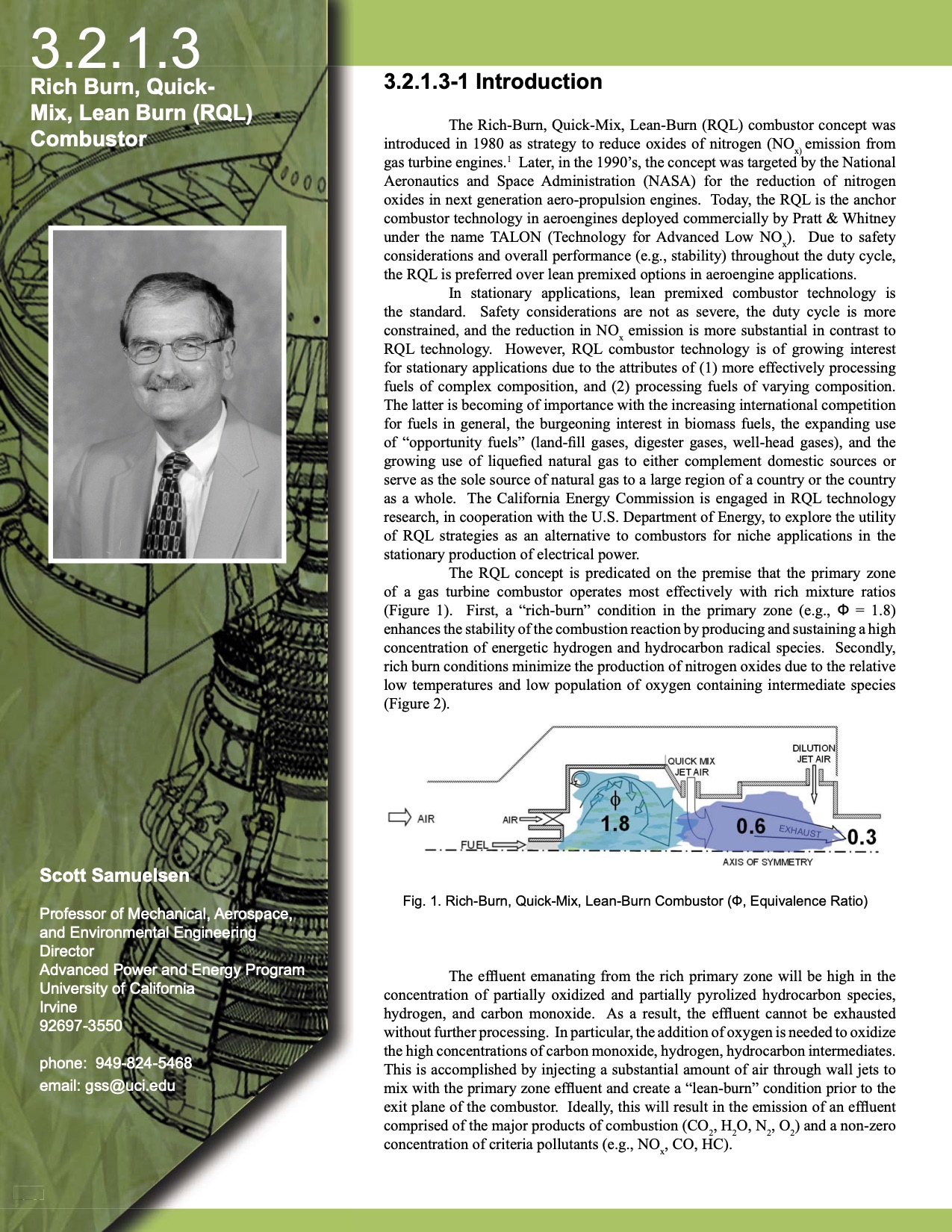
The RQL concept is predicated on the premise that the primary zone
of a gas turbine combustor operates most effectively with rich mixture ratios
(Figure 1). First, a “rich-burn” condition in the primary zone (e.g., Ф = 1.8)
enhances the stability of the combustion reaction by producing and sustaining a high
concentration of energetic hydrogen and hydrocarbon radical species. Secondly,
rich burn conditions minimize the production of nitrogen oxides due to the relative
low temperatures and low population of oxygen containing intermediate species
(Figure 2).
Fig. 1. Rich-Burn, Quick-Mix, Lean-Burn Combustor (Ф, Equivalence Ratio)
The effl uent emanating from the rich primary zone will be high in the
concentration of partially oxidized and partially pyrolized hydrocarbon species,
hydrogen, and carbon monoxide. As a result, the effl uent cannot be exhausted
without further processing. In particular, the addition of oxygen is needed to oxidize
the high concentrations of carbon monoxide, hydrogen, hydrocarbon intermediates.
This is accomplished by injecting a substantial amount of air through wall jets to
mix with the primary zone effl uent and create a “lean-burn” condition prior to the
exit plane of the combustor. Ideally, this will result in the emission of an effl uent
comprised of the major products of combustion (CO2, H2O, N2, O2) and a non-zero
concentration of criteria pollutants (e.g., NOx, CO, HC). |
