Search Gas Turbine Power for Data Center Publications search was updated real-time via Filemaker on:
Page | 001 1.3.3
Partial Oxidation Gas
Turbine (POGT) Cycles
Joseph K. Rabovitser, Ph.D.
Serguei Nester, Ph.D.,
Gar Technology Institute, Energy
Utilization center
1700 S. Mount Prospect Road
Des Plaines, IL 60018
Phone: 847-768-0548
847-768-0541
joseph.rabovitser@gastechnology.org,
serguei.nester@gastechnology.org
David James White
TRITEK Consulting
3633 Millikin Avenue
San Diego, CA 92122-2413
Phone: 858-453-8653
Email: tritek@san.rr.com
121 121
1.3.3-1 Introduction
There are two main features that distinguish a Partial Oxidatation Gas
Turbine from a conventional gas turbine. These are associated with the design
arrangement and the thermodynamic processes used in operation. A primary design
differentiating feature of the POGT when compared to a conventional gas turbine
is that POGT utilizes a non-catalytic partial oxidation reactor (POR) in place of
a normal combustor. An important secondary distinction is that a much smaller
compressor is required, one that typically supplies less than half of the air fl ow
required in a conventional gas turbine. From an operational and thermodynamic
point of view the key distinguishing feature is that the working fl uid provided by
the POR (a secondary fuel gas) has a much higher specifi c heat than lean complete
combustion products and more energy per unit mass of fl uid can be extracted by
the POGT expander than is the conventional case. (This is why the POGT uses a
smaller compressor than a conventional gas turbine.)
A POR operates at fuel rich conditions typically at equivalence ratios on
the order of 2.5, and virtually any hydrocarbon fuel can be combusted. Because
of these fuel rich conditions, incomplete combustion products are used as the
hot section working fl uid. A POGT thus produces two products: power and a
secondary fuel that usually is a hydrogen rich gas. This specifi c feature creates a
great opportunity to provide high effi ciencies and ultra-low emissions (single digit
NOx and CO levels) when the secondary fuel is burned in a bottoming cycle. When
compared to the equivalent standard gas turbine bottoming cycle combination, the
POGT provides an increase of about 10 percent points in system effi ciency.
The overall effi ciency of a POGT two-staged power system is typically
high and can approach 70% depending on the POGT operating conditions and
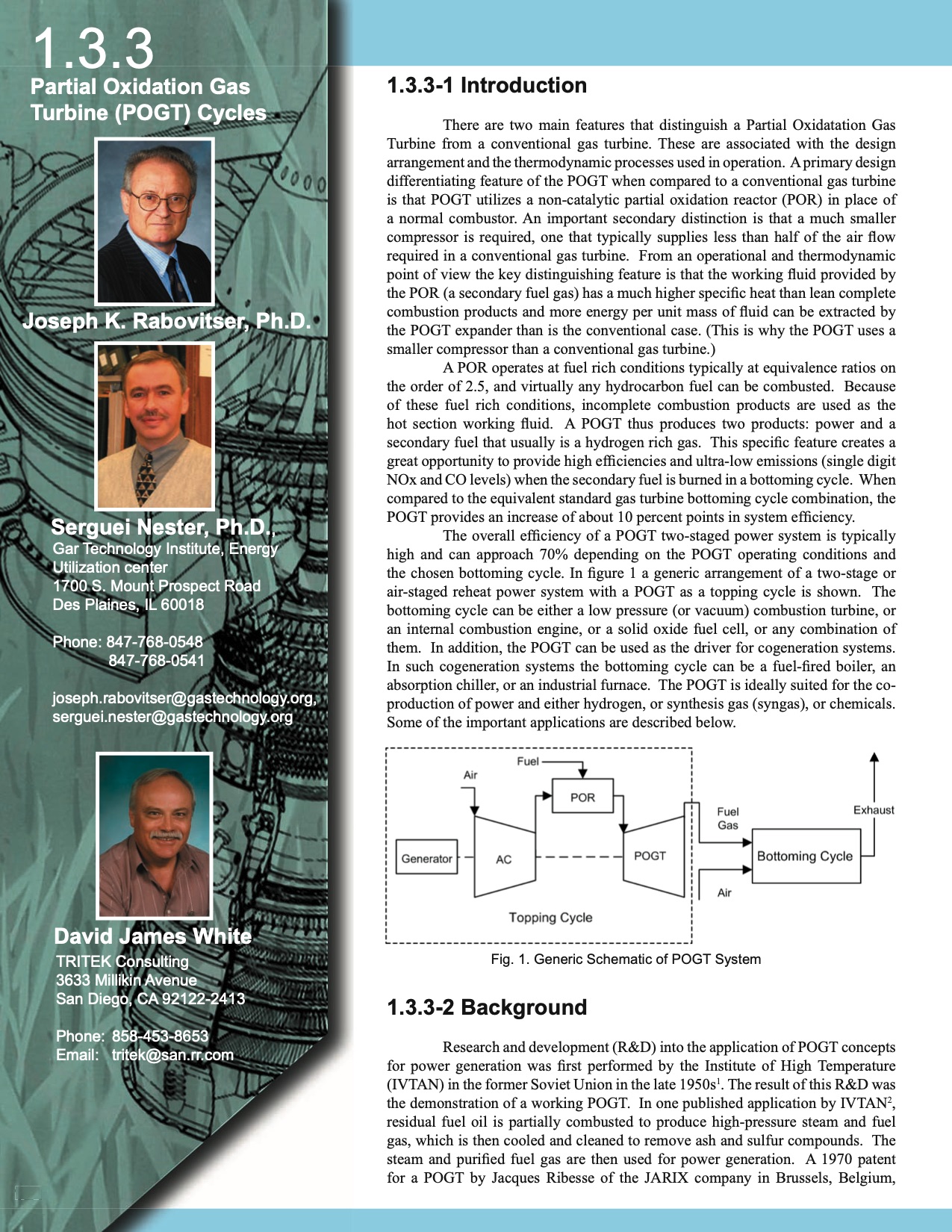
the chosen bottoming cycle. In fi gure 1 a generic arrangement of a two-stage or
air-staged reheat power system with a POGT as a topping cycle is shown. The
bottoming cycle can be either a low pressure (or vacuum) combustion turbine, or
an internal combustion engine, or a solid oxide fuel cell, or any combination of
them. In addition, the POGT can be used as the driver for cogeneration systems.
In such cogeneration systems the bottoming cycle can be a fuel-fi red boiler, an
absorption chiller, or an industrial furnace. The POGT is ideally suited for the co-
production of power and either hydrogen, or synthesis gas (syngas), or chemicals.
Some of the important applications are described below.
Fig. 1. Generic Schematic of POGT System
1.3.3-2 Background
Research and development (R&D) into the application of POGT concepts
for power generation was fi rst performed by the Institute of High Temperature
(IVTAN) in the former Soviet Union in the late 1950s1. The result of this R&D was
the demonstration of a working POGT. In one published application by IVTAN2
,
residual fuel oil is partially combusted to produce high-pressure steam and fuel
gas, which is then cooled and cleaned to remove ash and sulfur compounds. The
steam and purifi ed fuel gas are then used for power generation. A 1970 patent
for a POGT by Jacques Ribesse of the JARIX company in Brussels, Belgium, |
