Search Gas Turbine Power for Data Center Publications search was updated real-time via Filemaker on:
Search Completed | Title | NEXT GENERATION DATA CENTER BACKUP POWER SYSTEMS DATA CENTERS
Original File Name Searched: Next-Generation-Data-Center-Backup-Power-Systems.pdf | Google It | Yahoo | Bing
Page | 001 NEXT GENERATION DATA CENTER
BACKUP POWER SYSTEMS
DATA CENTERS
Data centers are growing rapidly across the US and around
the globe. They are the new industrial factory of the modern
digital economy and require a massive amount of power to
support their high-tech operations. Data centers are located
in every state, but the largest hyperscale data centers are
sited where power is the least expensive. However, low-cost
power does not ensure highly reliable power, so the standard
data center design includes backup power systems that can
carry the facility computing and infrastructure loads without
interruption during a power outage.
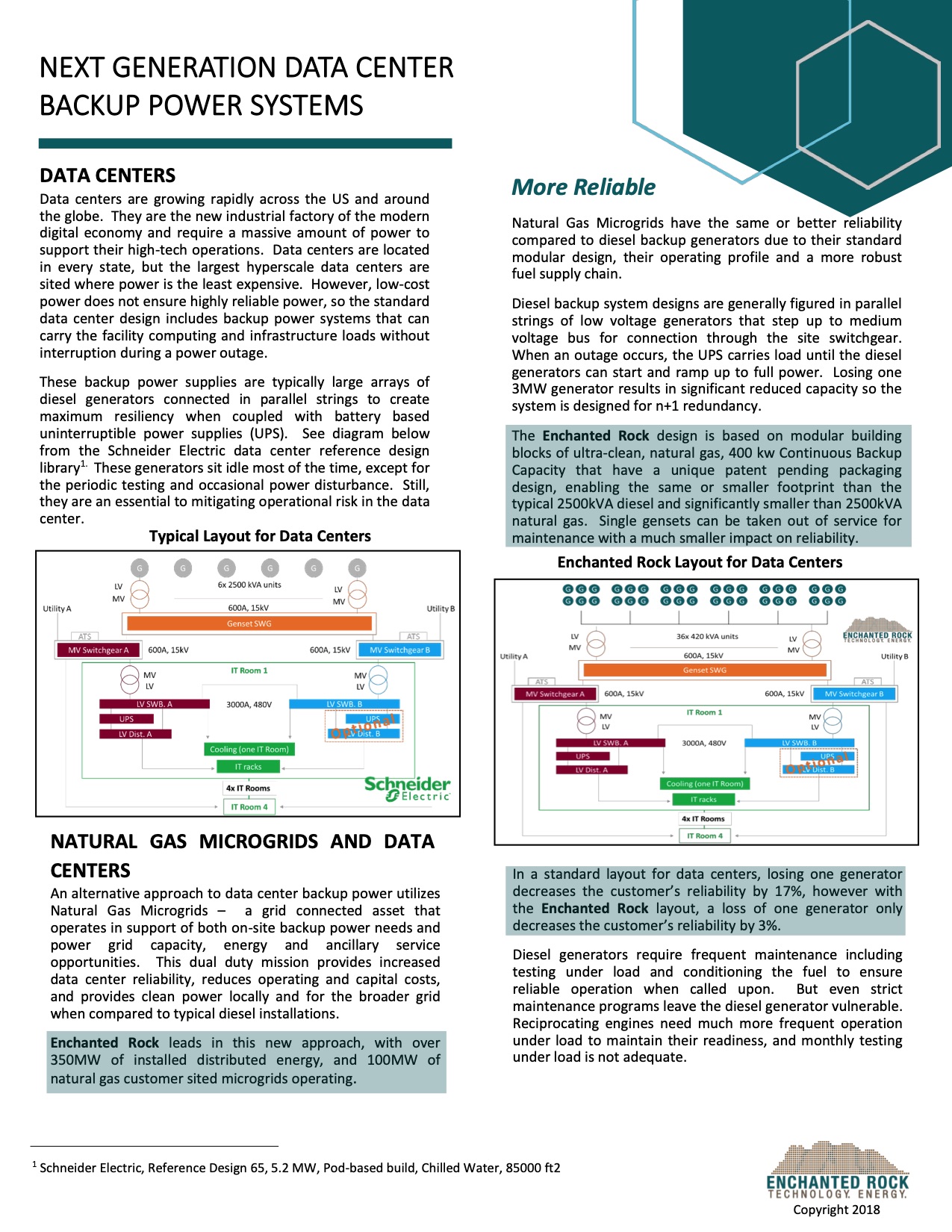
These backup power supplies are typically large arrays of
diesel generators connected in parallel strings to create
maximum resiliency when coupled with battery based
uninterruptible power supplies (UPS). See diagram below
from the Schneider Electric data center reference design
library1. These generators sit idle most of the time, except for
the periodic testing and occasional power disturbance. Still,
they are an essential to mitigating operational risk in the data
center.
Typical Layout for Data Centers
More Reliable
Natural Gas Microgrids have the same or better reliability
compared to diesel backup generators due to their standard
modular design, their operating profile and a more robust
fuel supply chain.
Diesel backup system designs are generally figured in parallel
strings of low voltage generators that step up to medium
voltage bus for connection through the site switchgear.
When an outage occurs, the UPS carries load until the diesel
generators can start and ramp up to full power. Losing one
3MW generator results in significant reduced capacity so the
system is designed for n+1 redundancy.
The Enchanted Rock design is based on modular building
blocks of ultra-clean, natural gas, 400 kw Continuous Backup
Capacity that have a unique patent pending packaging
design, enabling the same or smaller footprint than the
typical 2500kVA diesel and significantly smaller than 2500kVA
natural gas. Single gensets can be taken out of service for
maintenance with a much smaller impact on reliability.
Enchanted Rock Layout for Data Centers
NATURAL GAS MICROGRIDS AND DATA
CENTERS
An alternative approach to data center backup power utilizes
Natural Gas Microgrids – a grid connected asset that
operates in support of both on-site backup power needs and
power grid capacity, energy and ancillary service
opportunities. This dual duty mission provides increased
data center reliability, reduces operating and capital costs,
and provides clean power locally and for the broader grid
when compared to typical diesel installations.
In a standard layout for data centers, losing one generator
decreases the customer’s reliability by 17%, however with
the Enchanted Rock layout, a loss of one generator only
decreases the customer’s reliability by 3%.
Enchanted Rock leads in this new approach, with over
350MW of installed distributed energy, and 100MW of
natural gas customer sited microgrids operating.
Diesel generators require frequent maintenance including
testing under load and conditioning the fuel to ensure
reliable operation when called upon. But even strict
maintenance programs leave the diesel generator vulnerable.
Reciprocating engines need much more frequent operation
under load to maintain their readiness, and monthly testing
under load is not adequate.
1 Schneider Electric, Reference Design 65, 5.2 MW, Pod-based build, Chilled Water, 85000 ft2
Copyright 2018 |
