Search Gas Turbine Power for Data Center Publications search was updated real-time via Filemaker on:
Page | 008 3.2.1.4.2 Low Swirl Combustion
a)
b)
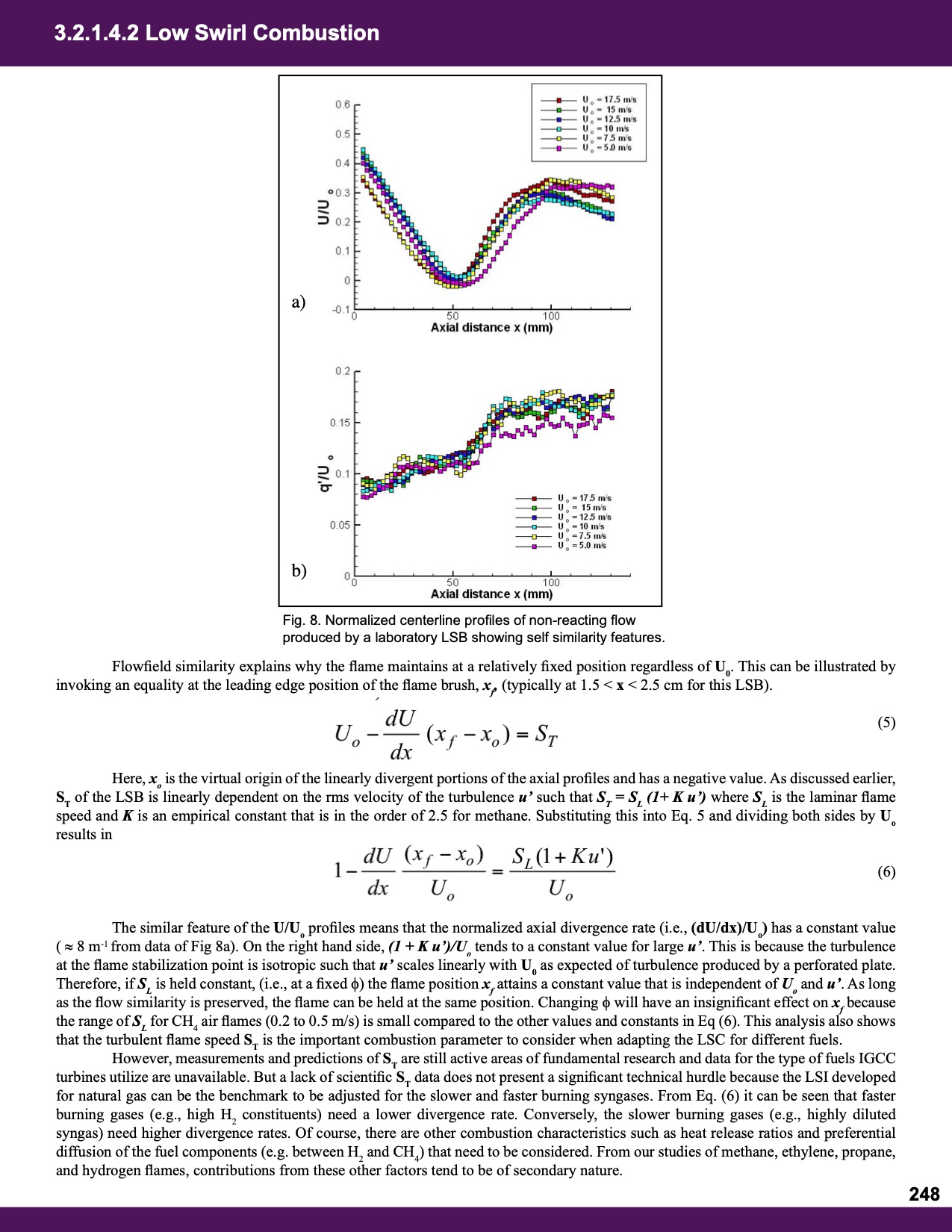
Fig. 8. Normalized centerline profiles of non-reacting flow
produced by a laboratory LSB showing self similarity features.
Flowfield similarity explains why the flame maintains at a relatively fixed position regardless of U0. This can be illustrated by
invoking an equality at the leading edge position of the flame brush, xf, (typically at 1.5 < x < 2.5 cm for this LSB).
(5)
Here, x
o is the virtual origin of the linearly divergent portions of the axial profiles and has a negative value. As discussed earlier,
ST of the LSB is linearly dependent on the rms velocity of the turbulence u’ such that ST = SL (1+ K u’) where SL is the laminar flame
speed and K is an empirical constant that is in the order of 2.5 for methane. Substituting this into Eq. 5 and dividing both sides by U
o
results in
(6)
The similar feature of the U/U
o profiles means that the normalized axial divergence rate (i.e., (dU/dx)/Uo) has a constant value
( ≈ 8 m-1 from data of Fig 8a). On the right hand side, (1 + K u’)/Uo tends to a constant value for large u’. This is because the turbulence
at the flame stabilization point is isotropic such that u’ scales linearly with U0 as expected of turbulence produced by a perforated plate.
Therefore, if SL is held constant, (i.e., at a fixed φ) the flame position xf attains a constant value that is independent of U
o
and u’. As long
as the flow similarity is preserved, the flame can be held at the same position. Changing φ will have an insignificant effect on xf because
the range of SL for CH4 air flames (0.2 to 0.5 m/s) is small compared to the other values and constants in Eq (6). This analysis also shows
that the turbulent flame speed ST is the important combustion parameter to consider when adapting the LSC for different fuels.
However, measurements and predictions of ST are still active areas of fundamental research and data for the type of fuels IGCC
turbines utilize are unavailable. But a lack of scientific ST data does not present a significant technical hurdle because the LSI developed
for natural gas can be the benchmark to be adjusted for the slower and faster burning syngases. From Eq. (6) it can be seen that faster
burning gases (e.g., high H2 constituents) need a lower divergence rate. Conversely, the slower burning gases (e.g., highly diluted
syngas) need higher divergence rates. Of course, there are other combustion characteristics such as heat release ratios and preferential
diffusion of the fuel components (e.g. between H2 and CH4) that need to be considered. From our studies of methane, ethylene, propane,
and hydrogen flames, contributions from these other factors tend to be of secondary nature.
248 |
